Showing posts with label micro 4/3. Show all posts

Sunday, 17 February 2019

Samyang 35mm (and a comparison to the P20 f1.7)

It turns out to be an excellent combination (well unless you have ultra-unrealistic ideas of how fast AF should be or how far you can pixel peep the corners at f2.8 on a lens which costs this little).


I was tempted into buying this lens because while I've historically been into wider than 35mm (indeed perhaps 28mm being where I like to start) over the years I've changed.

This is not a strict review of that lens instead it is an oblique look at the angle of view difference between 35mm on (so called) Full Frame and 20mm on micro 43rds.

One of the things which changed me is the little Panasonic 20mm f1.7, which works fantastically on a compact m43 body to give great renderings (indeed the above shot was taken with the 20f1.7 at f4 (because I like my subject to be clear to allow you to look at it, not a personal WankFest on how shallow my DoF is). This is a picture of the P20f1.7 on my GF-1


As a lens its almost the same dimensions as my Samyang.

Now an interesting thing is that the Panasonic GH-1 has a "multi aspect sensor" meaning that if you set 3:2 you don't just get a different crop, you get a slightly wider angle of view (read my post on that over here).

 The P20f1.7 somehow always felt it made my GH-1 feel a little chunky (even though its still a very light and compact camera)


Very similar cameras when you have them in your hand for weight and size.

So I was interested to see (and that's what this post is about) what would the difference be between them in "angle of view" when I set my GH1 to 3:2 ratio. In the following I've made no effort to adjust the pictures, they're Straght Out Of Camera JPG. Camera on tripod and unmoved between images.

Sony A7 & Samyang 35


GH1 and P20 set to 3:2


Well ... just about identical isn't it.

Just for "shits n giggles" I'll throw in a shot taken at 16:9 which I often end up cropping to anyway (well not with the GH1, but other cameras), which shows wider again:

GH1 & P20 @ 16:9


which works out to be a bit wider doesn't it. This is something I've observed a few times here (example), and it gets wider again if you use RAW files and don't do the lens corrections.

Observations

Interestingly even with these SOOC JPG's its pretty evident that the Panasonic is a bit brighter looking in its image. This is something I've observed with every shot I've taken with the two cameras side by side. I'm not sure why, but I assume that Panasonic biases its exposure a bit more to boost up shadows (same goes for my GF-1). Its not a concern of mine, because I like the images both produce. But its an observation.

Also I found that the differences in sharpness and available detail (when looking at 50%) aren't so huge. I wouldn't call it double and unless you're intending to make super huge prints (I mean really, not just in your dreams of when you take that winning shot) that there is really nothing amazing to be had in the Sony A7 from that perspective.

I still like my m43 system (despite its age) and wonder if the Sony is worth having (for my needs and desires).

The experiment of ownership continues ...

Thursday, 31 January 2019

really wide lenses (sort of a Bambi vs Godzilla redux)

premise

I feel that the Micro43 system (m43) is the low hanging fruit of camera equipment, it provides a level of compactness which is more or less unchanged by further dropping down sensor size, like the Nikon 1 Series which didn't really provide more compact cameras nor lenses. The lens range of the system is huge and indeed the availability of legacy 35mm lenses is presently far in excess of what the market can soak up (literally tons of good 35mm lenses can be bought and adapted) and adds to the system too.

The sensor isn't too small to afford reasonable focal plane control (shallow DoF), and indeed is almost the same as the very popular APS format (which indeed Canon released its first DSLR in way back in 2000 with the EOS D30 camera.

Its ability to do High ISO is of course limited compared to larger formats like Full Frame and or Medium Format Digital, and while latest m43 sensors will indeed go almost as high in ISO, you will be losing in colour fidelity and general bit depth (hello blowouts and posterisation).

I'm no longer on the path of having the latest and greatest (principially because I think we're already close to the crest of the diminishing returns crest) and so when I picked up the A7 it was a $500 experiment (rather than a $2000 experiment just 6 years ago) to allow me to see and confirm if there was something of value in this for me.


One of the things I enjoy having in my camera outfit is a very wide lens. Myself I've been inclined to this for decades, however anything wider than 24mm has often been outside my budget.

Micro43 brought along the equivalent of a 22mm lens (in the guise of the GWC-1 adapter for the Panasonic 14mm f2.5 lens) , which has been both my widest lens (lets ignore my Olympus 21f3.5 for the moment, not least because I sold it years back and I've only tried it on a 5D mk1) and a mainstay of my wide angle photography. Its enabled me to get some shots I enjoy in places, like this one in the Czech Republic in a dimly lit subway under maintenance.


Certainly no phone would have done that (either in angle of view or high ISO performance.

So given that I'm testing out the limits (and how I sit with the results) of my new (to me) Sony A7 I felt the need to find an equal for that angle of view.

Having read and seen good things about the FD 20mm f2.8 I decided to buy one. Sadly the prices have gone up since the A7 came out. This is probably because a 20 is within what one calls "normal" on m43 and almost nothing else can manage its shorter (for 35mm) flange distance.

Appearance

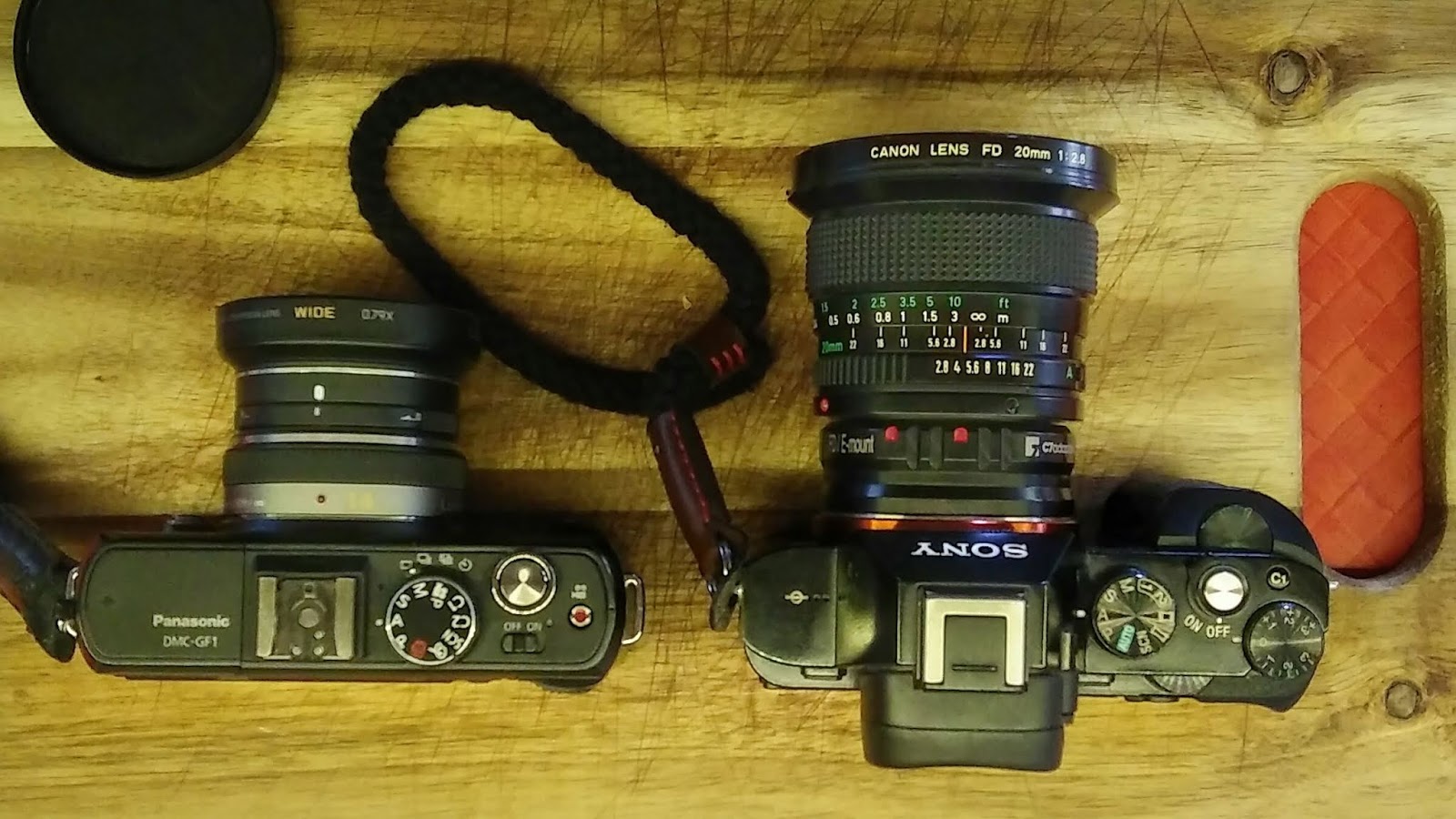
This is what one (mine) looks like on a A7


which may not be what you were hoping to see, but actually isn't too far away from what modern 20mm lenses (and wider) are looking like today.

Another angle makes it clearer that this is not a compact lens:


The amount of "stand off" taken up by the adapter also makes clear how much "space" was taken up by the mirror box on the FD cameras, or indeed any SLR or D-SLR camera.

However it does make for a nice firm grip of the lens with the left hand while holding the controls of the camera with the right.

In comparison the above mentioned Panasonic m43 with the GWC-1 and 14mm lens compares like this:


and


The A7 is indeed a bloody compact camera (as indeed is m43), however its a fact that the lenses are needed and make the entire system thus different.

A key difference also being that the GWC-1 comes off (it essentially screws onto the filter thread) and leaves the very compact 28mm equivalent 14mm lens  ... which is pretty nice for general picture taking (although about the same angle of view as most modern phones). If you want to know more about the Panasonic 14mm f2.5 and the GWC-1 I recommend my blog post over here as a starter.

aside:

 I'd rather have my camera nicked or broken in the field when out touring internationally than my phone, so think about that when saying "I do everything with my iPhone"...

image quality

Well for a starter the A7 produces a 6000 x 4000 pixel image over the 4000 x 3000 that the m43 camera has, and so that's going to perhaps give it an advantage. However I'd argue that the optical system of the FD20f2.8 vs the combination of the P14f2.5 &GWC-1 (note, for simplicity I'm just going to call the combination of P14 & GWC-1 the GWC-1 from now on in this post) is such that the m43 system is limited by the optical resolution not the amount of pixels ... but lets have a look.

First its important to understand that in modern cameras and lenses lens corrections are built into the JPG files and stored in metadata on the RAW files. With a legacy lens like the FD20 there is no such thing available, it must be chosen and applied in post processing ... so to even up the playing field I always photograph in RAW and then develop my file with DCRAW.

So  lets have a look at the FD20 on the A7 . This shot represents the scene taken for all these tests


now the GWC-1:


... which is a camera JPG not a RAW sourced image. Its worth showing an overview of the GWC-1 as sourced from RAW file, as you'll see that the Panasonic corrections for the 14mm are not insignificant (and of course make a difference to what the GWC-1 produces.


So you get a bit more image width now, nearly as wide as the FD20, but with substantially more barrel distortion ... if you correct in software in post it will look closer to the JPG sourced, and of course you'll (as always) loose some of the width.

I think its worth pointing out that Panasonic designed the GWC-1 specifically with the 14mm f2.5 in mind (well and a PZ 14-42 as well), so its quite likely that they knew what corrections would occur and worked to fit in with that.

The FD20 is a little bit wider and needs less attention as its a nicely corrected rectilinear lens right out of the box (which isn't surprising because it was made for the days of film when there just wasn't an easy way to correct for this stuff - and buyers thought it important back then.

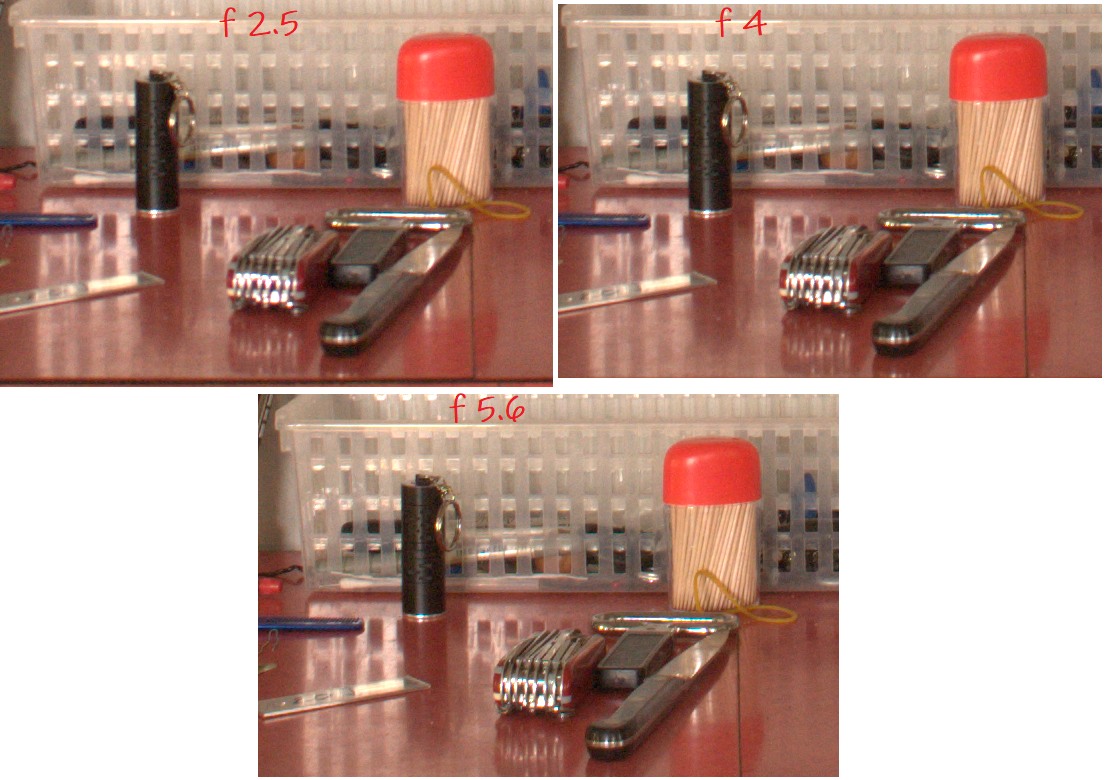
You'll probably have spotted some vignetting visible in both (the Panasonic corrects this in JPG a little, but not fully as there is no electronic coupling between GWC-1 and P14mm so it can't know its there to correct it. So lets look at vignetting

FD20


So strong at f2.8 and clearing up well by 5.6 but not observably better at f8 and (not shown) f11 is barely cleared up at all

GWC-1


where I didn't go past f5.6 because the lens system is already at it sharpest at f4 and starts to go down hill a bit due to diffraction around f8

You can see that the GWC-1 also has more barrel distortion, which depending on the subject may need some correction in post, the FD20 is much better out of the box.
Image details
As expected the FD is poor on the edges but not bad in the center from wide open, and gets better all over as you stop down. Again like vignetting I didn't see much in the step from f8 to f11

The following are 100% pixel crops from the TIFF files developed by DCRAW, what is interesting is how much smaller the same features are between the A7 and the m43 camera (yes, that 6000 pixel vs 4000 pixel makes a difference), so make sure you open these images full screen to observe that.

FD20 Corner


and by f8 the text of the ARSE postcard is visible (and the print of the plastic food container too).


GWC-1 (raw) corner


FD20 Center


The center however clears up so that even by f4 you've got quite good details on the black torch, the tooth picks and the swiss army knife.

GWC-1 center


and even at f5.6 (about the sharpest its ever going to get) its neither as large nor as sharp as the FD20 image at f4.

At this point I think it would be of benefit to anyone still curious to go and look at some other A7 lens comparisons and compare these both to my results and to other lenses. I happen to think the (excellent) blog of Phillip Reeve has some great tests which I strongly suggest you look at. Even if you're not a "Full Frame" person and instead are reading this because of the m43 content. I recommend reading his posts about


Consider the prices of those lenses and then that I paid

  • $350 (including shipping) for this FD20f2.8 
  • $150 for my GWC-1 (and I already owned the 14f2.5)


Discussion

So what does this mean? Again as I've mentioned I don't feel that this means "I'm going to dump my m43 outfit" (as is often said on internet fora) , what it does instead is highlight to me that my choices for a light weight camera which would also sit as an equal against my EOS APS camera (a 20D back then) has proven viable.

It shows me that the compact and light weight m43 system is far more than adequate, but virtually indistinguishable from my A7 in all but the largest of prints. For anything that will be web delivered (although 4K may change that a bit) the A7 is un-necessary.

I prefer to carry on holidays and day trips the Panasonic GF-1 and its small lenses, but when I want to go out and take an image I've planned and I know I'll want either bigger prints or to take advantage of higher ISO or to take advantage of more shallow DoF that Full Frame gives, then I'm glad I've got the A7

hope that helps someone else

 ... something else ...

Ouhh, and about the title, nearly 10 years ago I compared my Panasonic G1 (the very first m43 camera) to a Canon 5D MkII which I dubbed Bambi vs Godzilla ... so this is a nod to that article. I wrote that because I wanted to also examine what was the limits of sensors, as I knew that per square centimeter the G1 had a denser packed sensor than the 5D did. Indeed scaling up the density of the G1's m43 sensor I predicted that a Full Frame of the same density of 42 megapixels was possible. The A7 is only 24 megapixels, but indeed the Nikon D850 is  right there at 45 megapixels ... a standout camera even today.

Tuesday, 22 January 2019

Shallow Normal (bigger is actually better)

pretty much as soon as I got into digital cameras (like 18 years ago) I loved them for their ability to make quick pics and be able to send them via email to my friends (I was in Japan and my friends in Australia) or put them on my blog. Great stuff and (sadly) I haven't exposed processed film since 2014 and really since 2009 in developing my own.

While digital cameras have featured increasingly in my photography it has not always been with a view that they are universally "better". One thing missing (which I've blogged about a lot) is the lack of a normal lens which gives a pleasing rendering and a shallow depth of field. This was eventually satisfied for me with the Panasonic 20f1.7 and later the more commonly thought of "normal" the 25f1.7. It was pretty much 80% of my desired needs for focal plane control.

Naturally as soon as I got my A7 and put my FD50mm f1.4 on it (and took some shots) I was sold. This combination was (as expected) everything that 35mm film with a 50mm was able to give me and the benefits of digital too.

This was clarified the other day with a few shots sitting around in a bit of forest I know (and like) near where I live. I took two shots sitting on a tarp  on the ground (because ... ants) of my bike, one with the Panasonic 25mm f1.7 on my GH1 and the other with my Sony A7 and the nFD 50 f1.4

To me both these images have sufficient focal plane control, however they are both different to look at. I knew that the 50 would be better on the FullFrame than the 25 on the m43 camera, but its always good to see these things. To equalise things (such as lens profiles)  I developed these RAW files into a TIFF with DCRAW and cropped the GH1 into 3:2 format. I found also that I had to use the Panasonic at f2.5 to get away from that "wide open contrast softness" effect, (see this post for images) but more on that contrast difference in a moment

Panasonic 25mm @ f1.8


then ...

FD 50 f1.4 @ f2


Background isolation on the m43 unit is acceptable (and better than any or most zooms), but its my view that larger formats are where mid range angles of view shine and the A7 and FD50 renders a very nice image with much more natural seeming background with a more film like graduation of dynamics than the smaller sensors can.

Both were at 400 ISO (so that's why the A7 image is a wee bit darker f2 vs f1.8 is about 1/3rd of a stop)

A recent discussion about a presentation on YouTube centering around the idea that "people can't tell the difference in prints between m43 and Full Frame" left me wondering if any of the participants had actually seriously looked at this. There are many factors involved and especially with use of Aperture selection and Wide Angle lenses one can take Depth of Field out of the equation, but other components like contrast as well as resolution make a difference. And by resolution I don't mean 1000:1 contrast ratio line pair charts, I mean photographs of actual subjects.

People often talk of wanting to print large (while poo-hooing pixel peeping). My personal experience is that a 50% view on a good screen (100% meaning 1 screen pixel = 1 file pixel) is about as good as you'll get for a comparison online of a large print inspected close. So lets look at what we see on magnification:

Panasonic 25


now I suggest you "right click" that above image and open it in a new tab to see it unscaled by browser / blogger.

FD50


To me the FD holds up the best. Now it may surprise you to see how little cropping was done to take the overview (which started life as 4000 pixels wide) down to 2000 image pixels (no scaling) to see what one would see on a print from the 4000 file; but that's one of the facts of life.

Now the A7 gives 6000 pixels and so to keep "feature size" the same I chose to scale the A7 first back to 4000 then down to 2000. If I'd kept it at its native size it'd be like this:


highlighting a couple of things:

  1. how much larger a print you can make with the A7 without pushing it (1 meter x 68cm) vs the GH1 (68 x 45cm) with both printed to 150dpi because myself I've found that works fine without resizing for large prints
  2. how much better the picture stands up (both in pixels and in tonal range, look at the blowouts on the tree)
Looking at 100% pixels make is clear the advantage the A7 has over the GH1


and ... the same area 


Also, having recently compared the GH-1 to the latest G80 I'm not convinced that the GH-1 is significantly weaker, meaning that a G80 would still not render as well as the A7 has (and the used A7 cost an amount less than a used G80)

Contrast and clarity

One of the points in favor of the micro43 system is that people argue that many lenses don't have to be used "stopped down" to achieve adequate image quality. I would argue that this is not in fact borne out in practice. For instance the review here on the 25 suggests:
In a word: exceptional. The Lumix 25mm ƒ/1.7 provides sharp images straight out of the gate at ƒ/1.7, and while stopping down technically provides statistically sharper images, you'd have to peep pretty closely to see any kind of practical difference.

Yet this is not what I've observed, if you look again at the f1.8 segment (which is essentially the same as f1.7) is lacking strongly in contrast and sharpness. Ignore completely that there are any DoF differences because when you look at the above 2 segments DoF is simply not an issue; look at the footpeg or the word "YAMAHA" on the cover. As much as I want to say "theres no obvious difference" there indeed is.

I didn't present the images shot with the Panasonic at f2.5 because lighting changed between my first set (pairs of images with GH1 and A7) and my second set, however I think its clear that the m43 system will essentially have significant shallowness of DoF at f2.5 nor any "speed advantage" conferred by using a wider aperture. The FD50 on the other hand could be stopped down to f5.6 and its image clarity would simply continue to improve (over the f2 presented)

Dicsussion

So before anyone says "you biased it" ... well sorry, I didn't. I have no reason to bias this because I'm not trying to convince anyone. I'm just presenting my own exploration of gear I already own (as I always do).

This does not mean I'm some forum tosser about to write "I'm dumping my m43 gear" because it makes a great light weight kit for travel / general picture taking and unless one is pushing the limits one just won't notice most of this.

However when I do want to go out and (with something specific in mind) make a high quality capture of something which I approach with care then I'm glad to have the A7 in my arsenal ... cos I just haven't been using the 4x5 lately (and colour negative sheet film is getting hard to get processed these days, not to mention expensive).

In the above I have attempted to show that there are distinct differences between the formats (m43 vs FF) which a photographer can make use of to produce a print (even A4 sized) which can be identified as different by any astute observer.

Hope that helps someone

Monday, 15 October 2018

Full Frame (Sony A7) Adventures

For quite some years I shot 35mm film (which nowdays gets called Full Frame (FF)), and there was no digital. Then when the first D-SLR's came out I was abjectly disappointed to find that they were APS-C and none of my EOS lenses (and I had a few) worked well on them (or so I felt), so perhaps its better to say "worked the same".. my beloved 24mm became a sort of slightly wide normal (at effectively 38mm) and was neither wide (like 28mm or less) or "normal" (like 50mm) and wasn't even "fast" being f2.8

Eventually the 5D came out but by then I'd accepted the APS size and by 2009 had sold my EOS system and moved solidly into the Four Thirds (or specifically micro43) sensors with my G1 (and later GH1 and GF1). I have of course written *much* about that on this blog.

Back in 2014 I was looking with interest at the Sony A7 as being perhaps the perfect platform to use legacy 35mm lenses because "they were designed for that coverage" and in particular in "wide" and "normal" prime lenses were well priced (in a day when everyone wants a 24-105 f4 zoom), and (as the famous Ken Rockwell's discussion on wide angle lenses between digital cameras here observes, primes can be quite the advantage in some ways:

?

Both the above lenses are 28mm (the two zooms variously wider and less wide).

I know some people like to suffer for their art, but that's not me, I'd pick the middle one. Thus I've always preferred a selection of compact primes to a couple of huge zooms ... it brings other advantages with it too ... like DoF control. With a 28 - 70 f3.5~5.6 zoom you don't ever get "shallow DoF" ... thus you have abdicated control.

So knowing that I like shallow normals (which has been a kind of quest for me since I've been into m43) where the absence (at first, then dearth) them in m43 has been a problem. Over time this was solved with both the 20f1.7 and 25f1.7 (and yes I know I can spend big and buy the 25f1.4 or 24f.12 even) which were good and I was glad of but still somehow something was missing for me - low light performance of m43. Sure, f1.7 helped give better shutter speeds, but not enough, not if you wanted higher quality detail (IE: more than facebook or other social media image making demands).

Now just the other day I compared the Panasonic 25f1.7 on my GH1 with the Pentax SMC thread mount 50f1.4 on my A7 (photographing a packet of noodles) but found that test both "wanting" (I'm not really into noodle packets) and limiting. Not least because photographing at that distance isn't quite what I'm into with "normals". Plus I've wanted to use my Canon FD50f1.4 which I have used and tested before on my G1 (which of course using only the center portion) turns it into a crisp and sharp 100mm. Yet it was designed as a normal and I wanted to see how it "looked" ...

Today FD adapter arrived (from my favorite maker of FD adapters, I strongly recommend his products) so I could put my FD50f1.4 onto the Sony and have a look at photographing a person in a "normal" context. I took two shots, one at f1.4 (cos like why not) and the other at f2.8 (or maybe f2?) and they looked like this:


F1.4

and at f2.8


Which to me look (unsurprisingly) exactly like what I'm after, in contrast the P25f1.7 gave this wide open at f1.7


Its not as distinct from the background as the 2.8 (and indeed it should be closer if we assume the 2stops that exists between FF and m43). Its also a bit "wider aspect ratio because its 4:3 not 3:2 .. none the less its nice, but still, the books behind John are clearer and attract (unwanted) attention.

Overall (especially at this size) there is little rendering difference between this and a phone (less if you've got one of those that does the background Out Of Focus (OOF) in software now.

So what else is different?

Well for a starter I wanted to keep "shutter speed" above a minimum to reduce the possibility of subject blur (and yes I know IBIS will help with that, but won't help it if the subject moves ... as people are prone to). I also wanted to compare noise (which I also expected to show a 2 stop advantage to the bigger sensor, so I put the GH1 at 1600 ISO and the A7 at 6400 ISO (2 stops). This resulted in

  • the GH1 giving 1/250th at f1.7 (so yes its a dim room on a rainy day)
  • the A7 1/400th at f2.8 (and just over 1/1000th at f1.4 which really will freeze motion)
I don't want to pixel peep the shitter out of this because quite frankly it doesn't need that to show the differences, nor is anything more than 50% needed to replicate what a print looks like.  However the sheer amount of extra pixels captured by the A7 (6000 vs 4000 high) makes it hard to present them similarly. So I've chosen to present half size images for the A7 and full size GH1.
So lets dive in...


Straight away, just like with the noodle packet (in the earlier above mentioned post usig the Pentax lens on the A7) we see that the amount of detail available in the A7 just outright exceeds that of the GH1, and also contrast is better. What surprised me was how much more the noise was intrusive in the dark areas and even on the sides of Johns glasses. To me I'd expected that 2 Stops would see them on more equal footing than this. That the noise is larger in size (because its pixels are effectively bigger in the picture) makes it harder to apply Noise Reduction to without destroying detail.

To make the noise clearer (and highlight why colour channel noise is the big culprit here), lets look at just the Red channel.


The A7 noise looks more like "random noise" and the GH1 shows that its on the ragged edge of electrical read (sensor) noise.

This has a very detrimental effect on fine detail, which becomes clear when we look at the shot below.


So you can see the stripes clearly in the cushion, but the pattern in the covering of the chair is simply missing in the GH1 image (buried in noise). Click that image (indeed you should all of them) and look at the larger size ... the details vanished because the "feature size" of the image was about the same as the size of the noise ... so... gone.

Conclusions / discussion

Throughout this discussion I've used the names of the two cameras (the A7 and the GH1) however what really is significant is that one is FF (the A7) and one is m43 (the GH1). This is really the most significant point. All of the observations I've made are consistent with the expectations of the understanding of what is different between these two systems.

Big ticket items first, the FF camera gives better handling of noise and (via lower magnification) better contrast if not higher details. While its true that m43 can resolve as much as FF can its also true that things can erode that in practice, which we see here.


This experiment has shown to me that FF does indeed have benefits that extend beyond megapixel count, that even scaling the FF image down to a smaller than what the m43 camera still has greater details.

The smaller pixel size (relative to detail) allows greater use of post processing NR without destroying what RAW file posses.

So if you (like me) don't mind using manual focus (which requires a better skill set as a photographer) then you can take advantage of some great optics and get great images. Looking at the "native lens" options (meaning with AF and electronic control) available in a "normal" I see:
  • Sigma 50mm f1.4 for US$950
  • Sony E 50mm f1.8 with OSS (an advantage) US$300
  • Sony FE 50mm f1.4 US$1500
  • Panasonic 25mm f1.7 $150 
  • Olympus 25mm f1.8 $350
  • Panasonic 25mm f1.4 $600
Given that the FD50f1.4 costs about $100 it means that for a photographer, you have access to quality optics (but without the "bells and whistles") for a lot less. Yet still it on this camera the system outperforms the m43 option in terms of image quality and noise when in challenging light. Even if the P25f1.4 above could resolve more it would be eroded by the sensor noise. Perhaps its possible that some of the newer sensors (like the G80/85 I wrote about recently would come close to improving that situation, but  I doubt it would equal it let alone improve it.

So in conclusion (as I've expected) the m43 system will in good light give results in sharpness and detail that are well and truly "good enough". FF only pulls ahead when low light shooting is called for.

I'm in no way intending as a result of these findings to move away from m43 ... it offers so many things that FF does not (especially without having AF lenses). I will however be (now that I have a FF system {or at least not a film one}) rationalising my m43 lenses to be more in keeping to what I believe that basis of m43 has been right from the get go ... a compact and light weight flexible and system capable of excellent results as long as you don't have to contend with low light / high ISO.

Some random examples


Sunday, 14 October 2018

GH-1 vs G85 (big generational change)

I've occasionally done a look at the successive generations of m43 cameras, seeing as I started with a G1 (nearly 10 years ago) and then moved to the GH-1 (about 8 years ago,which I've sat with ever since); where I've found that pretty much all the developments have been "interesting" but not enough to "tip me over the scales" and buy a new one.

To my observations the changes have been about conveniences; which would of course be worth having, but for me (who works in RAW and seldom uses the Out Of Camera JPEG file (which I classify as one of the conveniences)) the actual end results in images just don't warrant spending a grand on a new body.

I've looked at different generations twice on my blog:


  1. GH1 vs EM5 (mk 1)
  2. GH1 vs GH4
and both times found that when processing a RAW file there was little actually in it. Meaning that Panasonic just got the GH1 so right back then that every subsequent camera could more or less be a re-tune off all that research and development.

Today I had the opportunity to have a decent look at the output from the G80 / G85 (depending on the market you're in) and compare it directly with my GH1. I' ve decided to put the spec comparison graphs at the end instead of the beginning this time.

Summary: its a game changer for me.


The GH-1 runs out of ISO at 3200, but soon after my first image I knew that it wasn't worth going over 1600ISO for me (which to be honest fits in well with over 90% of what I do or even want to do). Accordingly I'd resolved to not upgrade my GH1 until either it died, or something substantial came along. Well to me it has.

The G80 is well capable of being used at ISO right up to 12800, with RAW results just way nicer to work with than JPG. Throw in the 5 axis stabilisation and its an incredible camera.

1600 ISO

Given this is my comfortable upper limit lets have a look at what the GH1 and G80 produce at that point. Interestingly they both have different views of what "incandecent" colour balance should look like, but that's nothing really problematic.


These are OOC JPG, and as you can see they're both fairly acceptable at this size. You can see a little more flare from the lamp as I clearly sat down in a slightly different position when I returned to the table with the different camera (using the same 45f1.8 lens)

So lets look at the results from the RAW, stepping right into 100% (pixel peeping) we can see a couple of things, shutter speed was 1/60th and the eye reflection shows that while the subject didn't move, the photographer did (shake) and you can see the drop in detail in the pores of the skin and the eyelashes


not to mention (if you open it up and view it full screen) the amount of (not horribly invasive) noise already present in the GH1 (right image).

So marks awarded to the G80 right there ... and its even clearer when you look at the hairs on his head (both the clarity and the colour channel noise).


this becomes patently obvious when we examine just the Red Channel (if you happen to be one blind to what colour noise looks like)


chalk and cheese right?

Worth noting is that on a single grey hair there you can see the artifact of a stepping pattern which is I believe exactly what you'd expect with the Anti Alias Filter removed (which the designers of this this camera have chosen to do) (if you don't understand what an Anti Alias Filter is please read this).

So to me this is a nice step in improvement and something I'd not seen in any previous sensors I'd tested.

Very encouraging, so now lets go beyond my comfort zone and look at the higher ISO

3200

3200 ISO is the limit that the GH1 goes to, but for some reason I failed, and didn't take a 3200 ISO with the G80, so we have to compare the 6400 ISO (which the GH1 doesn't even go to)


even at this magnification we can see the reasons I've always stayed below 3200 on the GH1, sensor noise is becoming clear and quite marked ... there would essentially be no hope of clearing that up.  As well there is some strange colour casts starting (which correction will exacerbate noise further).

The image from the G80 though is looking a bit "gritty" or "sandy" but is clean enough even if colour vibrance is falling off (something has to give right). Looking in close (50% this time) we see that skin tones are pretty reasonable with the GH1, but its just lost it with noise ...


and the G80 is actually a full stop higher ISO at 6400 ISO ... like wow

Again, looking at the red channel we see clearly that sensor noise is the real source of problems here, but the G80 is just amazingly showing nothing more than just noise which is rather akin to Grain ... so sensor pattern types of noise are amazingly well controlled here.


Lets push this further

25600 ISO

Well I mean this results in (our dim room) me having a shutter speed of 1/500th of a second ... shit it wasn't long ago that such was daylight exposures ... yet this is what we got:


Simply amazing ... and having a closer look:


Grain is becoming more apparent, but we've gone up 4 stops ... so yes, in the same light we've gone from 1/100th of a sec exposure to 1/500th of a second ... that's amazing.

Further this grain is amenable to noise reduction with even simple post processing NR like Nix


Lets compare that to the GH1 at 3200 again


So certainly its losing colour saturation (which fits what we know from the measurements) but with a little more tweaking (just some saturation and local area contrast masking) amazingly this shows you can still get a usable image from the G80 in what would really be impossible portrait lighting just a few years ago.


So to me this a big generational change, not just a small fiddle.

Wow

Specs - and what they reveal to support or even predict this

Despite the contention that exists on forum about DxO measurements of lenses (which I happen to find meets my personal observations) their methodology for sensor assessment is pretty robust. So here is the comparison between actual measured ISO and the camera setting ISO for my GH1, the GH4 and the G80/85


So looking at this graph we see that while the GH4 on its setting appears to goe to a higher ISO it progressively actually only goes to 12800 with 25600 being just a pat on the head to make you feel better (and makes worse images along the way).

Interestingly when the GH1 is set to 1600 (and gives an actually higher ISO of 2154) and the G80 is set to 2 stops higher 6400 ISO (and actually gives a lower effective ISO of 4408) they are infact of shutter speed given only one stop apart (not two) and have similar dynamic ranges (which can be seen in my images above if you go back and look.


I encourage you load the DxO comparison (which I've snapshotted above) and go through the test results carefully.

As I've discussed previously the GH1 is actually performing equivalently at a setting of 1600ISO (when you look at obtained shutter speed) to other cameras (such as the Olympus OM-D E-M5) when set to 6500 (and by that to when its set to 5000 it will give similar shutter speeds to the GH1 when its set to 1600). Meaning that there has been no significant sensor improvement between cameras which are six years apart in release date (2009 and 2015).

However as we've seen the G80/85 camera (and from what I've seen but not presented here the G9 too (and probably the GH5)) indeed does.

I encourage you to have a read of those linked in articles.

bottom line

I feel that the G80/85 is a worthy upgrade for anyone who does a lot of low light shooting, you can actually get usable images from light where the GH1 (or indeed most other m43 cameras) would struggle. Combined with some of your own image processing of the RAW files you can get quite decent images, and in my view probably the equal (in terms of signal to noise and dynamic range) of most full frame cameras (if you are one of those poor bastards somehow in total ignorance and misapprehension lusting after one of them because it'll make you take better images).