Showing posts with label Tilt. Show all posts

Monday, 1 February 2010

4/3 "full frame" and large format - control over focus

I have been wondering about the merits of the Panasonic 20mm f1.8 as a "shallow normal" and this weekend took some photo's and did some thinking which helped me move a long a little in the direction of the Panasonic 20mm ... although perhaps I might be more inclined to look for a 25mm or even 30mm f1.8 lens.

To start the discussion, I thought I'd put these two images up. The first was taken with my 4x5 camera (and I used a bit of tilt to get the focus plane moving along the plane of the wood stack, keeping it in focus from right to left:
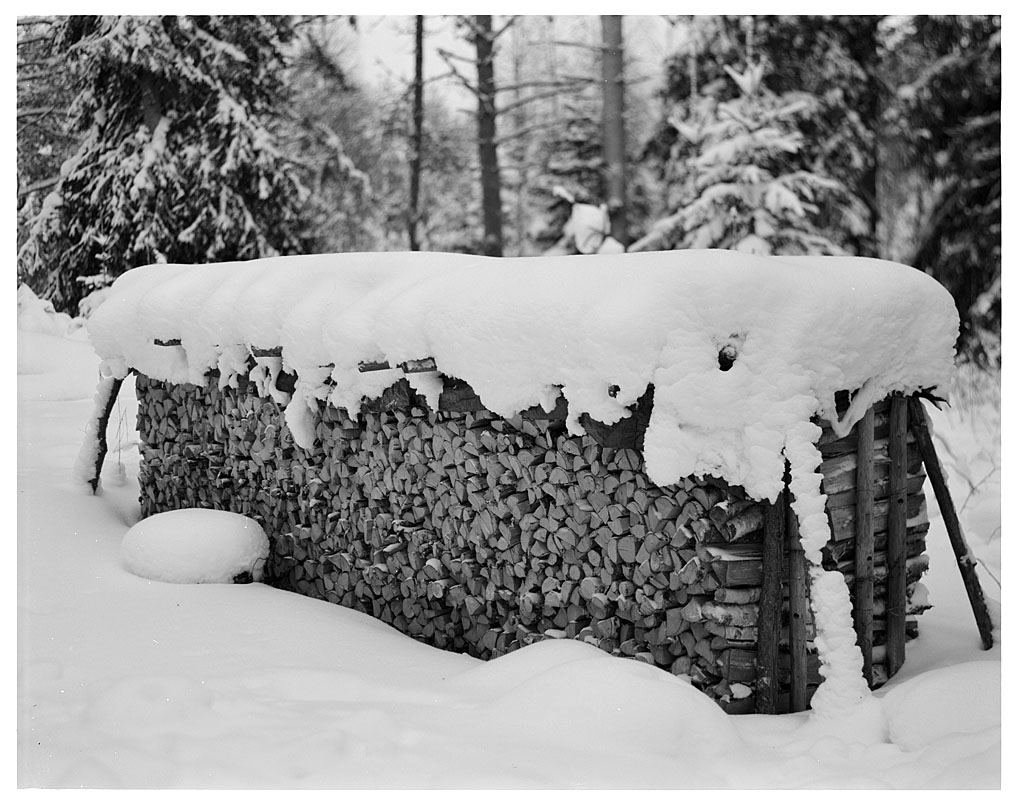
woodStackInSnow

The image is taken at f5.6 using a 180mm lens. This is essentially a "normal" lens on the 4x5 camera. Interestingly the depth of field of the 180mm at f5.6 is almost exactly that of a 50mm lens on 35mm film (the diameter of the pupil being 32mm while on a 50mm lens @ f1.7 it would be 29mm and f1.4 would be 35mm).

This image is taken with my G1 as my metering shot, and is also taken at f5.6:

P1070027

I think you'll note that the bigger capture sensor (the 4x5) had remarkably shallower depth of field than the smaller 4/3 sensor camera. It actually needs the tilt to keep the wood stack in focus. It also provides the benefit of giving a diffuse background to make the viewer focus more on the wood stack too.

NOTE: this reveals another benefit of 4/3; as I am after shallow DoF here, if I happened to have a 20mm f1.8 lens then I could have used that and had the benefits of 3 stops more light than f5.6 (and used a faster shutter if that would have helped.

I could have then used this to allow a higher shutter speed or selection of a lower ISO [and thus better noise] had that been of benefit to me. This is significant and often lost on photographers. R N Clark makes the case that larger sensors give advantages over smaller sensors in terms of noise and dynamic range. Normally he compares and contrasts itty bitty sensors against APS or Full Frame sensors. The G1 sensor however is not substantially different in size to the APS or different in pixel size to a 5D

-> thus there is a 2 stop advantage between full frame and 4/3 in increase of Depth of Field
-> meaning you can open up more on a 4/3 still have the image quality you want and either get 2 stops faster shutter or 2 stops better ISO (I can use 400 on my G1 while using a 5D I would need to use 1600ISO to get the same DoF and shutter speed)

This is another photo which illustrates that the DoF control one has with a "normal" on the typical range of subject matter which one would use a normal for.

I encourage you to open these each in their own full screen tabs so you can flick between them and see the difference in focus. They are taken from nearly exactly the same spot and the same distance from the wood heap.

Now while I love my 4x5 camera for lots of reasons I don't want to make it my main picture taking camera ... I am just too fond of digital.

Not to mention that at 1200dpi scanning this image isn't really streets ahead of the G1 ... meaning that for a light weight portable camera the G1 is bloody brilliant.

Now, my personal experience is that a 5D (not the MkII, just the 5D) does make as clean and clear an image as my 4x5 does at this sort of scan density. Just to put numbers on this, the 1200dpi scan of 4x5 will yeild 5813 x 4567 pixels (26.55 MPixels) and that's good for a 47 x 37 cm print. At this sort of scan density it won't matter if you have an Epson flatbed like me, or a drum scanner.

A 5D on the other hand will yield 4368 x 2912 pixels (or about 12.8MPixels) and to be honest will easily withstand scaling up to the same size.

This means that I can pop a 50mm lens on the 5D and get most of what I'd want out of my 4x5 and much better normal lens operation than I'd get out of my G1 (assuming I don't want really deep depth of field with everything in focus like any point and shoot does)

Now If I add a TS-E 45mm lens to this I can get (most of) the movements that I get with the 4x5 and still be way way more convenient than using the 4x5.

Of course none of this matters once you step back further, as then no matter which system you're using (4/3, full frame / 35mm, 4x5 ...) essentially everything will be in focus.

old sauna

or if I want to do some telephoto work then the 4/3 stands me in good stead giving me the effective pull of a 600mm lens (with my much cheaper and lighter 300mm one)

kuusiTinti

I photographed this little fella (and boy, I mean little) with the 300mm at f4.5

This also shows the benefits of 4/3 as it gives me a much better depth of field for this sort of thing than a 600mm lens at f4.5 (where wing would be in focus and head out of focus ...)

so ... maybe I don't need the 5D?

Tuesday, 26 May 2009

lens tilt on a Panasonic G1

One of the things which seems to be completely incomprehensible or ungraspable by the majority of photographers is the benefits of not having a stiff lens - body coupling. To a large format photographer such a restriction would render the camera all but useless.

Before I go much further I guess that I should explain what this is about to those readers who have never used anything else but compact cameras, 35mm and DSLR cameras (although there will be a few 35mm and DSLR users who know what I'm talking about already.

The image on the left is taken with a 'standard' lens at about f2.8.

As you see in the image focus is towards the bottom of the image around where I've drawn a blue ellipse.

The "depth of field" runs out due to the large aperture and as the table top moves away from the camera (towards the top of the image) things get out of focus or blurry.

Most photographers who were never trained on or used a view camera will say "sure, you just move the focal point further away to the middle of the image and stop down to f16 or f22.

Voilla ... its all in focus!

Well those of us who were trained on view cameras know that there is another way which is actually better (heck, classical education has merits?), that is to apply some tilt either to the lens or the back of the camera. View cameras have lots of movement aside from just focus you know. Check them out if you don't know much about them. They don't all have to be funny old stuff either, as you may be surprised to find that they are still used today for the top end photographic work on stuff such as jewelry or products.

So what doe the alternative look like?

Well, like this image.

Here I've held the lens in my hand and just tilted it manually (un-attached to the camera) to show that I can move the focal plane away from the normal "parallel plane".

You can see that focus goes up the table and even at a diagonal (gosh, I haven't taken takky images like this since I first played with a view camera decades ago in my student daze). I could have tried to just get the whole table in focus, but then how would you know it wasn't just kept in focus by depth of field at f22

This allows the photographer to not only better control of focus, but also gives control of composition giving the power to direct where the viewer places attention and remove items of distraction from attention.

Its well worth clicking on that image and looking around at the detail of where the focus goes.

Now despite there being no secret in this it is one of the best kept secrets of photography since rigid cameras came out. For years some photographers know about this and really long for such flexibility in rigid cameras and Canon provided their first Tilt lens with the TS 35 and then with the EOS system expanded it to include the TS-E 24, 45 and 90mm lenses (check them out on the Canon Camera museum). While I started using them as soon as I could afford it much to the marketing divisions annoyance they remain misunderstood and unknown.

Perhaps the problem was that serious photographers thought that 35mm was a 'toy' format ... there were some offerings in the medium format (MF) area such as the now gone Hassleblad ArcBody (reviewed here) and Flexbody. But MF being the expensive area it was I guess that most photographers who needed such things kept using view cameras.

Enter Digital

The digital age has brought us digital cameras which exceed the ready quality of 35mm and often come close to what was once MF quality. With photographers now using DSLR in earnest Tilt lenses are now entering a popularity never had before. With a TS-E lens on a DSLR camera you can do great things, for example I found that a fellow called Keith Cooper has a good review here.

Canon has has added a 17mm lens (perhaps to attract the APS sized sensor groups) and even Nikon has introduced (finally) Tilt lenses.

These are lovely devices but the problem is they're real dear. The Canon TS-E series lenses will set you back a grand ($1000) and even the old TS 35 (which is neither wide enough or standard enough to be useful) still fetches about US$500 on eBay.

lovely, but whats this got to do with the G1?

a good question, and I'm getting to that! You see to allow movements and tilt having a bigger "image circle" is essential. Large format lenses produce an image much larger than the film to facilitate this. This makes those lenses expensive and its also the reason that the TS-E lenses are expensive. They have to make an image to cover more than the 35mm frame.

Now, the sensor of the G1 is a 4/3rds sensor which is around 18mm x 13mm in size. A 35mm frame is 36mm x 24mm in size. So any lens which was designed to work on 35mm has plenty of coverage for a G1 and the short flange distance give the designer plenty of space for the mechanism.

Are you already using 35mm lenses on your G1 by an adaptor? I know I am. Heck its the main reason I bought the G1.

Right now, the only 'alternative' to the expensive TS lenses is stuff like the Lens Babies (which are essentially not good optics) and cost about $250 anyway. Imagine using an adaptor like that on any or all of your 35mm optics. Great (and cheap) lenses like 28mm and 50mm become equal to lenses like TS-45 and TS-90.

So if we could get an adaptor to allow tilt then the G1 would become one of the bargain of the year cameras for product and creative photograhpers!

In case you don't know the G1 well, the major thing which differentiates it from a conventional DSLR is the lack of a Mirror. The design is much more similar to cameras like the Bessa L which simply have a shutter behind the lens.

This means that to allow mount of 35mm SLR lenses that an adaptor must space off the lens by some 24mm. Looking at the picture to the left you can see that is quite a lot (this is a actually an FD 50mm f1.8).

I've drawn in some curves to show where a tilt to effect a nice easy to deal with center tilt would pivot around for such a lens.

Clearly there is plenty of space for a mechanism to mount to the G1 and attach a lens.


Whats in it for me?

Well, while I'm an ideas man, I'm a photographer not an entrepreneur and I'm also a great believer in the free market. Since the internet gives us (buyers) the possibility to form a community and become a cohesive buyer group we can start to have a say in what gets made for our needs (rather than just be consumers buying what ever gets served up). To some extent this is already happening with eBay sellers like this guy, and this guy are already making great adaptors (and cheaply) for the G1 before Panasonic even offered them.

I've had communication with both of these guys on the topic (one was interested the other didn't reply with much) but I'm sure that if they knew they'd sell some they'd be turning them out soon.

So, if you're as keen for this sort of development as I am why not send them an email and express your interest or even place a comment here on this article (as I'll be sending them this link too).

I've suggested some possible ideas such as this one (which is adapted from the Canon TS 35 mount by a Russian maker)


and another based on the simple mount system of the lens baby design. I don't know if that ball pivot is "patented" but it might not be when applied to an adaptor
or perhaps something like this?


anyway ... certainly heaps of other designs are possible.

Lastly for those interested in how I've done this without an adaptor, here it is.

I've put my smallest extension ring (12mm) onto my 28mm to force the lens iris to be fully open, then I've gaffer taped some rubber onto the bottom to light seal flexibly and neatly against the lens mount ring (and protect the camera too).

This allowed me to focus by simply pulling and tilting the lens to where I wanted the focal plane to be while looking in the view finder.

simple but neither precise or easy to use.

I've added 2 more samples of what can be done. In this image I've moved the focal plane to be parallel with the the bottle of cleaner but twisted it a little away so that even at the foot of the bottle the marker is blurred.


and then in this one I've tilted the focal plane back to get the table top in (nearly) in focus (plane runs from the mat in front to the middle of the salt shaker.


inexperience graphics people who may be experienced in photoshop and the use of selective blur with a gradient should note that the de-focus on the top of the bottle is impinging on the less de-focused items in the background (top) of the picture. You just can't get this kind of fully 3D de-focus after you've got a 2D image. This means you need to do it in the camera. And why not, with the right tools its easy!