Showing posts with label bikes. Show all posts

Wednesday, 24 May 2017

bicycle usage preference in Finland

Growing up in Australia I've pretty much always had "derailleur" style gears. I say "pretty much" because as a kid under 10 I had a "Dragster" style bike (like this, but I don't have a picture of mine)


 which pretty much got changed into something which would later become (yes, I'm old) BMX.

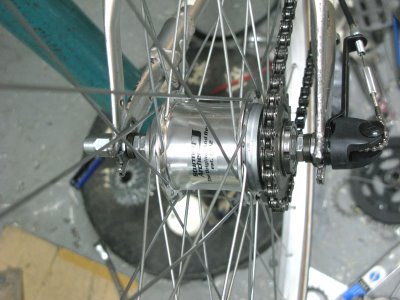
One thing about that bike that non of my other bikes (until I came to Finland) had was a "Sturmey Archer" style "internal hub" gear system.  For those unfamiliar with them (and mistakenly thinking that that shifter was just for looks because "that bike doesn't have gears" this is what they look like:


Clean, and simple, with no requirement to bend the chain as it moves across the lower cassette.

I quickly discovered (with my first 10 speed bike) how sensitive the rear hanger was (riding though bush all the time) to impacts and how often one needed to tune the system (something many folks could never properly do) or it wouldn't shift properly, would make a "rattle" sound all the time (while it was partially attempting to climb up or drop down on the cluster.

A great example on how you need to adjust your derailleur:
www.parktool.com/blog/repair-help/rear-derailleur-adjustment

My last bike in Australia was a Giant Yukon, which I loved and rode to work (and on trails as well as for general exersize) quite a bit for many years. Finally after some thousands of Km (literally) I needed a new rear cluster, but the Shimano Deore with "Rapid Change" worked great for me with only occasional adjustments and I loved the ability to keep a decent cadence and constant energy irrespective of slope or headwind.

Gears work. But most riders just don't know the first thing about how to use their gears properly, especially with a Derailleur system. For instance you can't just sequentially shift UP or DOWN, as you need to keep the rear sprocket more or less in line with the front sprocket, especially if you have more than 5 gears on the back sprocket. So as you shift up you eventually move from the smallest sprocket on the front to the middle, but you should do that before you've gone to the smallest on the back. Probably this will mean you'll need to change back down on the rear before changing up on the front ... which the rapid change system allows you to do (but you still need to be careful to not make a tangle of it).

It may sound complex but eventually it becomes second nature (or you just fluff it around like most people do).

Then I came to Finland where "entry level bikes" have most commonly got no gears (meaning a single gear fixed gear but with a coaster clutch / brake system not a "fixie") or a (most commonly Shimano Nexus) 7 or 9 speed hub. By most commonly I mean most of them.

These systems have the advantage that you just shift up or down with no thought of "do I need to change the front sprocket" ... just change.

Dead Simple ...

To show how common this system is here, here is a "for instance" just walking along and decided to film "poll" at my local small supermarket:


Note the number of mudguards and racks in that video. Its easy to see that bikes here aren't like most Australian bikes, they are clearly fundamentally practical transport. Because (unlike Australia) many people ride bicycles all the time, in all weathers for most of their daily stuff (like going to the shops or stuff like that).

After using my hub now for a few years I totally love it. Actually it was pretty much love at first pedal. Indeed while I see that "derailleur" style has some advantages in competition, almost none of that translates to street.

I have seen occasional posts on bicycle forums in Australia enquiring about these systems and usually they're regarded as "expensive" ... which is weird because in Finland they are fitted at almost the bottom end of the market. I expect its just another example of Australians being shagged up the butt for stuff because (either) the retail system just wants to simplify and have one thing to pedal (or the bike shops are populated by dedicated enthusiasts who just can't see the point of not being "comitted").

My bike (with the Nexus 7) has been a great transport unit and I paid 50 buck for it second hand (in really good condition. A real "low maintenance practical work horse" and my daily driver over here since 2013 (without as much as a screw driver put to it).


I wish Australians were as wise as Europeans.

PS: lastly if one is to get hung up on issues like efficiency , then I suggest reading this good reply on a forum here, its a good one.

Friday, 12 September 2014

Yamaha T-Max battery discharge solution

Those of us who have the Carburetor version of the TMax (2001 - 2005 IIRC) are likely to have a problem with the battery going flat frequently which I have discussed over here. I encourage you to read that older post to familiarize yourself with the problem, if you are not already familiar with it.

This is due to a strange design of the Auto-Chokes and powering them via a separate circuit independent of the ignition switch, directly from the battery. This results in the battery being discharged until the thermo switch has reached its low temperature cut off point.

The graph at left shows a simple EXCEL linear trend, this is however not the big picture with thermal equalization, as the drop in temperature will be slower as the difference between the heat of the item and the environment gets closer.

Meaning that this can take quite a while to get to the 55°C, especially on a hot day when ambient temperature is above 30°C, and even worse if you park it in the sun over hot tarmac. Essentially all this can easily keep the interior of the engine (where the switch measuring) above 55°C for up to an hour after you stop.

During this time the battery is having about an amp sucked out of it. Its of course made worse for your battery if you do multiple shorter trips during the day : so the engine gets hot in the 15 min of the trip, then the bike sits about sucking power out of the battery for another hour (and only charged for 15 min). This provides an increasing imbalance between charging and discharging.

Of course if I lived in a cold climate then the bike would probably cool in 10 min and it wouldn't be an issue ... but I don't

solution


I proposed a solution to the problem in that earlier post (linked above) where a relay in circuit to isolate the Auto-Chokes when the bike was not turned on, and thus saving the battery from being drained, but still leaving the existing circuit (thermo switch circuit) untouched during operation.

The wiring for the auto chokes comes through the loom at this point (red square in image to left) and so I prepared a Normally Open relay which will then Close (completing a circuit and providing power) when the bike ignition is turned on.

Taking a close up from the full wiring diagram I've inserted the relay after the thermoswitch and before the auto-chokes.


So to do this I cut into the loom where the plugs for the auto-choke come out and inserted my relay in series into that circuit.

Getting into that loom and inserting that switch in series was a tight job. I prepared the relay with orange wires for the shunt to the additional switch and red and black wires for powering the relay.

I powered the relay by plugging into an existing plug on the loom under the fairing near the indicators, which was designed for accessory heated grips ... I'm not going to be using that particular option here ;-)

So with the colwings around the foot well taken off, you can get access to the loom and you can move the wire loom section from under the seat and open the loom up carefully with scissors to access the wires.

I've marked in green where I've run the 12V power leads up to the front of the bike where the accessory connector plug is located. I've run it along the 'breather' pipe to make it obvious where it is, and keep it from possibly rubbing against anything metal on the way (don't want any shorts now, do we) .

So with the relay wired in and the protective casings of the loom cable tied prior to wrapping with electrical tape we see it like this


note the two plugs facing us, they are the plugs for powering the auto chokes. My switch essentially cuts the +ve lead of them (the yellow and red). The red and black wires from the relay will now be threaded along that green path above and into the accessory plug.

The relay is wired in by soldering and I have heat shrinked the connectors for safety. I wrapped a cable tie around it and anchored that to the Left Hand Side anchor point for the wire loom over here.


The green arrows point to anchor points (where the loom was held) except for the top red arrow which shows where the loom (also red arrow) will get held by a small metal "tang" which fastens it up there under the seat hinge.

I expect that its becuse of that possible rubbing against metal that this part of the loom had the extra protective sheath. I've supported that with cable ties pre-wrapping it with electrical tape, so as to keep it covering the wires.

results

I've been operating the bike for a week now, and done a number of small trips in and out of town (5 km) where the bike heats up to operating temp and after shopping or other business I've come back and tested if it was still discharging. To do this I
  1. pull the "auxilary" fuse, 
  2. test that there is no current across that fuse (there will be about 10mA from the clock, and a bit more from the seat light)
  3. turn the ignition ON to engage the relay
  4. measure if there is current across that fuse
  5. measure battery voltage
So now instead of winding down the voltage to the point where the bike barely turns over, the voltage is now a good 12.8V when I come back to it, and the relay is preventing the discharging.

Of course you will know if the relay is not working (and blocking current all the time) because the AutoChokes will be "ON" (as on this design they are powered OFF) and the bike will run like a bucket of shit when its warm.

Job done :-)

Saturday, 16 August 2014

Cycling and Safety - and confusing sinage

In a world of occupational health and safety and duty of care one wonders about sinage like this:


...and what it means.

  • Is this an acknowledgment that  riding across these tracks will rip your wheel off (therefore don't) and just about tantamount to an admission of a problem?
  • or is it advice to get off and walk it across? Strange that this is signed at a place where you cross at 90 degrees not at a tangent (note the cycle path painted on the road) it shouldn't rip your wheel off
  • just where is that wheel?

So far it hasn't ripped my wheel off, but then I think the vulnerable cycles are those with the really skinny tyres (and mine's a Hybrid MTB) and crossing at a tangent.

Unlike normal trams (street cars) this one is designed to prohibit "mixed" traffic, so it all seems incongruous to me.

Thursday, 19 June 2014

T-Max - further electrical mysteries (updated, maybe solved even)

I went to start my T-Max the other day and it was barely able to turn over the starter motor. Having only relatively recently had similar issues which led me to change the alternator stator (which was burnt out) I became instantly suspicious about what was going on.

upfront

I believe that I have now explained the issue, but still have not resolved this issue. I am sure that multiple short trips in the day will cause the battery to gradually be drained of charge as the discharging will be greater than the charging.

moving on


Anyway, going back to the other day, it started on the second go and so I gave the battery a quick charge (half an hour) and started it up again without trouble. So I did my trip and when I got home thought I'd check out the on battery charging circuit. As before it seemed to be "ok" but still a little under spec at 13.68V (which is 14V at 5000 rpm according to the manual).

So I then decided to pull the earth off and measure the current while the bike was turned off (and the ignition in the OFF position). I was a bit stunned to find that the bike was pulling 0.5 Amp

I started disconnecting things (by pulling fuses) and found fairly quickly (lucky) that the drain was brought to a halt by pulling out the (curiously named) Backup fuse.

Looking at the wiring diagram we can find the source of the issue.


So in the above diagram a few things are permanently connected to (and powered by) the battery irrespective of where the ignition switch is. One is the seat light, the other is the auto chokes.

On the left hand side we have the fuse (68) the seat light and switch (4 and 5) while over on the right we have a Thermo Switch and the powering of the Auto Chokes.

So I started doing some research and found the following:
Auto Chokes: the resistance across them, they should be 16-24ohms at 20 degrees C
Thermo Switch: switches OFF at at less than 55 ~ 60 degrees C and ON at greater than this.

So when you are sitting around cold (all things being normal) there should be no drain on the battery, but when you first come back from a ride there will be a drain on the battery from the chokes. This should stop when the bike cools down (which can be a while on a hot day after a long ride...).

Currently I'm still working this out, but for the interested you can measure easily if the battery is still being sucked dry by the following method. Be sure to have an amp meter that will cope with 10A and set it up right (plug the right lead into the right slot if needed).

  1. Lift the seat, and open the battery cover so you can get to the fuses. 
  2. Pull the Backup Fuse.
  3. Measure the amps flowing across that fuse terminals
If its zero (or less than 0.1Amps) then all is pretty good, the switch has indeed cut off (as it should) and all should be right with that circuit. Typically my bike has been sucking power when I get back in, and its up to 0.9Amps before it gets cut off by the thermo switch.

Please note: this circuit also powers the clock, so when you pull the fuse the clock will stop and need resetting.

If you wish to examine the setup on your bike and make measurements, the stuff can be found under the dress trims in front of the seat. So take off this cover.


You can just see them there in the middle. The brown bit there is the plug that connects the circuit (14 on the diagram).

In closer you can see the plugs to allow you to measure the resistance of the chokes, and you can just see the Thermo Switch and its bakelite (alike) plug at the bottom of the picture.


You can see it more clearly here (perched atop the housing for the engine thermostat). To disconnect the plug on the Thermo Switch (to then access the switch for testing) it disconnects with a press on a securing clip while pulling and can be seen easiest from the left hand side of the bike


However its bloody hard to get down in there and you'll need longer probe leads (and access it from the right hand side).

Note the hose? That takes water to the carbies to heat them ... gosh isn't this just wonderfully complex? Just keep the coolant changes up to this (and do not use plain water) because if you get corrosion from electrolytic reactions you just don't know what'll screw up.

The auto chokes (well where they plug into the carbi) will be visible now too.


This does not need to be removed unless you want to (I don't see why - and doing that may just make things worse).

So, whats the Fuzz


Right now, I don't know, I doubt its the battery being gumbie. So to sum up:
  1. things seem to be within tolerance but then there is the issue of why is my battery slowly winding down? Is it just because I've been making lots of short trips? (thus draining the battery while its cooling down but not operating for long enough to charge...)
  2. When the motor is hot (and the switch open) the charging voltage is 13.6, but 14 but when  motor is cold and the switch closed. This implies to me that the charging circuit isn't able to cope with this extra load (which is about 1 amp, nothing compared to the high beam) - why?

I'll post more when I have some better data ...

The Fuzz

Ok, so now I've done some more measurements and some unplugging and testing everything and thinking and I have come to the conclusion that this is the Fuzz.

If you do a number of short trips on a T-Max (well, at least my series) you'll really challenge the battery.

Why?

Well when its hanging around cooling its sucking power out of the battery to power the AutoChokes (which aren't actually doing anything) because they are solenoids and are powered by the independent supply circuit governed by the "Thermo Switch". This will continue until the temperature drops below 55°C

I took some measurements of the temperature and the battery when I got home to sus this out. I intended to have more measurements but I got a phone call and got distracted. So this is what I have.

Essentially the cooling rate of the bike at rest is relatively linear (and that's reasonably correct from a basic thermodynamics perspective until the bike gets closer to ambient temperature, but thankfully its not 60°C here) for the part of the range that's of interest to us (like 55°C when the thermo switch goes open circuit).

This graph suggests (and that's about my observation too) that the bike takes about 45 min to cool down enough to cut off the thermo switch (and stop draining the battery).

I pulled the Backup fuse out of the bike as soon as I got home so as to not cause the bike to suck the battery much more and to see what my battery stabilised to (to see if my battery was holing up to this). My battery was at 13.3V as soon as I got home (and shut the motor down) but at 30 minutes (without the drain) had stabilised to 12.68V which is pretty good.

However during the 45 or so minutes every time I sampled (see the graph for those 3 points) the battery needed to feed the chokes with about 700mA (actual values varied between 420 and 900mA - because as the copper cools its resistance changes and actually sucks more current [amps] as its resistance lowers as it gets closer to room temperature).

This means that if you do a number of short trips during the day the bike may spend more time sucking power from the battery while cooling down than it does getting charged. For instance you may reach operating temperature of 90°C in 15 min going to the supermaket but then spend 45 min cooling down and then ride 15 minutes home to spend another 45 minutes cooling down (sucking power out of the battery).

Depending on what you do with the bike this may not be a problem. Before this I used to ride it for 30min to work and then 30min back again. So I'd say that during that time the balance of recharge equaled the discharge of sitting around while it was cooling. Now however I'm using it differently, where trip times are about 15 min (just enough to get to full operational temp) and sit around and suck the battery times are still what they were (45min). Clearly this is resulting in more drain than charge and the battery is barely able to turn the bike over after two or three weeks.

So if your T-Max seems to run the battery down about once a month (so it starts sounding slow on the turn-over on starter) then the problem may be caused by the effect described above

But Wait, there's more

When I first started looking into this, the battery was charging at a rate slightly under the spec. I observed that it charged at spec when cold but under spec when warm. Interestingly this changed after I plugged and unplugged everything and its now charging at 14.2V all the time.

Why could that have done anything?

Well Ohms law (remember this is about electricity right) says that E (voltage) is the product of I (current) and R (resistance). So if by unplugging and re-plugging those connectors I essentially 'cleaned them' of corrosion then its possible that I altered the resistance of them a small amount.

from 13.68 to 14.25 V is actually a small amount too.

So it seems that (like so many things) the answer to this problem was unplug everything and plug it back in again. No matter how much I hate that as a solution its the only reason I can come up with as to why its now charging properly.

Of course this doesn't change the fact that the discharge to your battery will happen. T-Maxes it seems are demanding on batterys and more deeply cycle them than (say) cars. The charging issue seems to be almost unrelated to the "why is my battery getting flat over the week" issue.

So bottom line

If you use your T-Max for a number of short trips during the day you'll need to consider putting it onto a charger for a couple of hours every now and then (and you'll know because the starter motor will sound slow).

If your T-Max is not charging quite right, maybe unplug and re-plug the major items and see if that fixes it.

Best of Luck

PS:

I have now posted a solution to my discharging problem over here , this is of course done by inserting a relay into that auto choke circuit to cut it out when the ignition is off (and of course the bike is not running).

Saturday, 7 June 2014

Skid lids (aka helmets)

upfront:

I ride a bicycle and I ride a motorcycle. I do not just ride a fancy bicycle for exersize, I ride it as part of my daily transport: to the shops, to work, to visit friends. I don't just ride a racebike and fang around corners (although that's fun too) on the racetrack, I ride a practical town bike which I also ride to work, ride to the shops and ride for enjoyment. I also own and use a car so I'm (just) not a loony fringe biker.

I have been involved in a number of bicycle and motorcycle accidents so I am also speaking from practical experience.

Safety Standards: my view

Basically people have fixed and entrenched opinions. Few actually examine both sides of the argument and almost everyone who is vocal has a barrow to push (meaning there is something in it for them). What's in it for me? Well better safety I hope.

So before you go south on your impassioned view I will ask you this simple question:
how much do you actually know?
By this I mean, what have you read about it, what have you researched about it and what have you actually looked into with your own testing. (I'm sure that in the main its zero).

Bicycles are different to Motorcycles

Let me be clear here, I always advocate wearing a helmet when riding a motorcycle. However its what helmet at what price and to what standards that's my point here.

My experience is that people tell me frequently "I had an accident and without my* helmet I'd have been killed". *my meaning "their favorite brand"

On a bicycle, when doing extreme riding or downhilling, then zero doubt. But for just popping down to the shop and keeping an eye on things does it really make such a difference? I advocate active safety (meaning ride in such a manner as to NOT have an accident). 

Ok, you come off your bicycle, say your wheel slips on some ice sure, you got a shock, but seriously how do you know if a helmet would have made a difference? Maybe you didn't even hit your head ... Probably the outcome would have been an abrasion or perhaps even some skin losses to your hands and knees (no doubt) but how do you know what would have happened?

Personally I've had a head on with a car (on my bicycle with no helmet, in the 1980's) landed on my head but basically just had the scalp stripped off on the road.

In that situation its even possible that if I was wearing a helmet I may have got a worse injury (from rotational issues). From that crash I got 3 broken ribs, a broken ankle and a broken wrist. Would the helmet have stopped that? I don't think a reasonable person would say yes.

So, me new motorbike lid

So without further adieu here is my new lid:


its a vented polycarbonate helmet which I bought as a cheapie on eBay for (drum roll) AU$69.95 and that included delivery.

It has chin vents and crown of head vents which also extract from the rear (negative pressure).


The visor attachment system is actually not bad to use (more than I can say for my Arai RX7 RIII which regularly shits me when I'm trying to clean or replace the visor)


In fact the visor system looks awfully like that of the Shoei system ... whatever its a far cry from the crappy flappy systems used on cheapo (and sometimes even $800 top end helmets) of the not so distant past.

Now the helmet has stickered all over it (inside and out) that it meets the Australian Design Rules AS1698-2006 standard, and so it should actually do that. I noted that there is not a product recall detail on it on the ACCC website (although there is for some other name branded stuff). So I reckoned that either someone is lying (possible) or the product is ridgi-didge.

All up I just can't see anything "wrong with it" and indeed the price is so right that its almost tempting to buy another one and just do some destructive testing on it to check if it actually passes the specs.

On The Road

I've taken the lid out on the bike already and found a few things immediately:
  • its shitloads quieter than my Arai
  • its fit is not quite as luxurious as my ($800) Arai
  • Good periphery vision (slightly better than my Arai)
  • it fits ok and does not wobble around on my head at speed
  • visor and vents operate well
The liner is nice enough ...


but I doubt that it will stand up to the Arai which after 8 years of having my head in it still looked OK and the Arai is one of the few lids I've had which have a removable liner which you can clean!

Sadly the rest of the story on the Arai was not looking so good, with the rubber trim around the bottom of the helmet falling off (tried re-gluing it) and the vents smelling like ... well ... like something was living in there (rather like my Reach toothbrush).

So it seems to me that I can replace this lid every year and get a fresh helmet for 11 years and probably still break even. To me that's actually a significant point because a newer helmet will quite likely fit better.

poo-hoo'ers

I expect already that there are a number of Wangers who will say that "yeah, if you've got a 10 dollar head better get a 10 dollar helmet" ... my responce to that is "yeah goodonya". So here's a few things to chew on.

1) When I lived in Japan I could buy an Arai helmet of the same model as my (now retired) RX7 for $200 .. sure the Wangers will say "yearh mate, but ya know they make em shitty for the asian maket, we get different ones".

Sure ... evidence please?

2) I've seen cheapies destroyed on youtube ...

Sure, me too ... was it this one? I've seen (and held) some really crappy helmets in India that I could have bought for AU$10 ... they felt like they were falling apart in my hands. This helmet is quite different in feel. Unlike those lids this one claims to adhere to the AS1698 standard too ... which brings me to:

3) Standards: Man have I got some beefs with Standards.

First, I encourage you to head over to this site and read their article. Its well written and makes a lot of good points (as well as describes the basics for the person just getting their head into this subject). For instance:
To minimize the G-forces on your soft, gushy brain as it stops, you want to slow your head down over as great a distance as possible. So the perfect helmet would be huge, with 6 inches or mosre of soft, fluffy EPS cradling your precious head like a mint on a pillow.
 Now, how many helmets do that? None, instead they do something actually counter intuitive, they try to not absorb energy by not deforming the Expanded Poly Styrene liner. This means that they have to transmit no more than 300G (that's gravities) to your head.

FFS ... 300G? That's a lot ... let me quote from that article again:
Doctors and head-injury researchers use a simplified rating of injuries, called the Abbreviated Injury Scale, or AIS, to describe how severely a patient is hurt when they come into a trauma facility. AIS 1 means you've been barely injured. AIS 6 means you're dead, or sure to be dead very soon. Here's the entire AIS scale:
AIS 1 = Minor
AIS 2 = Moderate
AIS 3 = Serious
AIS 4 = Severe
AIS 5 = Critical
AIS 6 = Unsurvivable
Ok, so then:
a 250 G to 300 G impact corresponds to AIS 5, or critical; and that anything over 300 Gs corresponds to AIS 6. That is, unsurvivable.
which isn't good ... but it gets worse for us older folks
You can even calculate your odds using the Injury Severity Score, or ISS. Take the AIS scores for the worst three injuries you have. Square each of those scores—that is, multiply them by themselves. Add the three results and compare them with the ISS Scale of Doom ... For a 45- to 64-year old guy such as myself, an ISS over 29 means I'll probably die
So essentially as you get older the effectiveness of the helmets which pass the test at protecting your brain becomes less and less.

But it gets worse ...if you happen to like Snell ratings ...
The killer—the hardest Snell test for a motorcycle helmet to meet—is a two-strike test onto a hemispherical chunk of stainless steel about the size of an orange. The first hit is at an energy of 150 joules, which translates to dropping a 5-kilo weight about 10 feet—an extremely high-energy impact. The next hit, on the same spot, is set at 110 joules, or about an 8-foot drop. To pass, the helmet is not allowed to transmit more than 300 Gs to the headform in either hit.
so the "desirable" helmet actually requires the impact to be twice on the same spot, which means that it can't actually compress that point to absorb the impact because it has to take another hit.

If this strikes you as stupid then you won't be the only one, as researchers (including cited in that article) have been making this observation since the 80's.
Dr. Jim Newman, an actual rocket scientist and highly respected head-impact expert—he was once a Snell Foundation director—puts it this way: "If you want to create a realistic helmet standard, you don't go bashing helmets onto hemispherical steel balls. And you certainly don't do it twice.

But the ignorance of buyers to actually what is happening out there in "Standards Land" causes helmet makers to be merrily pied piperd away on a little path of "tougher" standards, more or less without evidence of benefit, seemingly just to make administrators happy with their increasing efforts at tougher standards.

I think Dr Newmans words are about spot on:
"The Snell sticker has become a marketing gimmick. By spending 60 cents [paid to the Snell foundation], a manufacturer puts that sticker in his helmet and he can increase the price by $30 or $40. Or even $60 or $100.
So, if you're starting to get interested in this subject let me link you to a study done in the 80's here in Australia, its about the best I've ever read and also makes recommendations on how to improve things. Not one of its recommendations has been implimented. That report is here, its really good reading for those who are interested. To me the most damning thing they say is this:


So, essentially the test makes helmets hard enough that they deform you head rather than absorb the impact. That in itself should get you thinking about this topic and your pre-conceptions.

Lastly I'll leave you with the point that having some uncertainty in my mind about if this helmet is or isn't the best of the best of the best (with honours - thanks Will Smith) is not actually a bad thing, as much research has been done on the psychology of risk taking because of perception of safety (engendered by safety gear). I recommend you read this.
Risk compensation is a theory which suggests that people typically adjust their behavior in response to the perceived level of risk, becoming more careful where they sense greater risk and less careful if they feel more protected. Although usually small in comparison to the fundamental benefits of safety interventions, it may result in a lower net benefit than expected

Ok, I'm off on the scoot now to go shopping and will put on my new orange skid lid to get there...

Monday, 5 August 2013

On yer bike

Clearly even in a small town you need some way to get around. As Finland is such a bicycle friendly place (as is much of Europe) I bought a bicycle!

Ok, its a girls bike (to my tittering Aussie mates back home) but its quite good at what I want it for, which is as a town bike.

The shimano Nexus hub gears are perfectly adequate in ranges for the local riding. 1st is good enough for all the hills here and 7th is as fast as one wants to go in mixed pedestrian cyclepaths.

I rode it some 20km home from where I bought it, and already its been a practical work horse too


ya mule :-)

Tuesday, 16 October 2012

T-Max change stator details

An issue with Yamaha motors is that the alternator stators are mounted on the inside of the crank case covers and a magnet that is on the crank spins to generate the electricity. It has the benefits of being a systems with minimal moving parts, but has the disadvantage of exposing the insulation around the wires to corrosive stuff in the oils. It was pointed out to me back when I had a Yamaha XZ550 that this was the cause of the alternator stator dying on that bike too ... (in adequate oil change regime). More details about that can be found here, and much of the mechanicals of that are almost identical to what the Yamaha T-Max has
So this is what the crank case cover looks like when taken off. The stator is the bunch of coils on the left where I have a blue arrow and circle pointing to the dead winding. You can also see the path of the wire through the (note it appears upside down relative to how it sits on the bike)


then I have the coil taken out, you can more clearly see the charring of the insulation around the wire windings.


Then on the frame there is the connector to which the stator plugs into. This essentially goes directly to the regulator (which is on the other side of the bike). An important test is to also check that the three wires that come from the stator into that plug do not connect to ground. That was the give away for my situation.


You can see that heaps of body paneling has to be removed to get at all of this. You can see the magnet that spins generating the voltage in the coils. I've covered it all under gladwrap (clingwrap?) to protect it all from dust and dirt while I waited (2 weeks) for the parts. Because the cooling system has to come off as well as the crank case cover it becomes a messy exersize.

With the new stator fitted and it all cleaned up ready to go back together.


You can see also in the top right of the above image the place where the water pump protrudes into the crank case. This is driven off a gear inside the engine too. So that's all of it. From here it all goes back together and the cooling system put on and the pannels and blah blah blah.

for the benefit of anyone doing this (and to explain why I was considering issues with the oil view window and oil filling here are some pictures of the crank case cover with the stator in place.

* stator on the right
* view window just below it
and you can see that there is a cover inside the cover, with a bearing in the middle of it. This is also a support for the clutch.

This view is not seen on any of the PDF manuals I have seen.

when removing that cover (which you'll need to do to get the wires out for the stator you reveal the insides of this chamber.

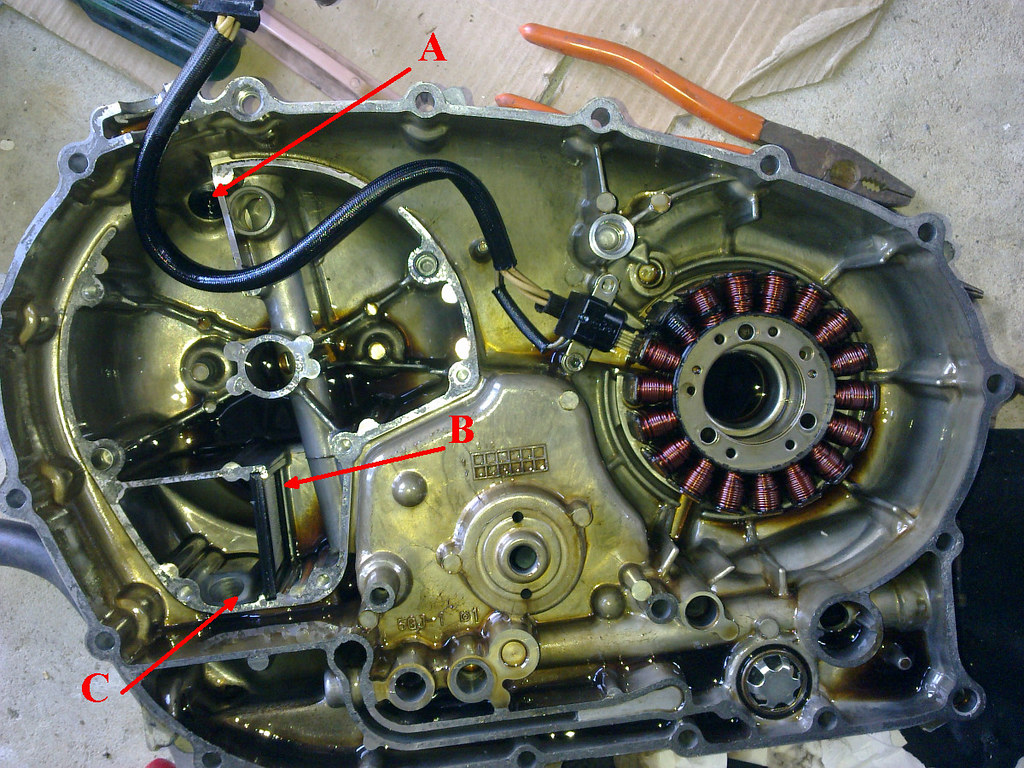
Image

You can see:
A) the oil filler cap entry to the engine
B) the gross particle filter
C) the drain from this into the rest of the crankcase cover area.

Image


I suspected that the gross particle filter was blocked with lots of crap.

The crap came (inevitably) from cleaning off the surface before fitting the gasket again. The cover side which you see is easy to clean without hassle but the engine side is more difficult. I drained a little of the oil to discover that it was actually reasonably contaminated with bits of muck.

Note also the thin oil gallerys on the bottom part of this cover. Important to not clog them with crap when putting the gasket goo on the surfaces. So as directed, apply a thin bead ... you aren't icing a black forest cake here :-)

All seems to be good now Oh, and the forks needed seals too...

PS

NOTE: I have had further issues with the charging system which I have gone into here.

In a nutshell, there is what I  believe to be a design flaw in the early model which leads to excessive draining of the battery in some situations (for many riders in warmer climates, most situations I suspect). I feel that this will have a direct influence on why the stator coils burn out - NB they are being used at their design limit all the time and overheat.

I have identified a solution for that in a post here. The solution is doable by a competent handy man or under direction any auto-electrician.

Saturday, 29 September 2012

My cooked altenator stator

Well I didn't want to have to rip it out, and it wasn't until I was totally sure that it was this part (cos its damn annoying to get to).

The final clue in my diagnosis was that there was continuity to ground from each of the stator ouptut points. Since they are floating, this should not be.

After pulling it out I can see the problem clearly.

So its time for a new stator.
You can read about the install here.

Saturday, 21 May 2011

Do electric scooters dream of being petrol powered?

Its starting to get fashionable to talk about Electric Cars again. The other day I was in at the local scooter shop getting a tyre sorted out for my Yamaha T-Max scooter (and pondering a purchase of a new 50cc scoot for my wife) when I spotted this electric scooter. So (being an engineering sort of fella) it is exactly in my nature to use this situation to mull over the whole thing (and present it to people who may not have thought about it).

I have been interested in the concept of an electric scooter for a while now but had not really done much research on the topic.

So since it was right in front of me I thought I'd ask some questions, take some pictures and write about it here.

I will say from the start that I like the idea of an electric scooter for city work more than petrol ones for the simple fact that most scooters are 2 strokes, stink and pollute something fierce.

India made a great move when they legislated their nasty "auto" taxis to use CNG rather than the regular 2 stroke ones of the past. Emissions fell and everyone is healthier and happier for it.

Its true that electric engines will need power from the regular power stations, which are in the main coal fired (at least in Australia). However at the very least we move this pollution to a single more efficient generation source (while introducing an number of other inefficiencies in the middle) which can be more controlled and monitored.

Before dribbling on about that too much I thought I'd toss in a comment about the rear drive on the scooter. A brush-less 48Volt 4000Watt hub mounted motor: man that means it can suck 83 amps!! wow


Which makes for some interesting observations about the changes in engineering of the swingarm and frame (because the forces are different now).

The motor can suck up to 4000 watts of energy out of your buttery but of course will only pull as much as is needed for keeping a constant speed when cruising along at a steady speed (say 50Kmh). This is of course exactly like a petrol powered motor, which sucks fuel faster when pulling power than does when cursing along. Interestingly both produce about 4000 Watts of energy (yes, 49cc scooter or electric scooter give you the same power to take off) which should come as no surprise because thats regulated by government.

[aside: to put this sort of tiddly power delivery into perspective, a "vanilla" motorcycle like a Suzuik GS500 has a motor that will deliver at least 38,000 Watts and a timid car like a Ford KA which squirts out something like 48,000 Watts of power. So as things go the electric scooter is not pushing the engineering envelope here]

Putting energy in:


People somehow think of petrol as fuel but electricity as energy, I blame our schools for creating this schizophrenic view of reality. The reality is that fuel (petrol, gas) is energy in liquid form. We release that energy by burning it. An Engine turns that energy release into movement. An electric scooter doesn't have an engine (somethhing else has to generate the power) it only has a motor.

The electric scooter stores energy in rechargeable batterys and gets the energy to recharge the battery from your wall socket using something like this:


This little device (which is about the size of a small shoe box) is the charger for the scooter.

To charge your scooter up you have to plug this in to the wall power and into the bike. You can not really run a long extension lead to of from it, or you will loose power so we meet:

Problem #1 - where can I recharge


If you have your own house and garage you can probably charge it up in your garage, but if you live in an apartment its quite unlikely you have power available where you park your scooter. So you'll need to find a place where you can park it and recharge it: which takes 4 hours. In contrast the regular scooter recharges with fuel at the local servo and takes about 5 minutes to fill and pay for.

So, with fuel being (at the time of writing) about $1.5 a Liter a petrol powered scooter takes about 5L in the tank and will set you back about $7.50 to fill up from dead empty. Its unlikely you'll run it dry, so you'll probably put in 3L at a time and walk into the servo to pay your $4 bill while grinning at the people who fill up their cars and are paying something like $60 for that.

So what does it cost to "fill up" the Electric scooter?


Well of course electricity costs, in my area right now power you pull out of the wall costs you about 19c per 1000 watts per hour. Its normally written as kWh which seems to confuse people who often profess to not understand their power bill. Its not all that had to get. Essentially if you plug in and turn on something which uses 1000W (or a kilo watt or 1kW) and leave it turned on for an hour it cost you 19c.

So how does this apply to the Electric scooter?

Looking at the charger we see that it supplies about 900Watts to the battery. I'm certain it is not 100% efficient so lets give it some grace and assume that its going to pull out 1000Watts of power from your power point in your home (or wherever its plugged into).

So (based on the above rate for power) a 4 hour charge will cost you something less than a dollar, 78c our thereabouts.

According to the information I have on the scooter (which you can verify here) For this princely sum you get to travel 90Km (only under particular conditions).

That is quite attractive. Sounds like its quite positive when reading the basics. So lets plumb into the ownership and do a little bit of thinking:

cost comparison


Ok, so 80 cents gets you 90Km on the scooter, but it will of course vary on how you ride and in what conditions. 90Km is of course also the maximum distance, so if you commute across town 25Km you'll not quite get two trips into the one charge (as 50 + 50 will put you out of battery) and you can't stop and top up on the way like you can with a petrol bike. The actual distance you will get may be less depending on factors like:
  • hills
  • number of traffic lights
  • how heavy you are on the throttle on take off (kiss bye bye to fast take offs)
This means that (unless you want to be pushing it home) you'll have to top up every day (fine if you park in a garage in your home, annoying if you have a flat).

So you may be plugging in again and paying that 80c every day instead of the potential discussed by the maker and seller of the bikes.So it may become more like 80c for that 50K round trip.

If you were to consider a petrol scooter (as a comparison) such as the Honda Scoopy, assuming you get something like 3l / 100Km (and some have suggested you can get 1.4L/100Km) you will pay $4.50 for 100Km or $2.25 for that 50Km round trip. Clearly the Electric scooter is in the lead here.

Yet, thats a worst case scenario too, as if do you get 1.5L/100km (which is actually likely) then that'll be more like $1.12 for the trip. Starting to look less like a clear winner as its much the same fuel cost as the 80c for the scooter isn't it?

Of course with the petrol version you have the flexibility that you KNOW how much is in your fuel tank, battery charge level is not as accurate and will depend on how cold it is. You can top up your fuel in minutes but need hours (back home where your charger is) to top up the electric scooter.

So this begs the question of how much is the convenience that petrol provides worth to you?

Costs

Back on the costs: an acquaintance of mine who has an electric bicycle (less power so smaller and cheaper battery) recently changed battery from the standard one. How much did that cost? Well think in numbers closer to $1000 than $500 and you're on the path.

So unless you're after a battery for one of those tiddly little electric bicycles (with all that implies) you're thinking big money for a battery for this scooter. This starts to lead into the next problem identified for the Electric Scooter and that is:

Problem #2 real operation costs:


Anyone who has owned a vehicle knows that there is inevitably more cost than just putting fuel into it. For a start there is repairs and depreciation. So, thinking about the above battery example, how long will your rechargeable battery last and what will it cost?

Well its only covered by 1 year warranty. So assuming you use the battery optimally (charge and discharge according to the makers ideals) you'll certainly get a year out of it, perhaps two. But what if you don't use it optimally and it fails outside of the warranty? Are you going to learn to do that or is convenience going to get in the way?

Consider that at the fuel prices of $1.50 /Liter (and before you say that may rise over 2 years ask yourself if power won't) you will get 20,000Km of travel from $450 of petrol.(*calculated at the worst fuel economy)

So using our example again: if you travel 25Km each way to work, thats 50Km per day = 400 days of travel.

Now, if that battery needs replacement (and ask anyone in Remote Control Helicopters how often that happens) then you'll be up for something between $500 and $1000 or perhaps more.

Yes, that's right ... your entire year of fuel bill will blown on a battery replacement. Which means in another way of thinking about it, that you are actually costing yourself an extra 80c a trip just for the hell of it when using an electric scooter.(not to mention all the issues like where do you charge it if you live in a high rise apartment without a garage)

Ok, but we're CO2 free right? That's got to be worth something hasn't it? Well, let me introduce you to ...

Problem #3 - CO2 generation

Its hard to get figures but it seems that (for coal powered stations) about 900g of CO2 is released for every kW of electricity. So given that the Electric Scooter will need upto 4kW from the wall every day (using the above situational example) it will thus end up generating about 3.6Kg of C02. Of course you could run it to the edge and charge every second day (and push it home occasionally) halving that figure, but that's up to you (and pushing is good exersize).

In comparison burning petrol will release about 625g of C02 for every Liter burnt, but if assuming you burn 1.5 Liters for your 50Km (that's 3L / 100Km) trip, at about a 1Kg of C02 (Note: these calculations are based on figures for C02 in petrol from here). If you get better fuel economy then you'll generate less.

so yep ... the petrol version generates less CO2 as well.

Its not looking good to me at this point ...

Developments

Naturally at this point someone will make the observation that Electric Scooters are at the beginning of their evolution and that petrol engines benefit from decades of development. Well if you have never gone to school or been taught to do any reading you may believe that line.

Let me assure you that both are quite developed technologies.

Petrol motors are actually not significantly advanced compared to 40 years ago (only we've worked on mainly curbing their emissions of other stuff) when you could buy a 70cc Honda Cub (lovely scooter) which used almost exactly the same amount of petrol as the bikes do today.

Then there is the Brushless DC motors used in the scooters, these have been in commercial use since 1886. So its mainly the battery technology which is changed to make storage more compact and perhaps controller circuits to make the motors more flexible. The basic physics of power required to move something hasn't changed between the motor types.

This does not effect the cost and pollution aspects of this calculation (except to say that modern batteries may be a more significant pollution issue than lead acid batterys).

Problem #4 - capital costs

Right now (if you look closely at the first picture) you'll see that we have been considering an electric scooter equivalent to a 50cc scooter costs about $4250, while a 4 stroke *(more powerful, much cleaner burning less polluting than a 50cc 2 stroke) Honda Scoopy will cost you about $2500

Yes, you did read that right, you'll pay nearly double for a less powerful electric scooter which will likely produce as much C02 (if that's of interest to you) and certainly more other significant toxic waste (read up on the disposal of Li batteries) than will result in the choice of a modern 4 stroke petrol powered scooter (compared to 2 stroke motors which are quite dirty creatures).

An excellent document prepared for the Victorian Competition and Efficiency Commission (here) suggests that scooters are more more effective people movers than cars are in cities. No surprise there...

To make the case even more for scooters, according to that same report: "A 2000 report (Motorcycle Transport, Powered Two Wheelers in Victoria) by transport researcher, Professor Marcus Wigan, found that motorcycle riders were the only transport mode to indicate no time delays as part of a trip."

There are articles available written to counterpoint this blog post (such as this one) where they suggest that Electric bikes are better than petrol powered ones. Its worth noting that these are largely written by people who actually sell the electric alternative (but not the electricity).

Its interesting to note that in the post I cited above the author makes the comparison between a electric bicycle and a postie bike (Honda CT110). The CT110 is a work horse, it'll carry another 40kg of mail and still accelerate and travel at 60Kmh if you desire, but the author makes a disingenuous comparison with an electric bicycle (which only carries you and you have to pedal too) comes out on top (when he ignores the battery issue). Yet the bicycle has a motor which wouldn't have enough power to pull the skin of a custard when compared to a postie bike ... gosh, bet that'll be popular on the farm!

But what about Solar charging? That would be CO2 free...


Well that's a good point (especially if you ignore the production of panels). If you were to get a 1.5 kW system it would likely produce enough energy on a good day to charge your scooter (if you left it at home) within 5 hours (you don't get 1.5kW all the time out of them, ask someone who owns one). So for the additional investment of $2500 (around about and you won't be back feeding the grid while your charging) you can be comfortable in the knowledge that you won't pay that extra 80c a day (but you'll still pay the other costs)

Woo hoo

But that's then an investment:
  • $4200 for the scooter, and
  • $2500 for the solar charger system (no rebate on that one)
taking your investment to $6700 for a system which needs you to leave the bike home duringthe day for charging ... sounds great to you too?

Depreciation bell ringing yet?

So in summary:


It seems like the following to me
  • I will save a little per trip (a best case of about 80c for a 50Km trip vs $1.25)
  • but I pay double to purchase ($4200 vs $2500)
  • unknown depreciation losses (but its fair to say you can't loose more than $2500 on the petrol scooter)
  • pay more for ongoing operational costs (the battery will die, motors often last ages)
  • actually create more pollution in almost every way by using an electric scooter over a petrol one.
  • You have to be able to park it where you can charge it (in a secure place or risk getting your charger stolen)
  • if your running low in power on the way home you can not just stop in to a servo to top up.
Why are you buying the scooter? Economy? Environmentally friendly?

The bottom line is if you want to be really environmentally friendly, go get a 110cc 4 stroke scooter stop driving your car and help save the worlds atmosphere and resources.

Wednesday, 21 July 2010

big scoots

While I have the DN-01 on loan at the moment, the goal has been to get a bike of my own again. Well this weekend I bought a Yamaha T-Max, which is a big scooter.

The scooter came from central NSW and I rode it home some 550Km from there, giving me some time to get used to it, see how it sits on the highway and get a feel for its fuel economy.

The two bikes are at once different and yet similar ...

For instance both are fully automatic, twin cylinder, feet forward riding position bikes while the purists would argue that the T-Max is a scooter not a bike its rather different in many ways:
* scooters normally have the engine as part of the rear drive train (massively altering unsprung mass), while the T-Max has the engine as part of the Chassis just as a normal bike does
* scooters are normally between 50cc and 180cc ... the T-Max is a 500cc engine with more power than a typical 500cc single
* scooters don't normally have a chassis like a motor bike does.


* the T-Max has larger wheels than scooters, but not as big as most bikes (they're 14 inch and 15 inch ... many bikes are 16 inch and 18 inch)

So while a T-Max may look like a scooter, its more like a motorcycle with a low slung frame and only with seating like a scooter.

chalk and cheese


The first thing which stands out is when you start the bikes up. The DN-01 sounds like a throbby V-twin and the T-max sounds more like an outboard motor.

hmmm ... if you're into the "ambiance and acoustics " then get the DN-01.

The next thing is seat height, the DN-01 allows me to sit on it like on a Virago 250, plenty of space under my arse when I stand up while astride the bike. The T-Max on the other hand is rather a high and wide seat which makes touching the ground difficult without sitting to one side a little. This is not a bike for learners who are short. On the move however it feels great and is by and away the better seat for long trip (if you ask me). More on the seating position in a tic.

I have not taken the DN-01 through any windy roads, but so far it makes me fee like it will do well ... as long as it does not run out of cornering clearance (a common issue in cruiser style bikes)

The things the same as a normal bike...


The funny thing is that while both bikes corner and behave very well on the road, the combination of seat height and orientation makes the T-Max feel more like riding a recumbent bike than a "traditional" bike, while the DN-01 feels just like any cruiser style bike (like the Virago). I reckon that anyone who likes bikes like that (Yamaha Virago Suzuki Intruder) will love the DN-01. Anyone who has tried a 'bent' knows they're fast and corner very well. Recumbent bikes only loose out to "traditional" bicycles in their ability to allow the rider to stand up in the pedals and get more power down to the ground on climbs ... the T-Max however has a motor for that :-)

After coming down the range from Tenterfield to Casino, I can say that the T-Max goes around corners very nicely and has good cornering behavior, even if it does not feel like a CBR-600 it goes well enough to hurry one along if the rider is not up to the task (I'm sure it surprised the rider of the one I hurried along).

After 5 hours in the saddle (with a couple of hours in cold sleet and rain on the New England Plateau) I got to home feeling quite good, with no aches, no pains and barely any fatigue (and I have not been riding as much these days as I once did). Folks this is one fantastic machine for long haul rides.

but it gets better ...

The fuel economy of the T-Max was astounding, so much so I will have to double check this, but on my trip home I averaged 28Km/L ... yes that's 3.5L / 100km

Combined with the excellent protection of the screen and the great seating that makes the T-Max one of the best open road commuting bikes around.

So far (aside from the limp "outboard" sound of the engine) its all positive stuff for the T-Max


After some years as a big bike fan, I find myself really liking this big scooter.

Wednesday, 14 July 2010

easy rider

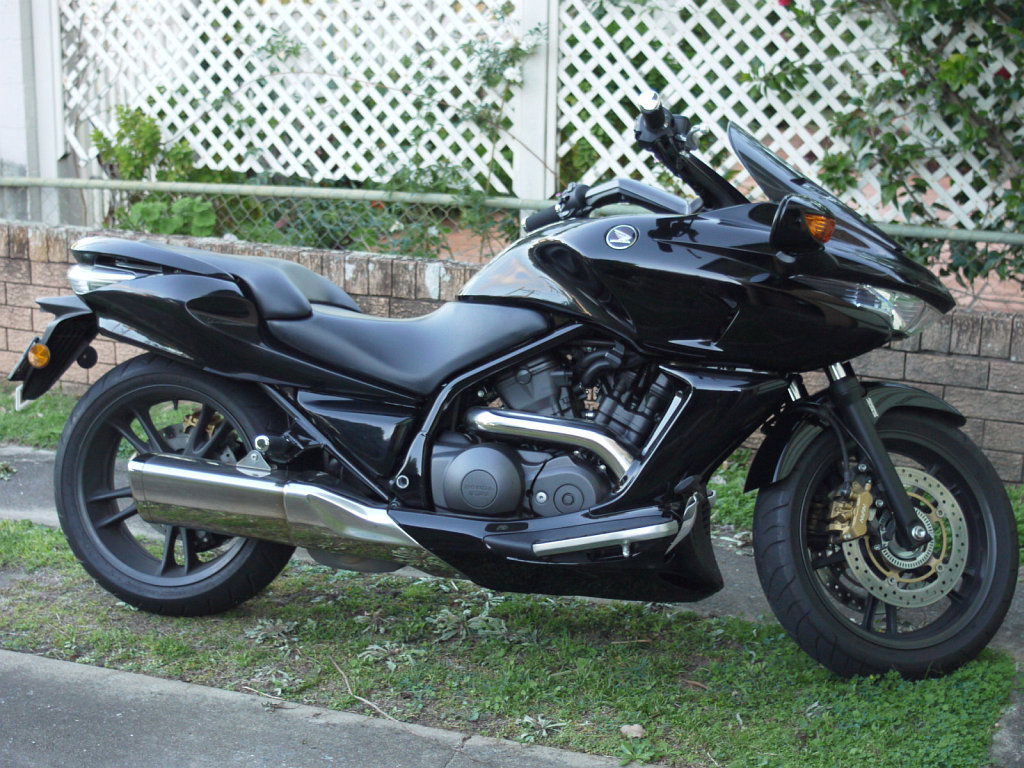
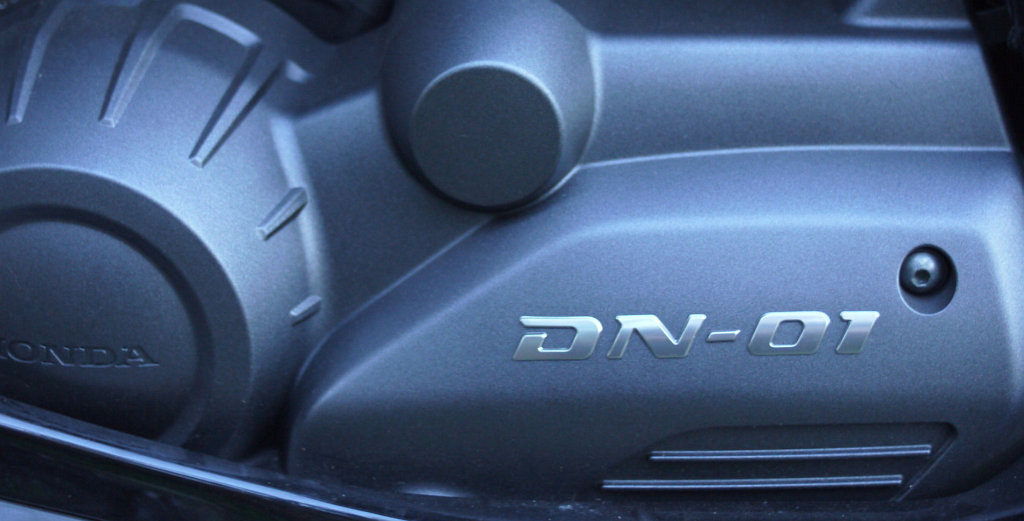
I've been a keen motorcycle rider for most of my life. I got my first bike (a Honda SL 125 as in the image to the left [which isn't my bike]) some time back in the late 70's. I've pretty much had a bike ever since then, with the exception of my time in Finland. Being back in Australia I wasn't immediately thinking of "gosh I have to get a bike" (honest) but with only one car in the family at the moment it was clearly a reasonable thing to start thinking of soon. Lucky for me a good friend of mine came to the "rescue" and offered me a bit of time on his new toy, a Honda DN-01. theDN01 In a nutshell it is an 800cc, V twin, fuel injected, water cooled, shaft drive bike with ABS and a fully automatic gearbox. shaftDrive Everything is neatly tucked away, no muck flying out of the windows incubating the passers by with this one ... Heck its the first bike I can ride to work and not get my pants dirty (chain lube fling off) or my black shoes scruffed up by the gear change lever (even my K100RS can't boast that). A close look at the front end shows the typical ABS sensor system and triple pot (six piston) disks. frontABS Yep, it stops quite well! The cockpit is quite nice ... and clean! cockpit nice foot rests too, and not a trace of vibration through them. The gear box is based on the CVT system which have been used in Honda 250cc scooters since the Spacy in 1986. If you're unfamiliar with the CVT system, I suggest this video will help clear up how the thing works. But think of your MTB bicycle gears and the way the gears go up more by both increasing the front sprocket diameter and decreasing the rear. For how the pulleys operate ... Its used in use in some cars now too. A little over a week and a thousand kilometers on the bike have given me time to get used to it and develop impressions. My first impression remains with me still ... "hey, I kinda like this bike" Sitting on the bike is an interesting experience, it is way lower than I expected. This is something which will / should make the bike more appealing to many riders who have "ducks disease"
"Ducks Disease", a term coined by the Welsh comedian Harry Secombe. He would demonstrate it by sitting between two men who appeared to be of the same height. Then they stood up and he was a foot shorter
Sufferers who ride bikes often go for bikes like the Yamaha Virago (ok if your a chick) or those wanting something different try the Yamaha T-Max (more on that soon). The problem with the T-Max is that while its a 500cc big scooter it also has a big seat height with a wide fat seat that generally keeps anyone shorter than 180cm (6 foot for the UK and USA readers) from touching the ground ... which is just the opposite of what a learner with ducks disease wants. The DN-01 however is perfect. I can even stand up and be 3 or 4 cm out of the saddle (and I've got ducks disease too!) The operation of the automatic gearbox is fantastic. Within a few moments you forget about it (aside from the reflex twitching of the left foot and reaching for the clutch with the left hand...) and just ride it. On the highway it cruises smoothly and if you want a little more acceleration when over taking, hit the switch on the left which puts you into S mode of the gearbox. The minor fairing does an excellent job of keeping the wind off my chest at everything up to and including 110Km/H (we have some sections of highway here that are that speed) without introducing any noisy turbulence. Fuel consumption seems to be something like 21Km / L (4.7L/100Km) out on the highway doing the speed limit. I reckon this is the easiest to ride bike I've ever sat on. The 800cc V-Twin gives enough power to sit all day at 100Km/H on the highway (about 3800rpm FYI) and even with a passenger it all feels effortless. If you were even roughly interested in a simple to ride, low seat height, competent easy to own bike then it would be hard to go past this. At the current prices they go for used they are a steal. Honda have a long history of making evolutionary bikes; they're quite capable of producing class changing bikes (like say the CBR 600 which totally redefined the 600cc class) or completely orphaned things like the CX 500 Turbo. I have a feeling that the DN-01 is destined to be more like the CX500 than the CBR600. That's not to say that Honda wasted their R&D money on the bike, as quite like the CX 500 Turbo they are bound to make great use of the many innovations which appeared on the bike. Stuff like the CVT, the electronic controls of the CVT, the well integrated ABS and the fact that its a "real bike" (not a scooter) which behaves like a bike and operates as easily as a scooter is bound to make an impact. dn-01 its a bottler. I reckon that something like this system in a bike like the Honda Revere would be a scorcher. Either that or you could get a Silver wing or the Yamaha T-Max (especially if they bring out the 750cc version) PS - some of my other bikes: