Showing posts with label Depth of Field. Show all posts

Sunday, 6 December 2015

Panasonic 25mm f1.7 (the m43 Shallow Normal I've been waiting for)

well recently a bargain of epic unmissable proportions came across my vision and I bought the Panasonic 25mm f1.7 for US$99 (plus shipping) which I just clicked "buy" on it immediately.

So this is my quick review of how the lens performs for me and how it fits with my equipment , style and needs.

Readers of my blog will know that I've long wished for a shallow normal, for example read these links dating back to 2010:
here
here
here
and here

When the Olympus 25f1.8 was released I was tempted, but just felt that it wasn't worth that much to me (they weren't cheap. Then the Panasonic 25mm f1.4 was even dearer (and bigger).

So now with the Panasonic 25mm f1.7 in hand I can say for me I've found the Graile.

Like Goldilocks pronounced, its not too dear, its not too heavy and its just about perfect.

Summary

This lens is great to use, it feels very natural for an old school 35mm SLR camera guy and feels great on my GH1, where it operates perfectly.
It feels less perfect on a compact camera, but my view is that such a camera makes subject "engagement" through the viewfinder (what view finder) impossible and when dealing with shallow DoF you'll really need to take care with placement (or take pot luck with results).
There is no substitute for faster apertures in low light, but its a killer outdoors.

The meat

I use a normal lens as (in my view) it was intended. A lens to take general purpose shots: shots which aren't too macro, aren't too telephoto, aren't too wide ... just "normal". I don't use it to take pictures of Mr Potato Head on my keyboard, nor sweeping wide scenery shots (well I suppose if I was stitching then of course).

So for me "normal" is also not infinity shots (implies scenery) and not in tight facial portraits (implies telephoto, if you respect your subjects facial features).

My first shot was off my balcony with my camera at 100ISO, and on a sunny day the brightness washed out with my max shutter of 4000th of a sec.


There is no one in this shot, but if someone was standing beside that pole it would be a "normal" sort of shot of them in front of the scene ... and man, is there great details in that pole, both in sharpness and in subtle textures. That's a camera JPG, but here is a dcraw development of that image at 100%:


This serves to show a few things:
  1. how much better dcraw is over in camera JPEGs (which I've mentioned many times here) and
  2. there are obvious colour differences between the camera selection and the RAW processors selection.
  3. there is better tonal handling (note clouds in background) in RAW
  4. CA is almost non-existant

I've read a few Wangers (term explained here) mention the lens has significant CA ... well just like I expect from Zombies of Moronity (from King Wang) they either haven't got a clue what CA looks like, or they don't even know what it means (probably both).

ePhotozine have done a review on the lens (here) and they rated it as Low CA ... have a read of their tech analysis.

Before looking at more images, I wanted to show the lens in perspective (as Foghorn Leghorn would say "I say, that's a pun boy"). So here are my three native m43 lenses which cover "normal".


The 20mm is perhaps a little wide (but I love it as general lens too, and its fast), then there is the 25, and then my faithful 14-45 that came with my G1 so many years ago. This is a great general purpose lens and (of course) covers normal.

Now I love the 20 on my GF1 because it is it more compact and fits in with the compact design philosophy:


But the new 25mm is (to me) a bit unweildy on it.


So to me the 25f1.7 is more suited to an SLRalike body such as my GH1 or an OM-D


Where the size feels natural, neither too small (which I sometimes feel about the Oly45mm f1.8) nor obtrusive. And while the 20mm isn't in the way, its sort of a bit pointless in terms of saving space ... when the rest of the camera doesn't really feel minimalist


So in my view the Panasonic 25mm f1.7 is really designed for the mindset of a camera like GH series or the OM-D series.

So with a contemplative engaging type camera we can use the 25mm to have some good renderings indoor in low light, using natural light not needing (yuck) on camera flash.

I took this set to compare the 25mm to my 14-45 set to 25mm (and interestingly the zoom markings are pretty spot on too). I wanted to see what I'd see.

https://c1.staticflickr.com/1/650/23240100290_866c41f1e7_o.jpg

If you click it you can load a full sized image and pixel peep around the place, but here is the center at 100%:


Notice how quickly the DoF falls off? Her locks are sharp on her forehead and the weave of the cotton visible, but by the back of her neck its really softening.

Now, lets look at another shot taken with the 14-45 zoom at 25mm wide open (which BTW is f4.9)


DoF is now no longer shallow, and there is that "phone cam" look about it starting to appear. Also, if it looks soft ... well here's why:


Motion blur ... so while a Wanger will tell you how good their IBIS is at allowing an extra 2 stops of shutter, its pointless when the subject moves ... and folks, if you didn't already know it, kids move ...


IBIS or OIS just ain't helping here is it ... Shutter speed is your best friend on this sort of work.

So the Panasonic 25mm f1.7 gives you something that the Zoom just can't ... shutter speed! So maybe you can find at f2.8 zoom that covers that range, but to me, even f2.8 isn't the same as f1.7 in neither DoF nor Shutter Speed. Plus such a zoom will be expensive and heavy, while the Panasonic 25mm f1.7 was well priced and light. So to me the 25mm f1.7 is perfect to toss in the bag (adding almost nothing to weight) and bringing to the table something wonderful, when your 14-45 is your main versatile picture taker (and outdoors it will be ideal).

Lastly on the little girl is this segment of a shot, a pixelpeeper who isn't skilled will probably whinge on a forum that the lens isn't sharp ...


But the fact is that if you look at the shirt pattern and the locks of hair over her ear the answer is that the focus was on them. In these shots I relied on the Face Detect AF to give me capture quickly as manual focus would have been a bit tricky with a fast moving subject who doesn't sit still ... when there is no 'recognisable face' (meaning two eyes and a smile) then the camera defaults to picking a focus point it wants ... and may miss.

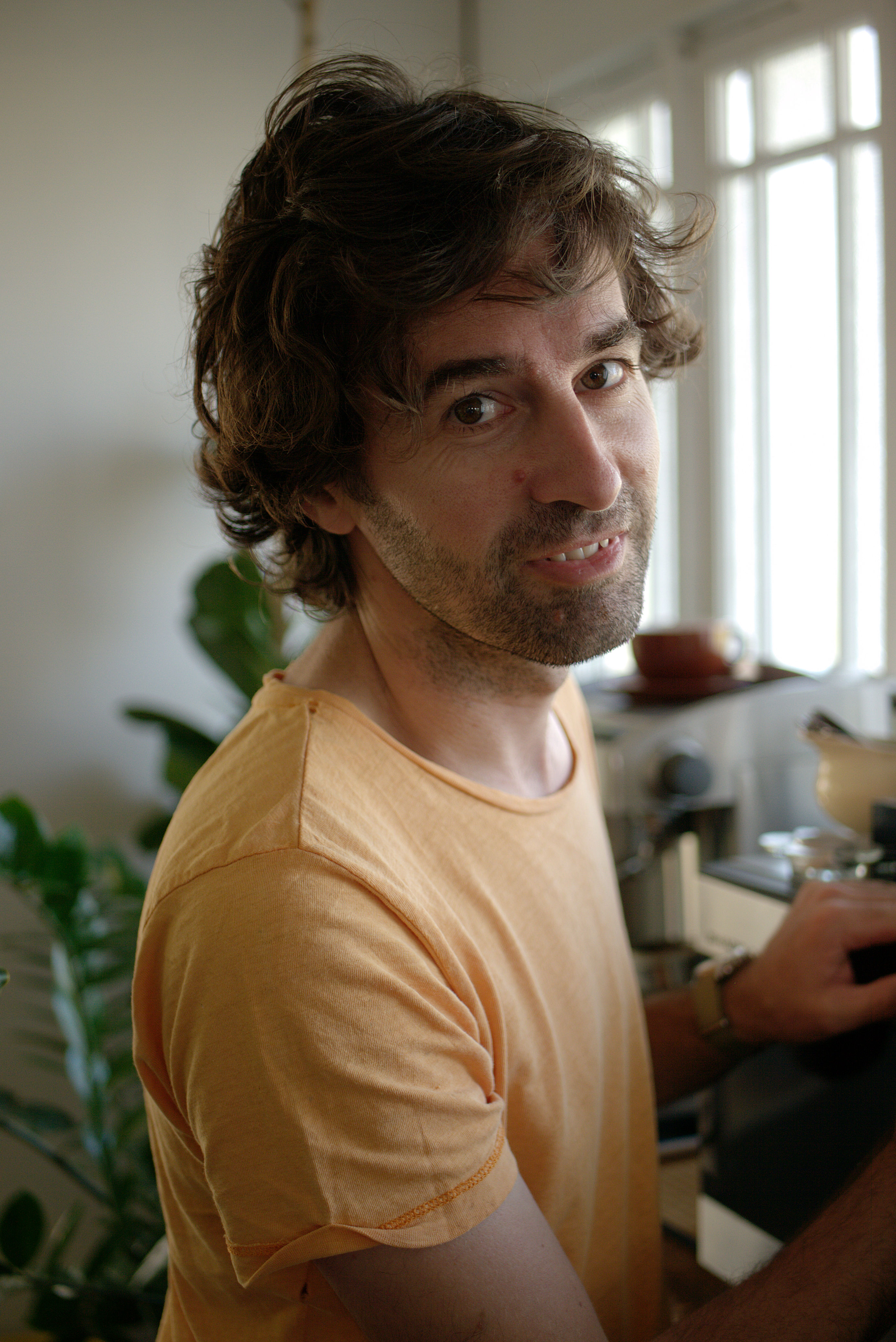
Here's another shot from the day, of my wonderful host, in this I used manual focus and got the focus on his face exactly where I wanted it (click image for a full size version).
https://c1.staticflickr.com/1/587/23453403261_cb0bd493ff_o.jpg


Its a hand held shot perhaps a little tighter than is ideal for a portrait (I'd prefer to have stepped back and used my 45mm f1.8) but it just goes to show how well the 25mm can do as a portrait lens ... in a pinch. Certainly better than the even wider 20mm f1.7. This shot also shows how well the lens handles flare and CA in what is a challenging shot for lighting.

Miles even took a shot of "Yours Truly" with the camera and found the MF (which auto enlarges the viewfinder) to be easy and accurate.


Conclusion

The little Panasonic 25mm f1.7 is a fantastic buy. It comes with a hood (if you could be bothered with such) and gives the photographer who knows what he's doing a great tool with which to make great shots.

I now no longer look wistfully at my 35mm or full frame gear as the shallow normal I want is here in my hands now.

Better than the "nifty fifty" of my EOS days, this lens is good corner to corner at f1.7 while the 50mmf1.7 normally needed stopping down to avoid softness, corner softness and vignetting. While there is some of that on this lens, it really is so minor that you probably won't even notice it unless you go looking for it.

If you take photographs that are of the nature shown here, then I'm sure that you'll be really glad you got one.

Saturday, 7 March 2015

my Full Frame camera is 35mm film

Fortunatly we've had 35mm around for longer than digital, and while I really DO like my micro43 cameras I am under no illusions about it and know that good old 35mm full frame (there was half frame you know, such as the Olympus Pen F series) exceeds it in many ways (though convenience isn't one of them).

At about the time when digital cameras (my main snapshot cameras for 15 years now) were good enough to use as a reasonable substitute, Film Scanners were expensive and their use was poorly understood. By the time that good scanners were at reasonable prices and systems like Noritsu's 35mm development / scanning process machines were around it was too late.

For the enthusiast picking up 35mm gear at bargin prices, and for those pulling out their old images, the quality you can get with a good scan rivals the best of the current Full Frame digital cameras (like the Sony A7 or any of the Full Frame Canon / Nikon cameras). Especially if you don't have shit hot lenses.

I was going through some older shots I took in Tokyo back in about 2002 and liked this one of a temple just up from where I lived


Its a good 20 Megapixels.

I took it with my faithful (still running fine) EOS630 with an EF24 f2.8 lens (still running fine too).

So lets have a look at some details ... at pixel peeping levels ... from over there on the left ... just under the roof


then the gutter above it ...


moving over to the right hand side:


and lastly one from the middle:


Which makes it clear also (judging by the reflections in the windows) that I could have focused a little bit closer than I did (instead I relied on the infinity "stop" on the lens) and the rope would be sharper .... when magnifying this much (which is what a good scan does) the DoF assumptions many people make on 35mm (like what's on the lens barrel) are inadequate.

So, all in all I'm not about to stop using my digital camera but I recognize that its got its place and that there is still a place for 35mm for me (especially for 4 day hikes in -15C where batteries freeze).

Enjoy

Sunday, 26 October 2014

the Roulettes

 Yesterday (well and today too) we had the Gold Coast 600 race (because we lost the Indy har ha ha ha) and as part of the circus we also had the Roulettes doing an air show at the start of the "big race".

I happen to live quite close to where the event is (Main Beach , Gold Coast) and so get a great view of it all.

Even better I live on top of a hill in the area and get an excellent "back row grandstand" overview of it.

I have found in the past that my Canon FD 300mm f4 lens does a fantastic job of aircraft at that range. The shot to the left here is "straight out of the camera" with no cropping to make my lens seem to reach further.

Given that its a 70's mechanical camera lens whacked onto the front of my GH1 I'm happy. Actually I've had it for a five years now and remain happy with it.

Just by way of comparison, here is a shot showing 100% pixels (its a 4000x3000 pixel image capture, so naturally it won't fit on a 1200 pixel wide screen right?) that top aircraft.


which all things considered (you know, like atmospheric losses {shimmer and such}, it being hand held...) I've got to say that I don't think that you'd get that much better with any other lens no matter how much you spent on it.

My technique for this is to focus on something about half a mile away (hat tip to the UK and American readers, as I usually use metric. ... and yes you can see the difference in focus on something further away at f4) and lock it down with my "rubber band" technique.

I then set in f5.6 so that I can get a DoF that covers almost everywhere the aircraft will be in (its called Hyperfocal Distance). Eg, from this online calculator.

So you can see that the amount of blur will trail off gently as they get further away (further than 2.6 Km anyway by which time the combination of atmosphere and distance will soften that loss). To put a perspective on that graph's "Blur" (which is the Circle of Confusion, excellent tutorial there) the value of 0.01 is the minimum discernable size in a 8x12 print and I reckon that the combination of this lens and camera will not attain such. So vrom 300 meters to 2km it won't really change the image.

Anyway, there's more to a good picture than just sharpness and maths right?

I liked this shot (even though it was further away)


and when pixel peeping you can see heat shimmer is already eroding the quality (no matter what focus or what lens I had, even if I'd had a SciFi Anopticon)


Anyway, some other shots from the day ...


It was nice to see the Roulettes

:-)

Monday, 28 July 2014

The Panasonic 20mm f1.7 (now I own one)

Why?
Because with a 20mm f1.7 on a GF it may be worth it because of size.

When the Panasonic 20mm f1.7 first came out I owned a G1 and had already had bought a 28mm f2.8 manual focus legacy lens to play with. I wrote a blog post about it at the time having tried one in a shop and gone away to think about it. I wrote a post then subtitled do I really need one. That post could probably also have been subtitled instead: "will I see a benefit"...

Given that it was €400 I was a bit shy with parting with my money I felt at the time that having the kit 14-45 (quite a good lens really) and a OM28mm f2.8 I thought it wasn't worth it.

Later when the Sigma 30mm f2.8 came out I thought I'd try that out to compare with my OM28mm f2.8, expecting them to be quite similar. Which they were (see this link). I initially thought that the Sigma may work well on my GF (which I didn't have back when I first looked at the 20mm) but to be honest its physical size gave me nothing much to love about it over the 14-45. When used on my GH (an SLR-ALIKE camera) there was equally little benefit as the OM28 was optically quite equal at f2.8 and manual focus worked better for me when I was after critical focus anyway.

So how am I looking at this?
Essentially I'm interested in:
  • differences in angle of view between the OM28 and the Pana 20
  • shallow depth of field on the lenses
  • clarity on the lenses
If there is a benefit to me I'll be keeping this lens and re-acquiring a GF1 (and probably the 14mm f2.5 and the GWC1 - 0.79x adaptor for that lens) as a compact and light weight camera system (I'm such a gear yo-yo).

So whats it look like?

I like "normal lenses" for working at "normal" distances and taking "normal" sorts of shots (you know, not particularly wide, not particularly telephoto). With a f1.7 lens working outdoors in full sunlight will challenge the shutter speeds even at ISO 100, so I took a shot of my mate Bob working in his shed.

All images are taken with each lens "wide open"

Firstly the Panasonic 20mm


then the OM 28 taken from exactly the same spot.


I guess its pretty clear that the focal length difference which I identified in my 2010 blog post is still exactly what it was. To make that clearer here it is in this instance again:


the red frame in this shot is about what you get with the 28mm and the whole shot is of course taken with the 20mm.

So, some difference, but nothing which is staggeringly different. In some ways this sort of thing is what can easily be achieved with "zoom with your feet"

So in the shot below I moved back a bit and took the shot again to get a framing with the OM28mm equivalent to that of the 20mm (standing that bit closer)...

Open the images up in different windows and switch between them, I'm sure you'll agree that the character of the 28mm and 20mm are quite similar and the background relationships between them (caused by change of focal length and shifting position) are not specifically drastic.

Of course the background snuggles closer while Bob remains the same in the focal plane. Depth of Field is not significantly altered. So unless you have a specific plan it just may be that for things at "normal distances" the 20mm is a nicer tool in some ways. Like it does give you f1.7 vs f2.8 which could give you 100th of a sec VS 30th of a sec ... or enough to make a hand held shot sharper. These were all taken with a tripod.

Cropping?
So this begs the question of "can I crop the 20mm lens image back to equal the 28mm lens (or maybe just equal to a much more expensive 25mm)?

Well here is the 20mm cropped back to the view of the 28mm


Which is surprisingly similar to the original 28mm lens image.

So, what have we lost in details by cropping? Well that's a good question as the Panasonic 20mm lens should be a much sharper tool than the OM 28mm lens (designed for 35mm so many decades ago now) so lets have a look at the 100% pixels from a cropped 20mm upsized back to 4000pixels wide:


and the original capture of the OM28mm at 100% pixels


which is not too far apart and unless you were doing a very demanding print to put on a gallery (in which case you'd probably plan ahead better).

Also interesting is that the DoF of the 28mm @ f2.8 is almost the same as the DoF of the 20mm @ f1.7 when you factor in the changes in shooting distance.

The 20mm cropped and upsized shows that it does well and would do better if we were only cropping it to equal the Panasonic 25mm f1.4 field of view (of course that lens is bigger, brighter, more desirable and more expensive). I'm not sure I'd want that lens on my GF1 but it would be good on the GH...

As I was writing this
It occured to me that what I should also have done is to take a shot with the 20mm stepping closer to the subject rather than just with the 28 stepping back (to equalise the 28 to the 20). This would give the effect to be seen of the 20mm in closer from where the 28mm was taken from. Luckily we used a tape measure on the floor :-)

As the light had changed I took another set of two shots. So

The 28 taken from the same place as the first 28 shot was taken from:


Then the 20 stepping in a bit closer...

Same sorts of background / foreground perspective changes, but now that we're in closer the DoF from the f1.7 makes the background softer (check out the CH of the top row of the business card behind the screwdrivers).

As long as you're not shoving the camera in his face the facial distortions from trying to capture in too tight with a normal (making a portrait use of it) the differences between 20mm and 28mm are barely apparent.

Conclusion?
To me the last shots clinched it for me, the 20mm with "zoom with your feet" is quite equivalent to the 28mm (and probably the 25mm too) and so I feel I've answered that question.

So, what'll I do ... I'm not sure. I happen to like this little lens, so I think that to do it credit I'll have to take some shots with it for a while and see.

Ultimately I think its not worth it to me on the GH body as it brings little advantage to me in its size. If the AF is not to be relied on for shallow DoF work (and picking focus right exactly where I want it to be) then its of reduced usefulness to me.

To me the question is now this;
will I be better served with a GF1 (still the best GF if you ask me) with this lens + 14mm + 0.79 wide adapter than I will be with selling it on again and just buying the 25mm f1.4?
I could still buy a 14mm and a GF1 for less than the extra required to have bought a 25mm f1.4 over this lens.

Sure its not just a question of the lens and is it good enough as without doubt the Panasonic 20mm f1.7 is a great lens, it also happens to be a compact pancake lens and makes the GF camera actually achieve its potential of being compact.

All of which most of the newer micro43 cameras seem to fail at (with the exception of perhaps the GM).

Hope someone has found it interesting to see the Pana 20mm up against a legacy 28mm lens and also seen that the DoF difference between them is not only what calculations may have revealed.

Saturday, 22 October 2011

Portrait lenses: 5D vs GH1

One of my favourite words is fungible. I'd never heard of it till I worked in the Finance industry (and who'd have thought but its a finance namespace word). Its defined over at Wikitionary as:

Adjective

fungible (comparative more fungible, superlative most fungible)
  1. (finance and commerce) Able to be substituted for something of equal value or utility; interchangeable, exchangeable.

With that definition in mind, the purpose of todays post is to explore the fungiblity of 50mm on 4/3 vs 100mm on full frame.

background


When digital SLR cameras came out I was unimpressed by the APS size sensor. I felt that it twisted lenses into something I was not used to. My fine 24mm wide angle became a middle or nothing semi-normal and my favourite normal (EF50) became some sort of half assed tele (something like 80mm which is too short IMHO). I ended up needing to buy alternative zoom lenses to cover the angles I liked and the DoF was never what I wanted.

Then I tried 4/3 and found that the x2 factor on the lenses was much more acceptable to me than the x1.6 of APS. I did find that the optical SLR viewfinder was pathetically small and so it wasn't till micro4/3 came out with the electronic viewfinders that I was fully comfortable with focus (and yes, I had a number of focus problems with APS cameras which included backfocus and front focus issues as well as inability to clearly manual focus on the small focusing screens).

Since I started using micro4/3 cameras one of the questions I have sought answers to is the ability to substitute half the focal length at 2 stops brighter and get the same thing. Back in March 2010 I made a comparison of this however I used 35mm negative, which didn't fully satisfy my interests because I still wonder about the utility of a 5D in what I photograph.

As I recently borrowed a 5D (for testing the Olympus 21mm f3.5 wide) I thought I'd do another test to satisfy my curiosity (and of course provide information for others pondering the same thing).

Too many reviews compare things with no context other than the optical one. I think that's invalid because I don't know anyone who just buys based on what the magazines say. Most people need reach into their pocket and pull out some money. So in someways there needs to be an examination of cost benefit. So lets examine some costs.

Both the GH1 and the 5D are only available now as used cameras (which to me is a good thing as they are cheaper this way, let someone else take a big depreciation hit if you can). A good used 5D body still fetches about $1000 while a good G1 about $250 and a GH1 (if you were after video as there is no other significant difference between the G1 and GH1) about $400.

The lenses uses in this test were the Canon FD 50 f1.4 and the Olympus OM100mm f2.8 - one can expect to pay about $100 for the FD50 1.4 and about $200 for the OM100mm f1.8 So one can take advantage of cheaper lenses. Because shorter lenses cost less than longer ones of equal quality and also 50mm was once a really popular focal length.

Then there is size the 5D is about twice the dimensions of the G1

So not only do you pay twice as much for the 5D as you do the G1, you have to carry around twice as much of a monster.

People often discount this fact when making considerations and instead ruminate about "what makes the ultimate image".

This "ultimate image" nonsence forgets an important fact in photogaphy: if you don't have your camera with you then you can't take pictures with it.

Hmmm?

This is of course why I bought a G1 and sold most of my EOS gear back in 2009 (after much rumination and after buying the G1 and having if for some months just to be sure).

Clearly then this test is not without me having some pre-conceptions from the outset. I think its important to say that some of my preconceptions were upheld here, while others were challenged and I think its fair to say I learned something in here which I didn't expect to learn (but wondered about in another context)

examination


In this test wanted to examine how well the micro4/3 camera would hold up against a full frame camera in respect to portrait focal lengths. I chose 100mm for the focal length because I've always like it more than 135mm. Canon and Nikon and Olympus alike have all made good sharp f2.8 100mm lenses for some decades. I happen to own a Olympus OM100mm f2.8 which I think is one of the sharpest lenses ever made (the TS-E90mm would get my vote as the best) and the 135mm range is a bit patchy if you ask me. Likewise there are plenty of good 50mm lenses out there (I own a few of them) which of course makes the basis for this comparison.

So to compare a 50mm lens on micro4/3 to a 100mm on a full frame one needs to consider that to get the same DoF look and feel, you need to keep the aperture 2 stops brighter on the 4/3 camera. So in theory 50mm @ f1.4 <=> 100mm @ f2.8. But of course its not without problems because (among other things) the aspect ratio is different the 4/3 format is far more square looking than the 3/2 format of full frame.

Notice that when covering the same width that the 4/3 gives that bit more along the top and bottom.

Next I'll state that all images were taken
  • in RAW
  • on a tripod that didn't move
  • converted using ACR 5.6 with exactly the same parameters
  • exposure set by my Gossen light meter and manual setting applied to the cameras
This was done so as to get the images as close as possible in terms of processing (camera JPG's would be more difficult for the nature of this comparison)

Something which came out right away was that: if you are taking shots in full sunlight that using f1.4 is a challenge.

The shutter speed required is often exceeding what your cameras shutter will allow. For instance on a sunny 16 kind of day (like this was) I was using 4000th of a second to get f1.4 and even then was needing to have shadows as part of the picture or have a washout. Check the nuclear glow of the shirt back for instance. At 4000th of a second fill flash is out of the question too.

So it seems that fast lenses and daylight are not good friends.

So anyway now lets take a look at the images.

First the image from the Olympus 100mm at 2.8


and then the 4/3 camera with the 50mm at 1.4
The first thing I notice is that the colour and contrast is different (there is also bokeh but that's for another post). The FD 50 when opened up to 1.4 is really soft and dull looking which influences the colour. This is clear in the 100% view below, especially where the stark contrast border between the white velcro of the cap strap borders the darkness of the hair in shadow. I would call this "blooming".


Don't get confused and think this 'flare' only exists where there is bright light, it exists all over the image area and is what serves to make the lens "low contrast".

If we now look at the OM100mm at f2.8 we see definitely better contrast.


Its interesting to note however that the outright resolution of detail between the two lenses is quite similar.

This is consistent with what pulled me away from my 10D and 20D cameras in favor of the Panasonic G1 ... it just has heaps of detail.

On that subject its a good time to observe that the 5D turns its 36x24mm capture area into 4368 x 2912 pixels while the G1 divides its (much smaller area) 18x13mm into 4000 x 3000. This means that while the outright capture of detail is quite similar the micro4/3 is actually a little more demanding of lens quality. Since the FD50 f1.4 (or in fact almost any super bright lens) has always been regarded as a little soft fully open, it translates to a bit more than that here.

So when you stop the FD50 down to f2.8 it clears up immensely

to be more or less equal to the contrast of the Olympus 100mm lens.

but of course loosing that nice shallow DoF. I encourage you to open up each of the above images in a separate tab to allow you to click between tabs and see the differences jump out.

Perhaps the new Olympus 45 f1.8 lens would solve these problems and yield a lens which would
  • have the contrast I find in the Olympus 100 f2.8 on full frame,
  • have at least similar (if not better) sharpness
  • be more compact and light weight than the FD f1.4
The lens will set you back about $400 as it seems to be panning out, which is quite attractive. The initial discussion of the new Oly 45f1.8 indicated prices would be much higher, but if it does come in at $400 that will put it right on par with the typical 100mm f2 lens.


So you would then get the compact benefits of micro4/3 without needing to pay through the nose for smaller.

Back when micro4/3 came out there was of course no such lenses available, but the potential was there. So to actually see and explore this potential I have experimented with adapted 35mm lenses so that I can get actual experience with images, not just a theoretical idea of what I can expect.

Both lenses used in this test were designed for different cameras than the EOS series, and so need adaptors. The OM lens was made for a camera with a shorter flange distance than the EOS, but not by much. So it only has a slim adaptor. The FD being used on the micro4/3 however has a much longer adaptor because (again) the flange distance effects the design of the lens (has to clear that moving mirror).

Paradoxically the 50mm lens actually becomes bigger than the 100mm lens when both are on their respective adaptors.

Of course a 50mm lens does not need to have such a massive stand off on a camera without a mirror. In this photo I show the Pentax 50mm lens (far right) beside the 50mm OM lens (on adaptor).

pentax-110-kit


So the new micro4/3 Olympus 45mm f1.8 is likely to be about the same size as that little pentax lens. If you happen to be interested in more compact 50mm portrait lens than the FD 50mm f1.4 I suggest you consider the little Pentax. I have reviews on them here , here and (perhaps the most interesting) here.

Of course adapted lenses lose "niceties" such as Autofocus, Face Recogntion Autofocus, auto aperture and a few other things which can be important (for people who don't know how to focus a camera or set an aperture). Since that time lenses have begun to emerge which don't cost an arm and a leg, may give better image quality and provide all the creature comforts (crutches?) for the photographer who needs them. For what its worth adapted manual focus 35mm lenses cost about ¼ of what one would pay for a modern equivalent.

However there is more interesting information available in this comparison yet. While the depth of field may be reasonably equal in a gross comparison there are some significant differences.
  • The 100mm at f2.8 has a more shallow depth of field at the subject


With both images I tried to focus on the back edge of the cap. Using the magnify zoom focus assist on the GH1 it was easy to get that spot. Looking carefully its clear that the 50mm lens on the 4/3 the focus zone is much deeper even at f1.4. By the distance from the ear to the eyelashes, they are starting to go out of focus on the 100mm at f2.8 but not on the 50mm at f1.4. This means also that you won't get that on the Olympus 45 f1.8 either.

This (shallow DoF) is exactly what one wants in a classic portrait lens.

The ability to have focus sharp and defined on the eyes
(my wife wanted to keep a little more privacy) but be soft by the ears or the back of the head, especially when the head is turned slightly.

Before people mention anything about pixel peeping, this sort of thing will become obvious on a 8x13 print and more so on a larger photo. Even if you don't "see it" obviously here it will be what makes it "feel better" when you examine prints.

This is not to say that the micro4/3 is bad by any stretch of the imagination. Indeed its pretty bloody good.

While playing around with these images I noticed something else, and that was the 5D also had a better dynamic range. You'll notice that the blacks in the shadows were better resolved? Thats because they had less 'noise' (as well as not being covered up by the flare)


The above are both taken at f2.8 (*where the FD lens became quite equal to the OM), the details in the shadow (arrows) are present on the 5D (right hand) while being muddy on the GH1. At the same time the highlight transition to washout (elipse) was similar. See the differences in the hair clarity in the shadows? If you were trying to dig a little into the image to pull out more shadow detail then the micro4/3 would give you a little less clear shadow detail than you'd get out of the 5D.

Lastly I thought I'd present the difference that one gets using a camera like the 5D in terms of outright printable size. The 5D image is slightly more pixels wide (4368 vs 4000), so if you were wanting to keep the aspect ratio at 3/2 then you'll get a slightly bigger print from the 5D, so printing at 300dpi from native:
  • 14 inches wide at native pixels on the 5D
  • 13 inches wide at native pixels on the GH1
Which is not exactly startling is it. On the plus side the 5D will tolerate more enlargement of pixels (upsizing) from native because it has a slightly better image quality (as identified above) and has a bit more to start with. In my comparisons above I've scaled the 5D back to the 4000 pixels of the GH1 so as to make it easier to compare. Here is the actual pixel comparison from these images.


So there is a minor increase in size of features in the picture, but personally I feel that if you wanted to print BIG or you want to capture every last skeric of detail then the 5D would do it that bit better.

Ultimately my call here is that the micro4/3 gives you 95% of the image feel and 99% of the image quality that a 5D will give. If the pursuit of that few percent advantage is worth doubling your money in buying a camera (and lenses)

PS: and now, after a long delay Part II is completed (sorry about the delays but some times life gets in the way)