Showing posts with label astronomy. Show all posts

Tuesday, 15 August 2017

The night sky

Living up in the hills over a hundred km from the lights of a city the skies look lovely..


But one only has to look in that direction to see things on the horizon...


I read that soon half of humanity won't even know the Milky Way exists soon

Saturday, 22 July 2017

Thursday, 16 July 2015

basking in the sun (as seen from different planets)

This image below was published by a fellow called Burton MacKenzie. He made this image and posted it onto his page in 2009 (http://www.burtonmackenzie.com/2009/02/sun-as-seen-from.html) however that server seems gone now, so only references are found today. So in a nod to his work I thought I'd publish it here.


So assuming that you know the size of the sun looking out the window, then it'll look bigger on Venus, huge on Mercury and by the time its out to Neptune it's but a bright star.

The New Horizons page reports:
The latest spectra from New Horizons Ralph instrument reveal an abundance of methane ice, but with striking differences from place to place across the frozen surface of Pluto. "We just learned that in the north polar cap, methane ice is diluted in a thick, transparent slab of nitrogen ice resulting in strong absorption of infrared light, said New Horizons co-investigator Will Grundy, Lowell Observatory, Flagstaff, Arizona. In one of the visually dark equatorial patches, the methane ice has shallower infrared absorptions indicative of a very different texture. "The spectrum appears as if the ice is less diluted in nitrogen," Grundy speculated or that it has a different texture in that area."

As Nitrogen melts at about -210°C it means that the surface there will be bloody cold.

So the sun which heats our world nicely (thank you very much) is shedding so little heat out there that as its size suggests, its not giving much more radiation than a star. Who knows, maybe Jupiter gives is something too...

Wednesday, 8 October 2014

the Blood Moon

Hi

downunder we (in theory) got to witness the lunar eclipse tonight. Well, the clouds made it difficult (read impossible) to do a sequence of the moons phases with any sort of regularity, so with that excuse made, here are some shots from tonight.


for reference, the full moon is by definition in full sunlight, so its a daylight exposure, or about 250th f4 @ ISO100 ... then


then


hmmm getting darker


and the redness starts to appear (and man does the shutter speed lengthen)


totality, where its really dark


and something nice to show off the colours


sorry its a bit blurry, but you know, it is moving at about 3600Km/H right ... and at this point it was a 1 second exposure f4 @ ISO 1600

So a quick and dirty sequence


:-)

Wednesday, 14 November 2012

eclipse 2012 - something different

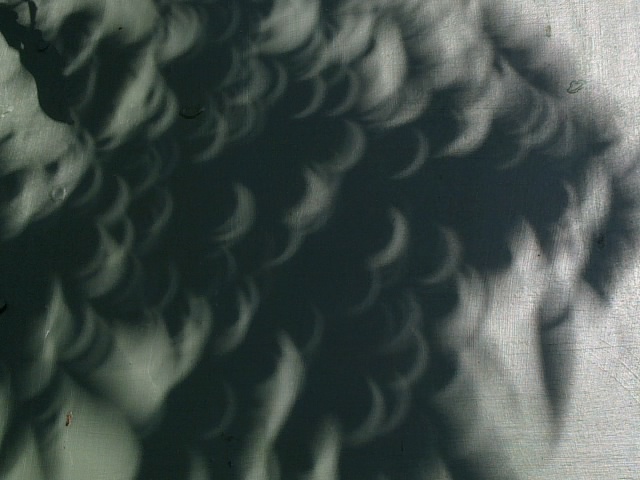
Down where I live in the south of Queensland we didn't get the full view of the eclipse, here it was about 82% or something.

Well everyone is familiar with the images of the eclipse, so rather than post anything more on that I thought I'd show how the light shining through the trees provided little pinhole camera examples all over the place.

141120121105

and closer up to the shadow its even more clear..

141120121107

I just wish Anita was here to see this as she liked this sort of thing

Thursday, 7 June 2012

observation of the transit of Venus

Sorry that this is 'post the fact' but I didn't see the point in putting it up hours before it was going on (or as it was going on) and with the next one scheduled for 2117 its unlikely that anyone reading this will make use of this information for that purpose.

However there are other events that the sun provides which this technique can be useful for and  I think its important for people to realise that scientific purposed aparatus don't have to be complex.

My method used as its basis a pinhole camera method. However my focal length was very long (about 10  meters). Now while this may seem impossibly difficult its actually not needed to construct anything between the camera 'lens' and the projection surface.

Basically I used a mirror outside to reflect the sun back into my house on a wall and looked at the wall.

So my apparatus was constructed from:
  • a mirror I had handy (in the form of one of my wifes powder cases)
  • a grinder disk to give me a starting circle for the aperture
  • a brass washer to stop down even smaller than the grinder disk aperture


This was then mounted to a ruler with masking tape and then mounted onto my tripod with more masking tape.


This was then projected a spot onto my wall where the diameter was about 11cm and the ingres of venus could be seen


So you can do heaps with bugger all if you want to. This fellows pages has many of the basic calculations you need to adapt this technique for observing all maner of solar events.

My point in all this is to try to pull back from the distraction of technology to the core point that it is Physics (and Chemistry) principles that are showing us the basis of the universe. Computers just assist and augment that.