I wanted to try the 45-200 because I have had good results with my previous Canon EF100-300 USM and miss having a zoom at this length. I didn't want to pay the money for this lens when it first came out, so I picked up a
FD 200mm f4 for not much and have been using that for about 10 months now, I like it its compact and optically great.
I will naturally compare the 45-200 to this lens so I thought I'd state that up front.
However its important to put perspective on the fact that the FD 200f4 was bought
just because I wanted to try it
and it was €30, yes that's right peanuts.
I did however want the 45-200 because I think that AF is a benefit. However, since I had not heard much good about it, I delayed purchasing. I recently decided to hell with the expense (and the prices have dropped) and have bought myself a Panasonic 45-200mm zoom for the G1.
There are a few articles on the WWW about it, including some lens tests on
Photozone.de which is a good read if you want a more through examination of the optics. I don't want to go deeply into the sorts of testing they did, but I will mention a few observations, quite likely I'll also do a followup in future with some more testing.
The first thing I noticed about it was just how fat and stubby it is:

its quite a little barrel on the G1 and I can see now why there is so much space just below the flash overhang where LUMIX is written. In fact the lens sits flat on the table exactly even with the camera base. So it sort of makes the G1 look as tiny as it really is.
When you zoom to 200mm the lens extends out of the main housing:

which starts to make it quite comparable to Canon lenses like a
EF 70-200 USM in size and operation
As I've been talking about the FD 200 f4 lens I thought I would compare them to give you something to go by, the lens on the camera:

which you will notice is essentially just as long as the 45-200 is when its being used at 200. Side by side however reveals that as a traveling companion it is shorter (
and 100g lighter) but noticeably fatter.

Interestingly they both share 52mm lens caps, the zoom shows what gets added to allow controls and interior sliding mechanisms. I've left the FD
on its adaptor so as to make the comparison more fair in some ways. Off the adaptor they are quite similar in length. Its a bit like the 45-200 has had a poor diet.
In use the 45-200 zoom operation is smooth and the controls are well placed. I like the location of the OIS switch as its well placed (better in my view than that of the EF lenses I've used) and certainly nicer to move. The manual focus ring is well located and seems to operate well.
This is however a
focus by wire arrangement, meaning that while there is gentle damping to the movement (turning to rather a solid struggle on a -10C cold day) there is little correlation between turning and effecting the focus ...
AF is reasonable but not as fast as my Canon EF100-300 USM which has a ring motor type operation and full time manual. (
Note: that lens is not an expensive L but a reasonable consumer grade lens check it out on the Canon website, but its now discontinued).
I would put AF as being faster than my Sigma 75-300 micro motor lens was but not as fast as the ring motor USM (
careful, they have micro motor lenses which have USM on them but are not the same as the ring motors)
An interesting point emerged when I started to compare the lenses. I have noticed before using legacy lenses that Panasonic applies some funny curves to what it does to the recorded data, exposing
right is tricky to implement on this camera. I'm now just thinking of this has something to do with the camera knowledge of the lenses its using.
I put the camera in Av mode put on the 45-200 set f5.6 and took a shot, swapped out to my FD200 lens and set that to 5.6 mechanically and took another shot.
God dam it the Lumix was darker! Looked at the data, and sure enough it had changed the shutter from 1/6th to 1/25th ... Hmmm ... why did it do that?
Right, I thought, I'll normalize things by using Manual,
and setting each at f5.6 and choosing the same shutter (1/15th of a sec). I was not expecting such differences.
 Quite a bit darker on the Panasonic isn't it
 (
Note: there is some nasty JPG artifacting in the red up there, but that's just the thumbnail blogger creates, click the window into a new window and you get rid of that).
My only view on this is that the aperture is one thing, but the lens transmission is another. This lens clearly drops more light though than the aperture values suggest. In case you are wondering,
T-stops are used in film industry where the actual brightness levels recorded on film are critical. In motion picture the post production crew do not want part of a spool of film to be darker or lighter than another just because a lens was changed. From Wikipedia:
modern cinematographic lenses now usually tend to be factory-calibrated in T-stops. T-stops measure the amount of light transmitted through the lens in practice, and are equivalent in light transmission to the f-stop of an ideal lens with 100% transmission
anyway, to really look at this I thought I'd use RAW and employ dcraw to convert the image, because by carefully selecting parameters I can get consistent results which I can not reliably get using tools like ACR or other plugins (
designed for photographers). Now, unlike the JPG, I can set it to do no colour corrections and do a fixed standard demosiac.
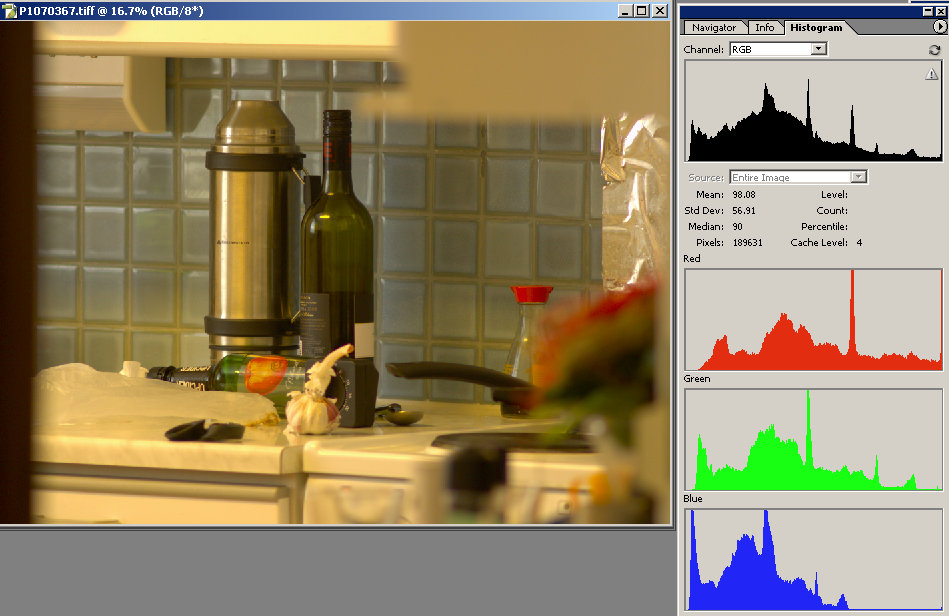
The idea here is to remove anything which the camera may do differently to the JPG. This should sort out if the sensor is getting the same exposure or if it was just curves ... first the FD lens (following the order of above image):

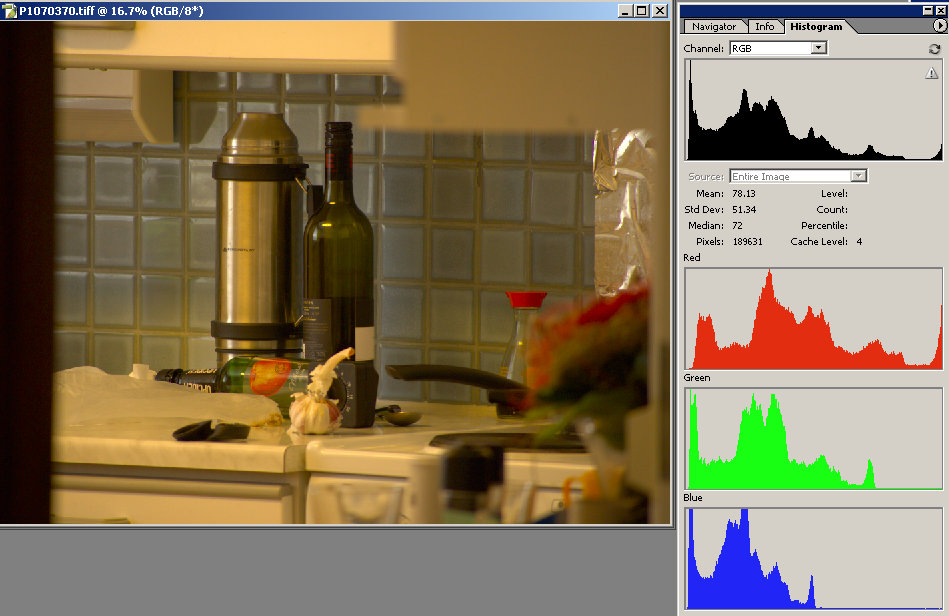
then the Panasonic 45-200

Firstly the colour looks odd because unlike the JPG's made by the camera (using auto white balance) and the light was not a standard colour temperature such as daylight. However even though there is a known standard curve applied to these images, the RAW images are more related to what the sensor captures than the JPGs.
They are still darker, but not as dark. Also you can see the levels difference in the histograms. There is more at work on the rendition of the images than just darkening and lightening. This means that contrast and colour rendition of the two lenses is quite different.
What does this mean
This means (
among other things) that your sensor will be getting less light to use when you pop on the 45-200 lens than using the FD200 mm lens. So even though you might have the same f-stop set on the lens, it will be darker and thus choose a different shutter to compensate.
You might notice at this point that I have done everything on the FD200 at f5.6, there are two reasons for this; firstly the 45-200 is a f5.6 yet the FD lens is f4. This would introduce differencs making comparison harder and so it wouldn't really be as simple to compare them at different apertures. As it happens the FD200 f4 is actually a little soft at f4 but works out nicer at f5.6
For the mega-pixel peepers:

FD on the left and Panasonic zoom on the right. You may notice that there is some chromatic aberration around the edge of the garlic stem (
against the black of the bottle so it stands out), however close examination of the Panasonic image shows a similar blur halo around the edge of the garlic (
contrasted against the black).
Since this raw conversion does not do any lens corrections it means that the Panasonic lens is actually nicely corrected compared to the FD lens. (
The really astute observers will perhaps have already noticed that the FD200 is actually just that wee bit more in tight than the Panasonic is...)
To go some ways to explain why it is darker, consider this: the
FD lens is constructed of 7 elements, while the Panasonic is 16 elements. Think about this for a moment, it means that the light has to go through twice as much glass to get to the sensor.
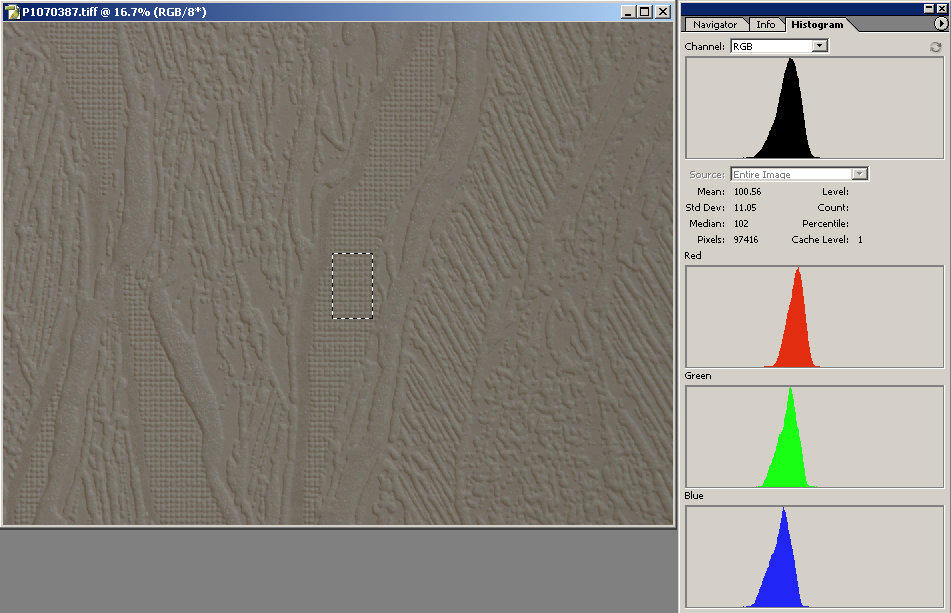
Looking at the above RAW results, I estimate its about 1 stop is lost. But the image is complex, so I thought I'd look at the results obtained by photographing a more simple subject which will also make clear the levels of vignetting occurring.
FD200

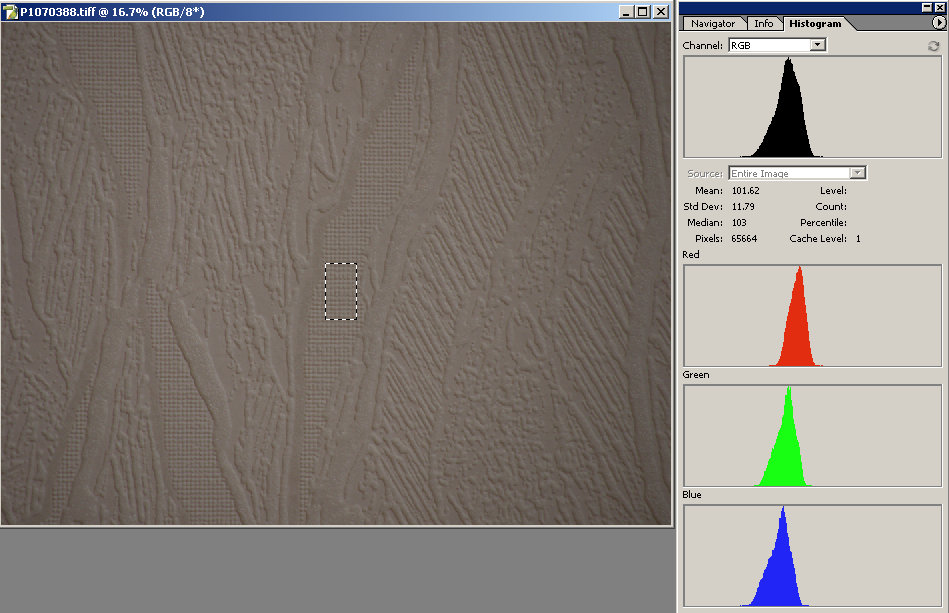
and the Panasonic
45-200

the vignetting becomes clear here (where it wasn't as obvious in the normal scene). I've also selected a small section of the central portion of the image to try to minimize the effects which are clearly happening on the edges. Open them up and check them out, it actually isn't as much as a stop in the middle, but it is more in the edges.
Because the camera corrects for this and evens it out I'm feel that this goes some way towards explaining why the exposures are different.
So while there is loss (
although uneven)
it will mean that the 45-200 will appear darker than the same f-stop on the FD lens.
Perhaps is really going to need that OIS even at the same aperture ... which brings me to the topic of ...
OIS
To check this out I decided that I'd wind up the ISO (
to 1600 in the lighting conditions) so that I could pull the camera off the tripod and use about 125th of a sec. Given that its a 200mm lens I thought that it would indicate if the OIS makes much difference.

The left hand side is the FD200 and the right hand side the 45-200. These are camera sourced JPG files, and I have tweaked the exposure on them to try to get black and white levels similar with just a simple small curve adjustment. The 45-200 image is a little sharper which could be because of stabilization and could be due to focus being better.
I actually took quite a few images more than this, but presented this pair because I feel its representative of what I found;
that the 45-200 is a little bit sharper at 125th sec hand held with OIS and AF than I could get the FD200.
outtakes
Personally I feel that this means that while there are some optical advantages to the FD that the combination of AF (
to get better focus) and OIS (
to help smooth out the shake a little bit)
puts the Panasonic 45-200 further ahead.
Added to this I also think that now the price has come down to something reasonable (
was € 399 I paid €200 for this one) that it is well worth buying.
Next I'd like to look at the AF performance and how it can make use of some of the snazzy features that the Panasonic provides.
PS I was out yesterday in the snow with actual daylight (
gone again today) and took these two with the FD and the 45-200. I think this shows how significantly the vignetting can intrude on images. The FD was at f4 and the Lumix was at f5.6 (
NB both wide open)


those images link to my Flickr photostream, so you can inspect them there a little larger if you wish.