Showing posts with label organizational organism. Show all posts

Friday, 23 September 2011

its life Jim but not as we know it

Understanding living things can be hard. Sometimes things that don't appear to be living can be.

summary


In this post I will argue why we should consider large bureaucracy and corporation as actually living things. They are not actually made of the same stuff that we are familiar with living things being made of, but they are none the less alive. I think its important to understand these creatures, grasp how they perceive the world and perhaps then we can begin understand their cognition.

introduction


I have often argued that people are unable to comprehend what they can't see. We build a variety of tools to enable us to see into things which are beyond our ability for observation in part to allow us to see and understand more.

Microscopes are a good example of this principle. Before we were able to observe the microscopic we had no idea what were bacteria or how much of what modern medicine is built upon worked or that it even existed.

In my blog I occasionally make reference to a concept that I call "The Machine". In this article I will attempt to explain what this concept is. The Machine is not just a mechanism, The Machine is actually a kind of living organism but one which certainly not entirely organic and transcends a couple of layers of conceptuality. This is what makes the concept difficult to grasp and for many it will seem just some sort of fancy.

So what is a living thing? Seems at first like an easy task to identify that which is living and that which is not. I would like to venture a definition; I think that anything which can:
  • make an observable change on the world
  • reproduce
  • make a decision
  • die
is a living thing. Seems pretty obvious, but perhaps many will struggle against this definition set when I apply it in a moment.

How often have you heard some politician or company director or person employed in some role in a company, say
"I didn't want to do it, but I had no other choice in my role"
Quite often I'm sure.

People have struggled for as long as we have written records (and probably longer) to understand what is it that makes a person or an animal alive. The various sciences have grappled with the question and we have uncovered many things about the nature of the bodies of living things to expand our understandings. While we understand much about biology, biochemistry, anatomy and even the electro-chemistry of nerves we just don't know why people are alive or why they die.

In this essay I would like to turn the question around, instead of looking at us I'd like to look at things outside of us, things we can't see but yet like the common cold know exists. We often call them systems.

Lets start with a system called Government.

Once upon a time in history we were manged in less complex groups and had a person who was our leader. We might call this person a King. Eventually the area of power under the control of a King grew too large and he called upon others to administer his authority for him.

This can become so large as to overwhelm the King and others in the system that the King has created. Eventually those who the King gave power to realise that they command more power than the King. So when something occurs to give them reason they can challenge his authority and even wrest power from the King.

Since I'm Australian and since Australian government derives its existence from the English government I thought I'd examine the this history (not because its special in any particular way).

In 1215 members of the King of Englands system Barons rebelled against him and forced him to sign the Magna Carta. This essentially took power from him and imposed a codified system of written ideas called laws.

These laws removed his power to act in any way that he wished and imposed upon him punishments (punishments upon the King!) if he resisted these laws.
a committee of 25 barons who could at any time meet and overrule the will of the King if he defied the provisions of the Charter, seizing his castles and possessions if it was considered necessary(wikipedia).
So for the first time in English history the King, the person who ruled the land according to his will, was subjugated to rules written on paper.

I would guess at this point that some are saying: But these are just rules, just writing, they are not living, they are not something which can constitute as a living thing.

This is true, they are just a set of rules. But then so too are all the chemical reactions which define how our bodies work. These rules of chemistry and physics can also be used and manipulated to effect us and our thinking. Anti depressant drugs are a good example of this.

Lets consider a system with some very simple rules. Imagine a checker board for a game, but one which only has white squares. The rules of our game are simple,

  1. if a checker exists on our board then that square is "alive" and if no checker is on a square then that is "dead"
  2. Any live square with fewer than two live neighbours dies, as if caused by under-population.
  3. Any live square with two or three live neighbours lives on to the next generation.
  4. Any live square with more than three live neighbours dies, as if by overcrowding.
  5. Any dead square with exactly three live neighbours becomes a live square.

This is essentially the rules of the game called Life by John Conway. It seems very simple, just a set of rules or laws governing what happens to the checkers. It also defines a method of spawning new life and a circumstance where death occurs.

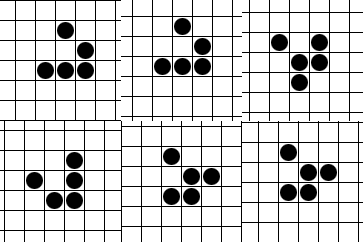
gliderYet from this simplicity of rules comes something which if we represent it as it moves through time we see something amazing. Sometimes things seem to be alive, like the walker represented here to the left.

The graphic at left is an example of stepping though these rules and showing how this "thing" moves across the board in a simple movement behavior. Sure, its not living, perhaps its not even real ... but then when you look at the biochemistry of just one part of your body (say insulin production) that doesn't look alive either.

The same set of rules with enough pieces to act upon can make amazing things. For example:
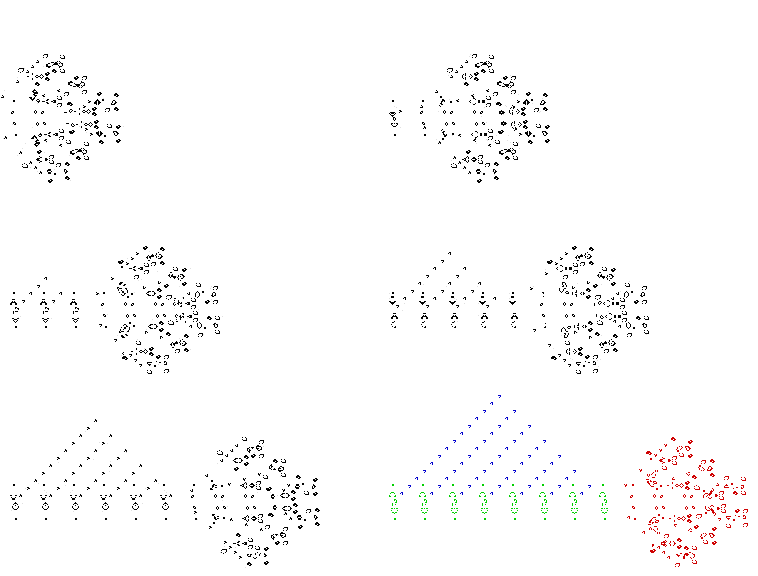
this combination of rules and its effect on the pieces creates a system which is self perpetuating and grows forever.

So is this a machine? Well classically we call things made of metal that use energy and go round and round machines. Stuff like this classical representation of a 4 stroke engine. It used to be harder to think of a machine as being something just composed of rules.

It is in fact exactly that when you look at it from an engineering or scientific perspective. The engine is a collection of the rules of thermodynamics, chemistry and physics.

By applying these rules (collecting things together in the correct manner) we can create a machine.

Since the advent of computers it becomes perhaps easier to understand that a system can in fact be just a collection of rules, after all programing languages are actually just descriptions of what to do and what decisions to make.

Clearly computer programs require computers to operate them and equally our government system requires humans to execute the instructions and do the tasks.

So people have become the base hardware for the machine which we run and execute.

If this sounds like something out of the matrix, or something out of fiction which could not be possible; ask yourself this question:
Can you imagine a person doing something that that don't want to do but have to do it because its their job and that they are compelled to do this by law?

so what about reproduction?


gliderWell consider that the English Government started colonies in Australia, when on 13 May, 1787, the First Fleet of 11 ships set sail for Botany Bay. They intended to establish a colony. That would require governance and that governance was clearly going to be modeled on that of England. The English government had successfully spawned a child. This child then became children with the creation of additional colonies of New South Wales, Victoria and so on.

Eventually some years later these colonies consider unification and the creation of a new governing body; the Federal Government was spawned in 1901.

When it comes to rules for the system to have complex morphology have a look at the list of legislations below, each one of them being far more complex in nature than the simple 5 rules which defined the operation of the "Life" simulation above.

If Government is a living thing then clearly Government is a very complex living thing.

It is not however only Governments which can be considered as living things. Companies too (especially under corporate law) are legal entities; they hold property, employ people, and make decisions.

So it would seem that we already have in our midst an organism which lives, yet does not breath and can not be easily touched. It shapes our lives and controls us in ways which expand with the rules which it creates.

If you doubt this then consider this article in a UK news paper where a child is accused of being racist by calling a boy ‘broccoli head’ and another was said to be homophobic for telling a teacher ‘this work is gay’. The article goes on to mention:
Schools are forced to report the language to education authorities, which keep a register of incidents.

and that
In total, 34,000 nursery, primary and secondary pupils were effectively classed as bigots because of anti-bullying rules.

The school can keep the pupil’s name and ‘crime’ on file. The record can be passed from primaries to secondaries or when a pupil moves between schools.

And if schools are asked for a pupil reference by a future employer or a university, the record could be used as the basis for it, meaning the pettiest of incidents has the potential to blight a child for life.

This does not sound like the sort of reaction a human would have on how to treat their kids but yet this is the reaction that the machine has for sorting us out.

What about this?
Arthur Mills, a fellow of the Royal Australasian College of Dental Surgeons, is accused of causing serious burns to the faces of two patients and superficial burns to another after a drill he was using overheated.
At least one of the incidents was referred to the Dental Council, which upheld the complaint about the burning.
It makes these findings in only 2 per cent of cases but still recorded no reprimands on his registration. He practises with no warning to the public.


It sounds more like a system protecting its component parts rather than something designed to look after humans.

I believe that there are far more examples and comparisons I could make to support my argument that Government and Corporations are actually living things, but rather than do that I'll leave you with a couple questions.

How do you negociate with such a machine?
Will it listen to you?
and can it be directed by human will?

holding the system responsible or even punishment of the system


If we decide that we don't like the party in control of government and we vote them out, does that change the machinery of government or just put it on a different PC?

As it stands at the moment we have very little understanding of this life form. We as yet are perhaps uncertain that it is a living thing, but make no mistake this thing can control our lives, alter the environment and exert influence.

The simple rule based system above called 'life' created stuff not so much different to observing bacteria growth, look again at the list of rules below which form our Acts of Law in Australia and tell me that does not form the basis for even more complex interactions. Combined with the execution on the human computing platform I think its almost certain we have something alive here.


*List of Australian Commonwealth acts (and don't forget the State legislations either!):
* 1901 - Acts Interpretation Act 1901 (No 2 of 1901)
* 1901 - Customs Act 1901 (No 6 of 1901)
* 1901 - Excise Act 1901 (No 9 of 1901)
* 1901 - Pacific Island Labourers Act (No 16 of 1901)
* 1901 - Immigration Restriction Act 1901 (No 17 of 1901)
* 1902 - Commonwealth Franchise Act 1902 (No 8 of 1902)
* 1903 - Judiciary Act 1903 (No 6 of 1903)
* 1903 - Defence Act 1903 (No 20 of 1903)
* 1904 - Conciliation and Arbitration Act 1904 (No 13 of 1904)
* 1906 - Designs Act 1906 (No 4 of 1906)
* 1908 - Quarantine Act 1908 (No 3 of 1908)
* 1914 - Crimes Act 1914 (No 12 of 1914)
* 1918 - Commonwealth Electoral Act 1918 (No 27 of 1918)
* 1928 - Transport Workers Act 1928 (No 37 of 1928)
* 1938 - Passports Act 1938 (No 15 of 1938)
* 1942 - Statute of Westminster Adoption Act 1942 (No 56 of 1942)
* 1948 - Australian Citizenship Act 1948 (No 83 of 1948)
* 1958 - Migration Act 1958 (No 62 of 1958)
* 1959 - Banking Act 1959 (No 6 of 1959)
* 1960 - National Measurements Act 1960 (137 of 2008) [1]
* 1961 - Marriage Act 1961 (No 12 of 1961)
* 1968 - Copyright Act 1968 (No 63 of 1968)
* 1973 - Insurance Act 1973 (No 76 of 1973)
* 1973 - Seas and Submerged Lands Act 1973 (No 161 of 1973)
* 1974 - Trade Practices Act 1974 (No 51 of 1974)
* 1975 - Racial Discrimination Act 1975 (No 52 of 1975)
* 1975 - Family Law Act 1975 (No 53 of 1975)
* 1976 - Federal Court of Australia Act 1976 (No 156 of 1976)
* 1976 - Aboriginal Land Rights Act 1976 (No 191 of 1976)
* 1980 - Crimes (Taxation Offences) Act 1980 (No 156 of 1980)
* 1982 - Freedom of Information Act 1982 (No 3 of 1982)
* 1982 - Taxation (Unpaid Company Tax) Assessment Act 1982 (No. 119 of 1982)
* 1984 - Sex Discrimination Act 1984 (No 4 of 1984)
* 1986 - Income Tax Act 1986 (No 108 of 1986)
* 1986 - Human Rights and Equal Opportunity Commission Act 1986 (No 125 of 1986)
* 1986 - Australia Act 1986 (No 142 of 1986)
* 1988 - Extradition Act 1988 (No 4 of 1988)
* 1988 - Financial Transaction Reports Act 1988 (No 64 of 1988)
* 1988 - Australian Capital Territory (Self-Government) Act 1988 (No 106 of 1988)
* 1988 - Privacy Act 1988 (No 119 of 1988)
* 1988 - Higher Education Funding Act 1988 (No 2 of 1989)
* 1989 - Lands Acquisition Act 1989 (No 15 of 1989)
* 1990 - Patents Act 1990 (No 83 of 1990)
* 1991 - Social Security Act 1991 (No 46 of 1991)
* 1992 - Disability Discrimination Act 1992 (No 135 of 1992)
* 1992 - Radiocommunications Act 1992 (No 174 of 1992)
* 1993 - Native Title Act 1993 (No 110 of 1993)
* 1996 - Workplace Relations Act 1996 (No 60 of 1996)
* 1997 - Telecommunications Act 1997 (No 47 of 1997)
* 1997 - Euthanasia Laws Act 1997 (No 17 of 1997)
* 1998 - Charter of Budget Honesty Act 1998 (No 22 of 1998)
* 1998 - Native Title Amendment Act 1998 (No 97 of 1998)
* 1999 - Federal Magistrates Act 1999 (No 193 of 1999)
* 2001 - Corporations Act 2001 (No 50 of 2001)
* 2001 - Intelligence Services Act 2001 (No 152 of 2001)
* 2003 - Intelligence Services Amendment Act 2004 (No 57 of 2004)
* 2004 - Corporate Law Economic Reform Program Act 2004 (No 103 of 2004)
* 2004 - Australian anti-terrorism legislation, 2004, incorporating:
o 2004 - Anti-terrorism Act 2004 (No 104 of 2004)
o 2004 - Anti-terrorism Act (No 2) 2004 (No 124 of 2004)
o 2004 - Anti-terrorism Act (No 3) 2004 (No 125 of 2004)
* 2005 - Anti-Terrorism Act 2005 (No 127 of 2005)
* 2005 - Repealed Workplace Relations Amendment (Work Choices) Act 2005 (No 153 of 2005) - (Repealed by Parliament, 2008).
* 2009 - Fair Work Act 2009 (28 of 2009) [2] (Passed as Replacement to repealed Act No 153 of 2005)

Friday, 18 June 2010

the Great Australian Sickie

one of my observations of the corporate (and government) world is that it is essentially a machine, rather like a computer. The software is the rules that govern it (often inflexible) and the hardware is the human resources which execute the program. If you doubt this view, let me quote from a recent job spec which I reviewed.
Agencies are asked to provide a maximum of one candidate, which has been personally interviewed. The efforts of agencies to comply with this request will be noted gratefully.
The following information should be provided as part of the quotation:

  • Application addressing the Key Selection Criteria (above)
  • Resume of the proposed resource
  • Hourly/daily rate for the proposed resource
  • Indication of earliest possible start date
note the use of the word resource there ... not contractor, not person ... resource.

With this in mind (from the night before) I read this article in the Australian which goes into descriptions of how the sickie is costing companies "$30 billion in lost productivity for the economy a year from casual and genuine sickies"

Heaven forbid we take genuine sick leave. The article wastes no time in suggesting:

“It seems to be getting worse,” says Paul Dundon, CEO of DHS, one of the growing number of companies set up to help employers manage absenteeism in the workforce.

Interesting, companies set up to manage absenteeism ... so now the machine is employing the equivalent of Lymphocytes to weed out this infection of productivity within the system.

Paul goes on to suggest that:

His latest research has found Australians now take off an average of 9.3 sick days each year, a 7.9 per cent rise from two years ago. That compares poorly with the UK’s average seven days and the US’s six.
So, we compare poorly with the USA or UK ... why them? I wonder about how we compare to other developed world nations ... perhaps in the EU?

Has anyone here ever heard of what a meat grinder it is to work in the USA or that Australian productivity was higher than the USA??

Perhaps there is a reason productivity is higher here ... we were already working happier, and perhaps working smarter?

Anecdotally there is plenty of evidence that this "pressure" to be productive is not working, as I'm sure we've all seen stuff in emails which shows the amount of discontent over this situation.


Which inevitably involve the boss hiring many middle tier management who seem to make everyone unhappy and bring little value to the organizations other than to report on the ant. The Ant inevitably leaves.

This is not a new theme in culture as even Australian movies such as Spotswood are based in the critique of this, and expresses the difficulties of marrying scientific management principles to an actual community of people.

Yet strangely this seems be not understood by management? The article above has a wonderful quote in it from a Peter Gleeson (executive general manager of recruitment):

The reasons for the rise in absenteeism, as well as companies becoming less vigilant about checking up on workers, include employees being burnt out by heavier workloads shouldered during the financial crisis. “Many don’t have the same loyalty to their organisation as they did when times were tough,”


Perhaps when he refers to tough times he means when it was a sellers market on the jobs market ... meaning it was tough for the companies to find staff.

When times were tough to staff in the most recent GFC I don't recall loyalty being mentioned when it was time to sack people. I personally have lived and worked through at least 2 boom and bust cycles where it has gone from being bloody hard to get a job to jobs are available. One thing I noticed in this experience is that when the market favors employees that companies are tying to get you to believe in them, believe in loyalty ... work towards building a better place. When the shoe is on the other foot however you find no such lamentations of loyalty when they're sacking or laying off. (unlike the company owner in Spotswood ... its a good flick, but clearly a fiction)

Perhaps its time that a little ethics entered the programming of the machine?

I seriously wonder who this article is aimed at ... its surely not the workers. Perhaps its aimed at small business ... however they are the ones who normally have the biggest problems in affording staff and have other issues. All the examples mentioned in the article are not small business, so it must be either "patting themselves on the back and convincing their other mates its all OK" or some lame attempt to appeal to the workers (who are getting screwed often enough with iterative productivity pushes, work smarter, how can we save money, do more with less and please take more overtime requests).

The last line from this apparent stream of pro business propaganda is this perl:
“If people are off work for long spells, it can then be hard to get back to work,” Mary Wyatt, chair of the AFOEM’s policy and advisory committee, says. “If they take 20 days off, the chances of going back to work are just 70 per cent. Seventy days off and they’re down to just 35 per cent. And the health consequences of being off work for long periods are up there with smoking and work in dangerous industries like oil and forestry.”

In case you're wondering, the AFOEM seems to represent the Australasian Faculty of Occupational and Environmental Medicine.
I can only hope that Mary is a "full blown - away with the pixies - out of touch academic", because what she is saying is that if you are off work for as little as 2 months you have a 35% chance of getting a job again. Looking at the figures she presents you drop from 70% chance of going back to work after 20 days to 35% after 70 ... this trend suggests if you're away from work a year you'll never get a job (with chances of going back to work falling to zero %).

If this is true, then its nearly a national responsibility for companies to never sack a worker ... as they would never again be able to return to work.

Having spent 2 years unemployed and actively looking for a job in Finland I can say that if she thinks people want to remain unemployed then she's way out of touch with reality. Not being able to speak Finnish made getting a job very difficult for me in Finland, but that did not stop me trying. When I did get a job (a technically demanding position in a reasonably high profile organization) I was not only pleased, not only put in great efforts but performed so well as to exceed my employers expectations.

So either I'm a statistical outlier or the people above are full of 5hit!

With people like them forming the eyes and ears of the organisational machine it seems almost inevitable we have these boom and bust cycles which are only bad for the community and in the long run bad for business.

So the remaining question is ... how do we solve this problem?

Thursday, 7 January 2010

prime ministers and books

Paul Keating is certainly one of the more divisive names in Australian politics, finding someone with no strong opinion on him is to find someone young enough to have never known him. But as a Treasure and later a Prime Minister of Australia he was not only highly significant in Australian economic reform, but was extraordinarily well known and respected through out Asia.

Kevin Rudd is our present prime minister, and I think that it goes without saying that he is a formidable debater with a keen eye for detail. However I genuinely feel that he lacks the sort of "stuff" of which Paul Keating was made.

Perhaps he does know quite a lot about China, but knowing and having experience in something is not quite the same as being respected by the leadership of those places.

I read today that Kevin is writing a book ... Paul wrote a book too.

Paul wrote a book called "Engagement: Australia Faces the Asia-Pacific" while the title of Kevin's book is yet unkown that its a"kiddies' adventure story about the PM's cat and dog will be published this month."

Paul publishes the first chapter of this book on his website here. I encourage you to give it a read.

I personally think this underscores the difference between politicians and politics between the 90's and now.

I was in Japan in the time after Keating, so I knew first hand what his influence was. At that time I was more or less still naive about politics (both Australian and International) but it didn't take me long to comprehend there was more behind the man than calling protesting students "Scumbags" and talking about "the recession we had to have".

I fear we are moving into an age of "democracy" where our "leadership" are little more than professional poll and voter mood watchers. Few seem to have ideals which they make public.

When was the last time you voted for someone who you really felt represented you?

So now I think the time has come for us to look closely at the machinery of government and legislation and get that legislation more in line with our community and its needs. The legislation is the "source code" for the machine of Government and the politicans are simply the agents who execute that code.

I think we should all get involved in a code review.

Friday, 27 November 2009

ants (vs human organisations)

One of the interesting things about Ants is they remind me of people

antNestThey build their little city close to nice places and all scurry around doing what the hive needs.

Its sort of fun to watch them.

They scurry about busily, with seemingly no specific purpose. When working alone they can be carrying something back to the nest or carrying something out of it. Work is clearly getting done.

In groups it all seems to break down, with what seems to be an uncoordinated tug of war in all directions.

Eventually the item seems to get back to the nest (despite) all their efforts.

Strange thing is, no matter how disorganized it looks they are really quite successful creatures. Each ant may have totally no idea, but the hive does well

Reminds me a lot of people.

Like this week ... after spending some months working on a database project it appears that the other part of the organisation has decided they can't coordinate themselves properly and have instead gone with each member of their team putting data into a spreadsheet. Essentially leaving me with the leaf ripped out of my mouth after some struggling with pulling it in the right direction. It remains to be seen how much better their direction is ... Glad I'm not the one putting that together later ... mean time I've picked up something else and I'm wandering around with that in my mandibles.

In contrast to Ants (and our organisation), White Ants are quite organized creatures. These cool little guys normally eat decaying tree in the natural environment (and people's Homes in the urban one ;-)


whiteAntsTrackYou won't see them easily in the wild because they can not tolerate extremes of humidity and UV.

So they live inside their food and construct sealed environment walkways between food sources and their nest.

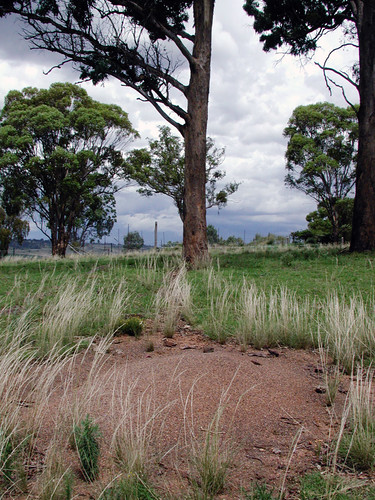
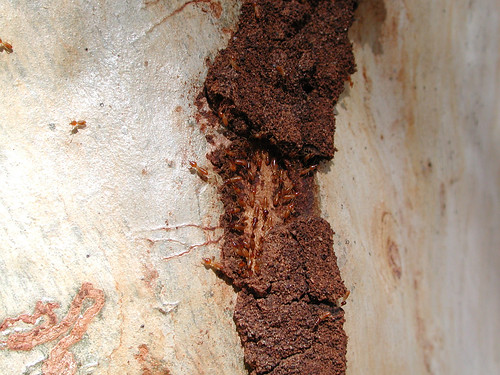
These are really hard to spot as they're made of chewed up wood pulp and blend in nicely, but on the trunk of this white Gum (Eucalyptus) their track stood out clearly.

I thought it would be interesting to give them a little challenge, so I made a small bit of damage to this walkway roof, exposing the interior.


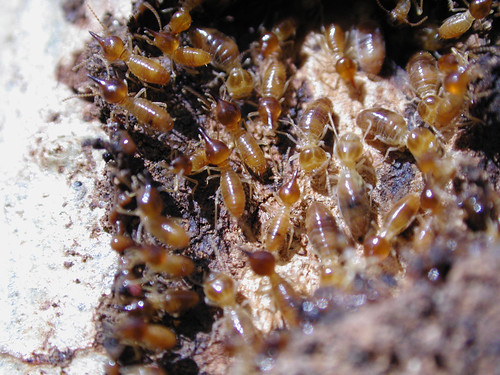
whiteAntsFairly instantly they all set up a guard and protect the gap in their tunnel.

Notice the fellows with the pointy heads? They are quite different to the other ones there which have jaws.

Quickly they set up a strong defense perimeter but do not go beyond it ..

They are quite specialized creatures, some being defenders others being workers.

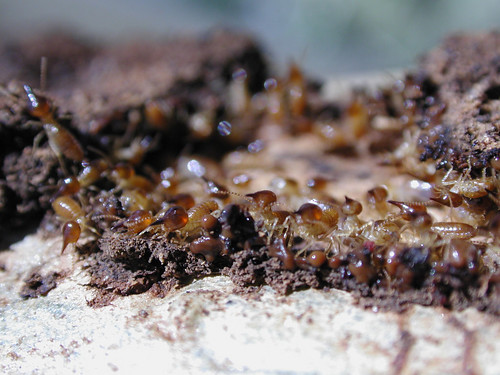
The fellows with jaws are the workers, and you can see that soon after the defense is set up they emerge and begin repairing the breech in their system.

In the image below you can see clearly the guard ants (with their antenna spread wide to sense any movement or smells) with the workers in below them already chomping and spitting up chewed wood pulp to rebuild the damaged wall.

whiteAntsBuilding

Quite a good system they have ... no wonder they're so successful.

Monday, 5 October 2009

measuring bullshit

And on the topic of "the machine" gone spakko is this article:

CLAIMS that cattle and sheep are responsible for 10.9 per cent of Australia's greenhouse gas emissions have been called into question after scientists discovered considerable variation in the amount of methane produced by individual animals.

right ... but we're not talking about cars here, we're talking about our food. Seriously government bodies can live without food but isn't the health of people who make up the system more important? The system seems not to think so.

Perhaps if we just ate 20% less meat (might be good for us) we could make a bigger per captia reduction?

An earlier study by University of Melbourne researchers found methane emissions varied from 146g an animal a day in a Victorian feedlot to 166g an animal a day in Queensland.
well, if you look at the feedlot issues in the USA (corn fed beef) I think there is more at issue here than managing numbers. Health issues of what our food does to us seems to be left out of the picture here, and meeting 'target numbers' is paramount.

sheesh

does the machine make a good parent?

for the greater majority of human history parents and extended family have been raising children, more recently laws intended to prevent children being abused by parents has created the basic environment for the machine to grow into the Nanny state that it is becoming. I'm surely not the only one to express this problem as I regularly hear it from those around me and read things on the net to similar sentiment. Reading this article in the Australian

A 13-year-old boy has been charged after an 11-year-old boy was shot in the leg with a stolen firearm.

The article sounds really bad with stolen firearms, sounds like some kind of US gangland stuff, I'm sure htat to someone who has grown up and only lives in the city this may be hard to comprehend but examining the article a little further a picture emerges of just some naughty boys who probably just needed their asses kicked by their dad ... should they have had a responsible father figure.

Police say four teenage boys broke into a property at Coolagolite, near Cobargo, on the New South Wales south coast, some time between Friday and Sunday.

They allegedly took four firearms and ammunition from a gun safe and fired them while at the property. The 11-year-old was wounded while the boys were shooting yesterday. He was taken to Bega Hospital and later flown to Canberra, where he is in a stable condition after further treatment to the entry and exit wounds in his leg.

So essentially 4 kids (probably bored) broke into somes house (probably not locked) and pinched some guns to most likely shoot at road signs and peoples water tanks. Definitely this is wrong behavior and without a doubt needs to be dealt with ... but remember these are kids, so why is the "machine" of the law dealing with them as if they are adults...

A 13-year-old boy has been charged with reckless wounding, aggravated breaking, entering and stealing, and possessing and using a firearm. A 17-year-old boy and a 12-year-old boy have each been charged with aggravated breaking, entering and stealing, and possessing and using a firearm.

All three have been granted bail to appear at Bega Childrens Court on October 27.
Seriously, do they even understand the words? Why is there no mention of parental responsiblity here? Surely the parents are responsible? Well perhaps not ... the machine is taking away our rights as parents making control or disciplin of children a vexed issue. I don't have any answers for this (certainly not in this blog) but I'll leave you with a question: are we moving in the right direction? I think not, because one thing is sure about Governments, noone thinks of them as efficient or compassionate. Both things which kids need. Now if you don't have kids of your own this still effects you if you're a taxpayer. Why? well ... from another article ...
WESTERN Australia's juvenile justice system is in crisis and desperately needs more resources to reduce the number of children being detained, according to the head of the state's children's court.
So, as soon as we shift the burden of and responsibility for child rearing away from the parents we must put it in the hands of Government. Have you ever dealt with anyone who was a "ward of the state" ... Tough question, but we need to start thinking about and talking about this in a meaningful way in our society or we'll be heading for another Brave New World. Remember ... with rights also comes responsibility, we seem to be ditching on one and wondering why the other is being eroded.

Something to ponder


Thursday, 9 October 2008

The Machine

every now and then something happens which reminds me of the difficulty of dealing with "the machine", and how being part of the machine turns nice people into ... well ... machines themselves.


If you've ever read The "BIOLOGY OF COGNITION" by Humberto R. Maturana you might be more comfortable with the idea that evry organisation is perhaps also a kind of living thing, an organizational organism.

Since the organism does not really exist (only its rules and governance policies), we tend to see only the people themselves who form the substance of the machine. Yet these people (while in their roles, following the rules which are its stuff) are not only doing the work of the algorithm that defines The Machine they are also giving it an ability to interact with the world (our world) and function.

Normally people are oblivious of this fact, but occasionally "things happen" which bring it to your attention. You might have had a clerical error in an accounting system in a large organisation or had a moderator remove your post from a list. If you don't think of it in these terms its easy to get confused and think that some person is causing you trouble. After all, we're all people, we're used to dealing with people, and its a person we see who is representing the organization. A good example of this is brought up in the documentary "the Corporation" (if you have not seen it I recommend it).

A classic example of this is Terry Gilliams movie "Brazil", in which the 'hero' finds himself fighting against people who are just regular policemen and civil servants carrying out their duty dispassionately, and unaware of why it is that anything is wrong.

So when problems occur, the people who are parts of the machine appear to take a contrary stance to another person. Their personal reactions cause them to feel uneasy in being contrary to another person (whom they often don't know) and so they react defensively by "sticking to the rules" (which compounds the situation).

Conciliation and compassion go by the way and we find that previously smiling neighbours can become our hated enemy. At times like this its hard to maintain composure and not feel something against that person who (now) represents the organizational organism and not just a person we know.

The temptation to "rage against the machine" is high. But just as the officials in Brazil aren't guilty of torturing an innocent man ("I got the wrong man delivered to me as the right man ..."), you have to remember that the representatives of the organizational organism are also bound by their association with it, and can be duly punished b it if they don't follow the rules. The reverse however is not true, we as humans have no way to send any message to the machine by punishing it, for it can't feel or perceive that. All we can do is perhaps reprogram the machine (which is much harder than it sounds).

I believe that the root of the problem is that the organisational organizations need to learn how to structure themselves to allow their people to be people and perhaps we'll get along better.


PS: I just found (March 2018) that a quote from a book I read many years ago may have indeed spawned this theory:
“A government is a living organism. Like every living thing its prime characteristic is a blind, unreasoned instinct to survive. You hit it, it will fight back.”
– Ben Caxton (Robert A. Heinlein, Stranger in a Strange Land)

Same is true of sufficiently large corporations. They are all living machines just running a program (their corporate system) like a cell runs the program of its biology. Further reading on that topic in my article Its life Jim but now as we know it.