Showing posts with label musing. Show all posts

Thursday, 4 January 2024

Happy New Year

Well its just into the New Year and I'm reflecting on a busy year gone, not sure what the new year will bring, but today I went out for a nice afternoon ride (late to avoid the heat) on the SR


Aside from some watch wanking, I've managed to complete or tidy up a few projects, not least of which was finally finishing off the rebuild of the front end on the T-Max


which included:

  • wheel bearings
  • full brake caliper rebuild
  • fork rebuild
  • steering head bearings
  • new tyres
Basically I already know how much of a PITA it is to do the steering head bearing (not least because of all the tupperware that needs to come off) but because of the length of the steering head tube. I've more or less perfected this now, as I've done it once before on my last T-Max

Have also bought two other motorbikes and sold one of them (so leaving me with the T-Max and the SR500). I'm probably going to be doing some work to the SR500 soon, so now that the T-Max is back together (and riding very nicely) I can perhaps swap which bike is in the spot.

Solar floor heating system is now looking more modular and we'll see how well it "goes back together" come May.

I consistently enjoy having my workshop and all the experimental learning that making it has brought.

The INR management book was written but I've not published it formally yet due to concerns about possible liability (and a lack of liability insurance), but I'm hoping to get something happening this year with maybe some clinical trial.

I sent this "cover idea" to a friend who's returned a cover based on this which I like more. But I also like this title.


Still, I'm told it sounds too geeky to sell well, and ... well I don't want it to sell to people who aren't just that bit geeky anyway. It is by nature "not for fools or idiots".

At the very least I feel I've learned a quite few things this year, improved my skills in some areas, and perhaps most importantly found myself more adjusted to my "new life" without my wife. So, what's that, over 11 years, under 12.

Looking forward to what will happen in the year before me, well I just don't know. I don't actually have any plans.

Lets see what happens.

I hope you have a healthy, happy and enriching New Year

Thursday, 19 December 2019

Scooters in Retrospective (where are we going)

... and indeed where am I going?

Back in 2009 I worked in an office which was a significant walk from the train station, and as it happened largely down hill (mostly gentle, mostly). I decided to buy a kick scooter to get from home to station and station to office. I wanted something with decent diameter wheels (200mm) and got this little fella for €50


it served me well and I used it for quite some time with no issues (even solved the wet and grit throw-up at the back with some duct tape)

Then just this year, I started back at an  office where I wanted to "shorten the walk" and a scooter immediately came to mind, I bought this little fella which was more or less identical and for about the same money AU$70.


but perhaps has less heavy duty "everything" because the bearings collapsed after less than a week of my usual scooter treatment. Certainly the spokes look less substantial and the PU "tyre" feels harder than I recall the other being.

Anyway, I promptly replaced the bearings, but (due to a knee ligament injury on a trampoline (don't ask)) began considering something I didn't have to kick and soon settled on the Mercane 500W single motor (although seriously considered the dual motor 1000W version, which I subsequently ended up buying...) pictured here beside my little kick scooter.


Quite a difference in so many ways (including price).

Much nicer tyres, which are a composite of foam and a pliant grippy rubber, and some suspension too to help reduce the impacts to critcal things like bearings, axles (which are hollow on electric scooters with hub motors) and perhaps even you.

I notice now that people are King Wang'ing on about "comfort" (as if these things were like luxury cars). Probably these people have never ridden a kick scooter (or have forgotten what it feels like with actually solid tyres).

I had to move my (sadly now disused) little black kick scooter and thought how small it looked. Picking it up I nearly laughed at how light it is. Quite the contrast in relation to my 1000W dual motor Mercane.


So while my little kick scoot would comfortably fit into an overhead rack on an intercity train my dual motor Mercane would certainly not (and something may well get broken were I to try shoving it up there).

Recently I've started serious investigation into buying a Zero 10x ... which is even heavier than any of these scooters. It goes like this:

  • Evo = 5kg ($60)
  • Mercane 500W = 19kg ($1000)
  • Mercane 1000W = 23kg ($1400)
  • Zero 10x = 36kg (for the 24Ah model) ($2700)
*(prices in Australian Dollars)

It was not that long ago at all when electric scooters were like this:

*(wikipedia image)

So, what else can I do with $2700 (or more), well actually I could buy a pretty decent 500cc motorcyle with low kilometers on it for less than the price of the Zero, like say one of these:


Which will do many thousands of kilometers, last for many years (my Yamaha is already 12 years old with 125,000km on it) and be able to take you out all day, tour, commute and carry a friend too.

Better yet there is another sort of safety in motorcycles; rego and insurance (which the kiddies will squeal and shriek about), which is mandatory on motorcycles and cars. While this may seem like an "unnecessary expense", it will mean that if you're in some sort of accident (it won't happen to you right, err, unless you're one of the kiddies justifying a full face MTB helmet, elbow pads, body armour and other cos play wankery, then its inevitable) then you'll probably find that the $200 per year you paid in insurance is cheaper than forking out for that multi-thousand dollar car door repair (which you'll be blamed for because the cars insurance company will sniff out you are not in a good position to defend that) or worse yet, you hurt a person and be liable for hundreds of thousands for personal injury.

Doesn't sound cheap to me (and is the reason we have laws around vehicles to prevent cheap scates from leaving people at a loss) ...

All this has me wondering where I'm going with this and if I'm trying to make the Electric Scoot into something more like a motorcycle, and indeed if it actually even is?

Myself I think the sweet spot is somewhere around the zone between Xiaomi 365 and my Mercane.

Dunno ... I'll keep you posted on what I choose to do.

PS: I found this review of a Zero 10x on Reddit, this guy seems to think like me.

Monday, 24 October 2016

The Mote in God's Eye (not quite a book review)

As it happens I grew up reading SciFi and Larry Niven was one of my favs (as indeed was Arthur C Clarke, Asimov and some others).

For one reason or another I never got around to reading this book until recently (like on the flight over to Finland).

I think it was Arthur C Clarke who said that futurist writers often fail by making predictions too wild or too conservative.

Living as we do in the period leading up to 2019 its hard to imagine that we'll have anything like the technology that is explored in Blade Runner.

The Mote in God's Eye sets itself far into the future after the rise and fall of an empire of humanity and into a time where humans are living across parts of the galaxy connected together by "tramlines" (or wormholes by another name).

They sidestep faster than light travel neatly by using this "time space" effect which is kept (wisely) nebulous in nature, but related to stars (and presumably their gravity distortions).

What I found most interesting was not so much the story (which isn't bad, but typical to Niven the character development is poor) but the concepts that occur in the book. Indeed I'm not entirely sure if some of these were accidental or intentional.

The first that stood out to me was the "pocket computers" and the descriptions of how they would actually reference material stored on the central computer, although it wasn't stated how, it was implied by radio. Quite interesting when you consider that  this was written in 1974 and the earliest computers which were considerable as "pocket" came out 10 years later (like the Sharp PC-1401)

The Sharp was only programmable in BASIC and had a puny amount of memory and certainly nothing like WiFi or 4G connectivity. Even WiFi as a protocol would not emerge for decades later, but Jerry Pournelle would surely have been exposed to Packet Radio protocols where data (at drearly slow rates) was sent by Radio.
What I liked even more of his imagination touch (I assume it was Jerry) was the addition of a touch screen on the device (thinkfully not described clearly) and the whole thing came out as reminding me very much of current emerging devices such as the current Android devices like the Galaxy Note series.

This sort of stuff would have been barely imaginable to most back even 20 years ago when exposure to technology was much lower. Heck even my Palm Pilot (which I bought in 1997) was barley understandable to many around me and it wasn't even the first such device I'd used (which was an Apple Newton pictured here beside an iPhone released nearly 20 years later).

Clearly these guys were not only visionary but also well acquainted with what was actually happening in the world. Yet (as Clarke observed) this sort of thing is a failure in imagination, and in some ways dates the book to a modern reader. Its both nice and at the same time quaint.

Imagine where computing and portable computing will actually be in a thousand years? It makes me think that for the general public you can't be too imaginative because they just won't grasp it.

The next thing that I found interesting was the Moties themselves. If you haven't read the book and intend to, stop reading this now, if you want a quick summary try the Wikipedia entry about the book here.

After reading the book it occured to me that the Moties were actually not a natural species of their "solar system" but may indeed have been just the ultimate expression of technology of their creators. I don't know of Jerry or Larry intened this, but there are enough pointers through out the book to make is a possibility that the original Moties were all dead and just their genetically engineered creations remained (a bit like the story by Ray Bradbury).

The original "Moties" (presented briefly in one small paragraph in a museum) seem to have vanished. Perhaps they developed genetic engineering and electronic technology to such a level as to have made biological robots (not unlike the Replicants in Blade Runner) which were able to do tasks with an effectiveness that modern robotics can only dream of (in stories such as I Robot). Indeed I'd go as far as saying could never attain, because when you consider how fuel efficient a biological creature is you would have to agree that making a mechanical machine VS making a genetically engineered living creature would of course be ineffective , power hungry and be clumsy.

Now this is not to say that these Moties didn't use machines, its clear reading the book that they do, but rather than build in automation to their machines they themselves (the lower castes like the browns and watchmakers) were the comptuers which drove them. The inclusion of a "Brown" with almost every machine is very suggestive of this.

The specialisation of the "current" Moties (much like insects or even humans within Aldous Huxleys' Brave New World) was also a further que to me that these were a bunch of biological robots (or may I call them biobots to coin my own term) intended to perform specific functions. These then took over doing things entirely after their "masters" became extinct.

Its a tantalising question if the original Moties were wiped out in their own nuclear wars, or if indeed their own biobots were responsible for their over throw (in much the same way as the machines in the Terminator series).

Lots of good material for the imagination in the discussion of what's implied in this book, more so than just whats written.

Lastly I wanted to mention that the allusion of the fate of actual Humanity is touched upon in the contrast (and parallels) between real human history (us being stuck on this planet in this solar system) and the Humanity which is discussed in the book (that of the space faring race able to move between solar systems via wormholes and having survived for another milennia (and the book is set in 3017 sot its timely) look at the Motie who have survived for (perhaps) hundreds of thousand of years (certainly 40 or 50 thousand) in an unending cycle of growth and collapse ... or boom and bust.

Reminds me of the works of John Calhoun in his work "Mortality-Inhibiting Environment for Mice: a practical utopia built in the laboratory"

Makes one think about what will happen for us.

Tuesday, 30 March 2010

the naked truth

meaning naked as in uncovered ...

For ages there has been something separating digital photographers from film photographers. People don't often even know its there and those who do often don't even remember its there.

In management we talk about glass ceilings that prevent advancement, but in digital photography I'm wondering if the glass ceiling is indeed all the filters.

These are required to prevent the ugly aliasing effects which are associated with Bayer arrays or the heavier filters applied to prevent the sensors from seeing IR (which will disturb the colour as we perceive it), where they are quite sensitive, and to further limit the spectrum to Red Green or Blue as each respective sensor needs to be to assemble colour from the Bayer Array.

In my recent post about the 2010 Shootout I had some thoughts about this issue, and some of the comments I got reminded me of another digital camera of the distant past which seemed to side step many of these issues and take advantage of the technology with a different philosophy and design criteria.

That was the Kodak 760M camera.

Back in 2004 the above review of this camera made a simple statement which seems to have become lost:

Without an anti aliasing filter and no Bayer color matrix, the resolution of a 6 mega pixel monochrome camera is astonishing. In monochrome, 6 mega pixels effectively does what it takes 12-24 mega pixels with a color matrix


So forgetting for a moment any of the issues of how many more megapixels we can cram into a sensor, think for a moment about how much light is lost putting the sensors behind all those filters. Think about it, its well documented that a Wratten 25A deep red filter kills 3 stops.

In fact in that above review of the "special" Kodak camera (nothing more special than not munging up the sensor) Pete Meyers found his ISO was way way higher than he expected:
Correct exposure for my work meant not clipping the whites. I ended up in shock at watching exposure times go from 1/60 or 1/125 of a second with my Leica M6 and film, to 1/800, 1/1200 and even 1/1600 of a second for the same aperture with the DCS 760m. With a base ISO of 400 exposures times are brisk – another advantage of a digital monochrome over a color based sensor.

very interesting, thats a 3 or 4 stop increase.

So (if you ask me) the cost of colour digital is we get sensors which are 1600ISO but if you could just filter IR out and get rid of the other crap (I've got an IR filter anyway, and I'm sure Leica M8 users are familiar with using one too) we'd have black and white digital cameras which would give us jaw dropping image clarity and be equivalent to 12800 ISO all with existing technology.

Considering that Canon and Nikon are already putting out sensors which are 12,800 ... well that's 102,400 ISO imagine the stage photographer's joy of being able to use fast shutter speeds or even stop down a little to get better contrast.

The mind boggles ... so you guys in at Nikon and Canon, try to keep in mind that not everyone wants colour and munged black and white..

Sunday, 28 March 2010

the 2010 shootout: a brief review of their review

Show me an artist who knows nothing about their materials and I'll show you a poor artist.

So when people wonder just why the hell do I waste my time understanding my media I don't mind, clearly they don't know much about how to work with anything.

As a photographer we rely on media which now more than ever is changing rapidly, as a photographer I want to be able to make the best "go" at capturing something fleeting I can. Knowing my materials is critical to this.

So from time to time I examine what I have and what's around and try to see if I would benefit from this or that and how.

One of my friends recently pointed out this comparison to me
http://www.zacuto.com/shootout

which is a more detailed analysis over a greater variety of digital SLR cameras and a couple of films.

These guys did a world class job, working with the worlds best and showed their results to top cinema photographers. I encourage you to watch that video ... its a little 'long winded' but worth 30 minutes of your time.

Some things I observed from it, which I think seem to coincide with many of my own observations over the last year of examining my Panasonic G1 and film.

Now the purpose of their analysis (being cinematographers) was on colour rendition and contrast response to lighting (shadows and highlights).

I don't want to regurgitate their findings here, but I'd like to point out some things which I noticed and was not clear among the points which they brought out

First, looking at the the two film stocks (which of course are their reference as cinematographers)


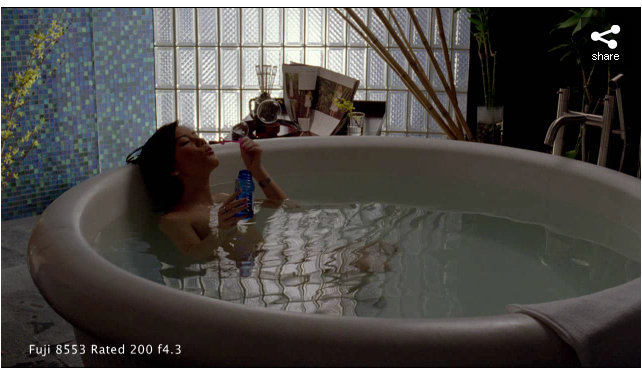
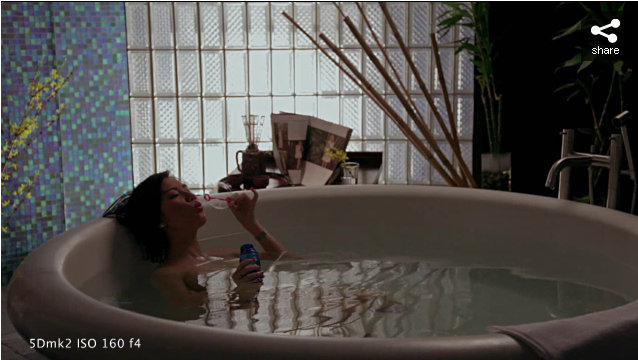
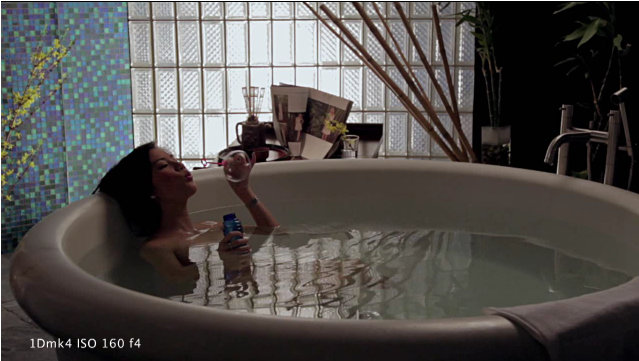
Quite an amount of detail is visible in the patterns of the glass bricks behind the bath tub (why these guys always choose chicks in tubs is beyond me), but look at that part of the digital images.


just blown out ... (although it appears nicely in the reflections on the water), maybe thats what people are used to accepting with digital, and maybe its just a detail ... after all what artist would be interested in the details....

Everyone in their audience also thought that the results were really good. Putting aside for a moment this issue; if you were a small budget producer you could buy a 5DMkII for less money than you could hire an ARRI camera for a 3 week shoot.

That has to be attractive for any director / producer.


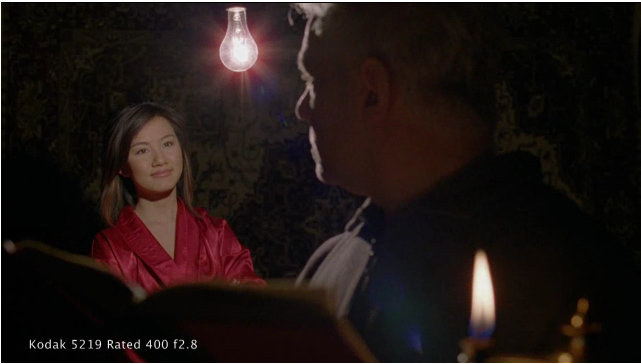
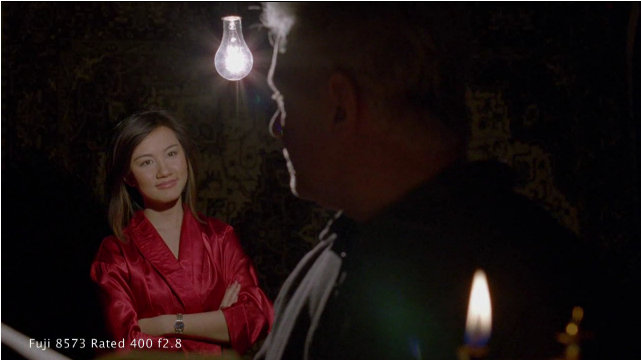
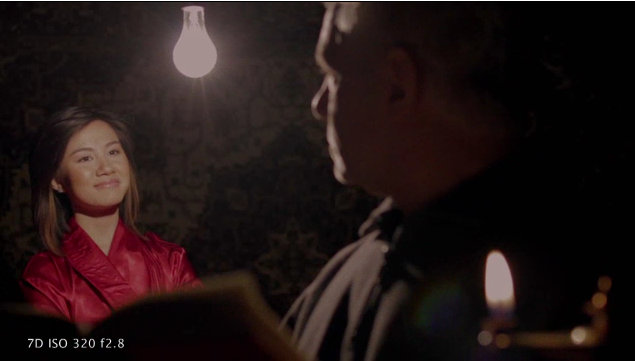
Then they did another scene. The topic of discussion was mainly about the light bulb ...


clear an "normal" in both of the film shots ... but in the digital's it looked washed out and nasty.


Every digital camera tested behaved like this ...

This is exactly consistent with my previous findings of how well film handles high key items like this:


Film:


Digital


as well as other examples, even HDRI


All very interesting.

They discussed briefly in their "brain storming" discussion this concept and called it "blooming", I have my own theory of this. I feel that this is not only related to the sensor, but is related to the combination of anit-alias filters / IR filters / blah blah

I mean think about it for a moment.

The sensor on a digital camera has a number of layers over it for a variety of purposes (including protecting it).

Film is simply naked at the time of exposure, so there is nothing over it to flare up ...

More, film has this concept called an anti-halation layer which is specifically designed to prevent this happening at the deeper layer of the film as it's illuminated and perhaps glows internally.

I'd also suggest you look at the contrast of the images in the high key light of the naked bulb.

The digitals all show some sort of flare overall, which I'm suspicious is related to reflections from that shinny surface of the sensor and reflecting back to the back of the lens ... which is shinny too.

I feel there can be no way around this and its an inherent advantage of film, unless we can make sensors naked and matte in surface.

While your watching that video, I recommend that you keep an eye out for the way that the makeup on the model shows shinny cheeks more on the digitals than on the film and the ugly way that her face blows out as she approaches the bulb.


in comparison the film remained beautiful and faithful in the face of lighting adversity....


lastly I'll suggest you take some screen shapshots (as I did) and examine them yourself, because there are differences in the final balance that their colour guy got. The GH1 Panasonic was rated least hightly (although they were impressed) yet interestingly they managed to get its white whiter and a higher level than the other cameras tested.

Check the levels on the bulb in all the shots, only the film managed to make white and had the best control. Now this could be as a result of their WWW compression, or it could be something else (like effort needed to keep things under control in post production).

This was a very interesting test and there is much more information to be had that was directly presented. Perhaps they all yakked about it, but it would be nice if more of it was presented.

Monday, 15 March 2010

tools for the job: why don't we have them?

I was reading a post by a friend of mine who has written of what he's found in looking at the RAW files produced by his G1 via a tool which has no bling, and just does the job of converting the RAW data into an image. He focuses in that post on the extra pixels which are available around the edges of the image (normally 4000 x 3000) which can be had by using dcraw (however wrapped in funky GUI apps) as the underlying tool for conversion of RAW files into images.

NOTE: after a comment from Don below I thought I should add that I do not really recommend you turn to a tool like dcraw for your general RAW conversion, as tools such as LR and ACR are more suited to production processing and will be faster. However they do mask much of what is happening happening in the process, so for those who seek to explor and understand what is there in the RAW file I encourage you to play with dcraw.

This got me to thinking about the other issues I have with digital cameras, and that is exposure.

Exposure is something with digital which has driven me nuts, and comprehending it without access to RAW files is like comprehending your exposure on film looking only at prints. Thus this article is about determining exposure and is also a complaint about the tools we have at our disposal for determining a proper exposure.

Lets start with this image, I took it a few weeks back when we had lovely soft -20°C snow that softly lay in big flakes over the garden (some 30cm deep).

snow covered stick

I've tweaked this image a little, so I thought I might present what I had started with. Below is the JPEG image as the camera made it into photoshop.

looking at this I did not really use expose to the right (which I am certain is the best strategy for minimizing noise on) but I was a little concerned with the possibility of blowing out a channel.

Out of interest I converted my RAW file using dcraw to make a 8 bit TIFF file with standard gamma. Now understanding gamma is important, nay critical to really getting digital imaging. If you come from a history of printing with enlargers onto paper you may begin to think of this as choosing a grade of paper ... not perfect but that'll do.

The result of the "standard" conversion to a TIFF gave me this ...

which looks quite different, and quite acceptable to me (close to my personally tweaked one). However it doesn't take much to notice that the blue channel is going to be showing some clipping in there looking at that channel (and I'm sure I can guess just where).

This of course got me wondering what was really lurking there in the RAW file because I didn't see anything like that in the JPEG ... so I converted it using a LINEAR gamma. This basically applies no corrections. Now keeping in mind that digital cameras produce numbers to represent levels (0 is totally black and 255 is totally white), gamma basically applies a maths function to the starting number and then writes a file with the changed number as the new value for the pixel.

Eg
  • 1 might become 1
  • 10 might become 15
  • 100 might become 180
  • 180 might become 255
stuff like that.

So, using a LINEAR gamma shows us what we had to start with ...


bloody hell ... I call that under exposed if you don't.

Its a reasonably well known (and bitterly complained about) fact that digital cameras histogram is based on the JPG data and not the RAW data. So while we have the cameras light meter for determining exposure it really is not sufficient to work out where clipping is (should you want to expose right).

Of course Film is a different creature to digital sensors, especially negative where you can bravely shoot with the sun in your face and still not get a blow out.

This is of course because film has a shoulder which you can see appearing in this spec sheet of the characteristic curve of neg ... the maker (Fuji in this case) cuts the response curve while its still mostly linear but you can see its starting to shoulder off over there to the right hand side.

It gets difficult in film because the linearity of the responses is uneven after this graph stops ... but that's not my topic today ...

So with that thought in mind I thought I'd attack this RAW file and put my sort of preferred gamma for this subject and this lighting. You can see that its really steep and rolls of gently with a taper at both ends (not in a hard angle).


This results in (what I think) is a pleasing rendering of the scene and in keeping more with what I saw with my eyes when I was there.

This of brings me to further support that you should never apply harsh machine like maths to a subtle thing like an image and certainly the light meter and histogram are inadequate tools for determining the right exposure or capture of the image in the first place.

If you download and examine that image (click to get a 1600 pixel version) you can see that noise isn't dreadful, but remember this was 100ISO ... it should be nearly perfectly noise free.

The "near enough is good enough" approach may suite some people but just as scene brightness ranges vary and need different gamma applications to obtain the best results, so too do we find histograms as an exposure determination tool inadequate because of the Gamma applied to them. Particularly as I've found that the greatest strength of digital is the subtle renderings it can yield in soft light, its sad that we can't maximize this with the tools on the camera.

I'm tempted to take my spot meter with me ... which if I'm going to do that I might as bloody well use my LF camera with all that hassle.

Saturday, 13 March 2010

internet discussions: can they work?

I occasionally lurk around photo.nazi, despite the fact that I hate their policy, because occasionally good questions are asked and answers I can benefit from are provided. I can't provide any answers to people because I was banned by the rectal cavity who is the head of the head kicking over there. He is about as popular with me as the Kempeitai were in Korea.

Anyway, a thread came to my attention over there which exemplifies the difficulties of having any kind of intelligent discussion on the many internet forums. The thread started with a mis-guided but passionate fellow suggesting that ETTR was somehow a flawed system.

After presenting his evidence his reactions to reasonable critique of his experimental methodology and his conclusions descend into personal attacks and slurs which would any sane person would want to distance themselves from quite quickly. Would you ever want to work with or employ someone who makes personal attacks like the following as part of his defence of his work and dealing with criticism other have reasonably proposed:


Tell me, Andrew, have you stopped beating your favorite underaged male prostitute? A simple yes or no answer is fine.

pathetic ... not once does he address any of the points properly because he is already convinced he is right and has no interest in learning or developing.

So Photo.net despite its pretense of providing a groomed community with moderation to remove the wild west thugs that destroyed rec.photo (and other usenet discussions) is really only a thin sham for corporate fascism to ride roughshod over who they feel like "dragging out for a hanging" (without a trial) and not a place where people can engage in discussion and debate.

Just doesn't seem to be many places that you can engage in a reasonable discussion, present arguments rationally without finding this sort of crap.

sigh

Monday, 8 March 2010

the new G cameras: and what this means for the GF-1

I've been wondering about the GF-1 as a second camera. I'd like to like it, but its over priced and under featured if you look at the actual technical bits you get


Mean time, around a year and 10 thousand images after I first got my G1, the successor the G2 has been tentatively announced by Panasonic. But they didn't just announce a G2, they have added a G10 to the lineup This is interesting as it helps throw light on what I think is wrong with the pricing of the GF-1 (namely that its milking the market, who are perhaps more ignorant of cameras than at any time in history).

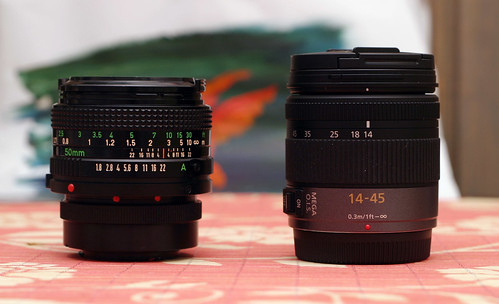
As well they have changed the standard zoom lens which is being supplied with the G cameras from the 14-45 shown below;

two G1 Lenses

to a 14-42 which has a plastic mount, and does not have the OIS switch to engage / disengage OIS operation (something to frustrate tripod users, but won't matter much to others).

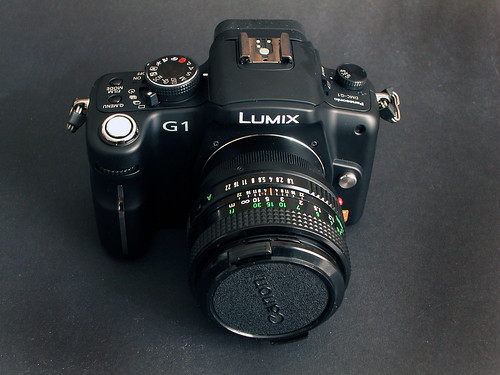
FD 50mm on G1 CameraI normally use legacy lenses like this Canon FD 50mm on my G1 when its on a tripod so this won't bother me much.

You see the Panasonic version of image stabilization is in the lens not the body.

If you're not using a stabilized lens then you don't have it :-)

The introduction of the G10 to the series is interesting as the specification of the G10 is interesting.

Looking at the information on the DPReview site (assuming they don't move it as they did with the G1 preview) we can see that the G10 is some sort of halfway house between the G1 and the GF-1.

The GF1 has no EVF (it can be purchased as an optional extra for about US$190) and has a non swivel rear screen. The EVF that you do buy however is sadly much smaller than the EVF that is in the G1, GH1 or now the G2. It is 202,000 dots (which is 0.20million) pixels, with a 60 frame per second refresh, and 1.04x magnification.

The GF-1 viewfinder is however coincidentally exactly a match in spec for the one which comes in the G10.


In contrast the G1 has 1.4 million RGB pixels which are perhaps unique in that they are each cycled through Red Green and Blue (rather than being a red bar beside a green bar beside a blue bar) giving an effective viewfinder resolution of 1.4 million dots at 180 fps and a 1.4x magnification. Everyone who uses one is impressed by just how big and good the G1 viewfinder is.

To get an idea of the view of the GF-1 viewfinder have a look at the image on the DPReview site here.


This should in my mind create a little quandary in the minds of those who are interested in buying the GF-1, as the G10 now has almost every feature of the GF-1 plus it comes with the EVF built in. The GF-1 currently sells for more than the G1 (never understood that) and when you add the price and mass of the LVF-1 viewfinder it will be as bulky (worse actually) as the G10, and have precious few advantages aside from looking more like a typical digicam while the G10 will look more like a high end tiny sensor digicam like the Powershot SX10 or SX20.

Of course both cameras will be 4/3 sensors which will make much better images than any tiny sensor digicam.

So, what'll happen with the pricing of the G10?

If it comes in at less than the GF-1 (my suspicion) it will then make the GF-1 look more over priced and under featured than it does now. If it comes in over that price then it will be far too close to the G2 in price which can't be too high with the GH1 already setting the upper limits (and of course great cameras like the new Canon 550D nipping at the market).

Talk about make a rod for their own back.

:-)

Sunday, 21 February 2010

micro 4/3: where are the compact lenses

I've been waiting to see if Olympus actually make something great with their announcement of a micro 4/3 version of their 9-18mm zoom.

Sadly, looking on DPReview this morning I don't see that they have:

9-189-18

Ok, it looks compact while its folded in and unable to be used, but to me the amount of extension happening makes it look like a flimsy mechanism and I prefer the Oly 9-18mm for 4/3.

I've been using that on my G1, which you can see shown here on the adaptor beside the very compact 14-45mm

bunchOfLenses

Really this new lens is quite a joke, as my regular 4/3 Olympus 9-18mm even with its adaptor looks to be about the same size. So now to use the lens you'll have to unlock it turn the collar to wind it out and turn on your camera.

The old one via adaptor was at least faster and seems to be the same optical design looking at the lengths of this. Reading the specifications on this saying that:

57 x 50mm and 155g - new lens
79,5 x 73mm and 280g - old lens

reminds me a bit of the amplifier specification wars. While a professional level Yamaha claims 100W RMS per channel some chintzy home theater amp for 1/3 the price claims 200W but don't tell you proudly that this is the sum of all the channels and at Peak (a more attractive number not as meaningful as RMS).

I'm sure looking at the extension in those pictures above that with the lens ready to use that the lens will be at least 79,5mm as it is only 40% shorter in spec and the pictures seem to show it doubling its length.

Perhaps the reviews will tell a different story, but until I get my hands on one I'm thinking its just poor.

Thursday, 11 February 2010

micro 4/3: what are the limits to the system

While I am very enthusiastic about my G1 camera (and have eyed carefully the EP-x and GF1) I have been wondering about the lack of lenses in the lineup and wondering if this is
  • an accident,
  • a lack of early investment (while testing the water) or
  • a design issue which will prevent extending the system easily (or make it bloody expensive).

If you're the kind of photographer who buys the camera with the standard zoom and never does anything else then there isn't much meaning in the following post for you.

However if you're the sort of person who likes to (or needs to) extend their system to cover additional things (like a professional or a "soccer mum or dad") then this may be applicable to you.

Quite a number of photographers (including me) like to extend their G1 from the basic kit and get it to do more. I for example have used FD lenses by adaptor to fill out what Panasonic does not provide for my G1 or would be simply too expensive.

I picked the FD300 (cheaply) because I wanted more reach than the 45-200 gave, and the FD200 on the right was less than $50 and makes a nice light thing to pop in a backpack for stuff which might crop up when travelling, the 50mm is a great portrait lens and the 28 ... well it was $6 and I thought it might make a better 'normal' lens than the zoom (its a yes and no on that one).

While optically brilliant, none of these have AF or allow the camera to control the aperture ... its all strictly manual focus and manual stop down. The first part is actually less problem than the second if you ask me.

But I don't always want to use manual focus (I'm too spoiled by over 20 years of AF with Canon EOS cameras) and we have not covered anything wide here yet. The standard zoom (while very good) will only go as wide as this:
coloseumNight2

which is not enough for my tastes in that picture and in places like this:

pantheonInterior1

isn't nearly enough. This interior shot uses a 9mm focal length.

So, some time ago Panasonic announced a few more lenses in their lineup (sorry folks, that link was in Japanese but the pictures are pictures). Notably they added:
  • a 14mm f2.8(with no OIS and therefore no orientation sensor for your pics)
  • a 8mm f3.5 (nice and wide, but again with no OIS...)
  • and a 100-300mm zoom (which appears to have OIS)
this extends the existing selection of:
  • 7-14mm (no OIS)
  • 14-45mm
  • 45-200mm
  • 20mm f1.7 (no OIS)
  • 45mm f2.8 macro
of this only really the 45mm Macro, the 7-14mm, the 20mm the f1.7 and the 8mm are lenses which would likely appeal to any serious user. The 14mm f2.8 is borderline as it sits right where the standard zoom sits (14mm), while offering not even a full a stop faster aperture than the zoom and without image stabilization.

I think that the 14mm (which I've already said isn't really wide) will appeal mainly to GF-1 users who didn't buy the 14-45 zoom kit but bought the kit with the 20mm can add a compact wide to their pockets.

Fair enough ... that makes the GF-1 a nice niche market camera for those who desire a (nearly) pocket sized compact camera with just a few bits n pieces.

If you're after a more versatile camera (which the G1 is) then there are some problems here. If someone is going to give up their Canon or Nikon DSLR I think it might need a bit more in the mix. Looking at the selection available to them (or Pentax, or Olympus) you have quite a lot to choose from.

Now, (getting to my design issue) looking at all of these lenses only the 14mm and the 20mm seem to use a more typical AF where the whole lens element stack moves, the others (especially the zoom) will seem to likely rely on internal element movements for focus.
(NOTE: I am not talking about rotating the front element)

As I said, of all these lenses only the 14 and the 20 (and the Olympus 18mm f2.8) use this sort of focus concept (which is pretty important for low cost designs), the rest use inner element movement for focus.

Its interesting to note that Panasonic can use precious few of the existing 4/3 lenses in anything other than the most basic of ways (yes, they mount, yes they manual focus, and yes the aperture iris is integrated to the camera full list of compatibility here), even their own lenses only work in AF-S mode.

None of this allows photographers to take advantage of their fantastic image tracking AF and other great features of their camera.

Why is this, and what may it mean for the system?

Firstly there is not a lot published about this system and how the AF physically works on the moving the lenses (unlike say Canon, where there is a wealth of information on how their AF systems work), so gathering what I can I found this from the imaging-resource page about the GH1 [emphasis my own]:

.. It turns out that not all lenses are able to move their elements quickly enough to work with the G series' contrast-detect autofocus. Normal phase-detect AF systems are fairly forgiving of focusing speed, because the correct focal distance setting is determined independently of the lens elements' motion: The camera looks at the subject, calculates the correct focal distance, commands the lens to move, and then snaps the shot once the lens reports back that it's moved to the correct setting.

With contrast-detect autofocus, though, the lens has to move multiple times, and must come to rest before the camera can take each "look" at the subject, to determine whether the focus is better or worse than it was at the previous focal setting. In order for the overall focus cycle to be performed quickly, the lens needs to be able to shift focal settings very quickly, multiple times per second. This is a demanding requirement, and not all lenses are up to the challenge.
...
So, while some current Four Thirds lenses will work just fine on the new Micro Four Thirds system, with full support for AF operation, other lenses will be reduced to "guided manual" focus
...
Like the Panasonic G1, the GH1 uses a very fast contrast-detect autofocus system, capable of adjusting focus sixty times/second.

Because of a basic law of physics (Force = Mass x Acceleration) if something more massive must be started and stopped fast (high acceleration) it will require more Force, which means more energy and strength.

So the system seems to be limited to use of moving around light weight inner elements or light weight elements.

For existing AF lenses where the entire element moves (as in say a typical 50mm lens), the motors just won't be fast enough and snappy enough to do it, so no AF

I think it poses a critical problem for Panasonic on their lens design, as it means that a mass limit is effectively applied to movements.

It seems to me this is going to be a major restriction for the system, despite its alluring features, there are quite a few restrictions on its implementation (as was the main point of what I was saying).

In fact if we look carefully at the lineup again in this light:
  • 14-45 zoom - uses inner focus to move what is probably a very small element and not have to move it far.
  • 45-200 zoom - probably the same
  • 7-14 zoom - probably the same
  • 45 macro - does not extend during focus (as does say lenses such as the EF 50mm macro or the FD 50mm macro) so works with inner elements.

of all of these lenses Panasonic says on their site that (with respect to AF)

AF tracking is slower than the counterparts in HD movie support Micro Four Thirds lens(LUMIX VARIO HD lens). Also operational noise in AF may be recorded while motion picture recording.

and

For the Full HD motion picture recording( [FHD] in [AVCHD] ) in DMC-GH1, AF does not work, and it records in MF.

although only the first point applies to the 45 macro.

These limits mean that to me, lenses like the Olympus 300mm SWD will need to be redesigned to make use of advanced focus tracking systems that the G series has (unlikely) and that lens is already 50% more expensive than a similar Canon EF lens which has Image Stabilisation too.

So people who wish to take advantage of these nice camera features are perhaps never going to see lenses other than a few zooms of consumer grade quality.

Unless one is after the GH1 for video work and its HD rated 14-140 zoom then it sort of leaves the G series in a bit of a funny spot.

It makes a nice experimenters / amateurs camera for used legacy lenses, but you have to invest heavily in lenses if you want wide angles (like US$1000 for the 7~14mm, which doesn't appeal to this amateur) or not much less for a Olympus 9-18mm (and the adaptor).

You have to pay big bucks for a normal (try US$399 at present for a lens which is equivalent to a less than $200 Nikon), heck I have a 30 year old Pentax 110 lens which was never that dear, and all they've added are 1 1/3 stops brightness, coupled Iris for aperture and AF.

Telephoto's are so far just a couple of mid range zooms (not really any standout from the Canon USM 100-300 or the Nikon AF VR IS 75-300) so they'd better be well priced.

I notice though that among the bird watching crowd that people don't seem to mind spending up on L series (like a 300mm f2.8 or f4 with IS), paired with a 40D (or heck even a 20D) the amount of price difference between the G1 and the 40D will soon get soaked up by the lenses. These aren't even professionals.

So, with the promise of things being "smaller and lighter" with "high quality" things had better change soon ... cos its looking like the intentions have stumbled into dividing the G series into a pair of niche markets (compact with only a few alternatives and HD video who need stills).

The G1 is not seriously more compact than a Olympus 420 and while I do love its EVF and articulating screen its not the end of the world without them. If I'm stuck using legacy lenses to keep those features (EVF and articulating screen) and miss out on the promise of their great AF system, then its like having a Ferrari but its stuck in the living room, I can only dream of how good it could be to drive.

... at least in my view.

Tuesday, 9 February 2010

out of my depth in digital

99% of digital cameras are APS-C or smaller sensors, this makes them quite a small format. While they often create excellent image quality in an outright sence there is often something lacking in there ...
This chart shows the sizes for those who aren't familiar with this
with the outside being the largest size of professional digital sensors such as in the Phase One or Mamiya or Hasselblad cameras (you don't normally read about these on supermarket digitcal camera sites like the big one owned by Amazon).

One of the things I'm finding about smaller format digital is that I'm often out of my preferred depth, as in depth of field. I happen to like controlling Depth of field and I understand that the inability to do this is exactly why I'm unhappy with most of my digital images.

For instance, I took this image of a Stone God around a temple (facing out) in Korea,

?

however its just that little uninteresting in some ways. Now if I'd have had my 35mm camera and my TS-E 45mm with me I'd have probably taken something like this (which I munged up quickly in photoshop to see)


?

personally I prefer this ability to control focus, and its the reason I like taking images with my LF camera (and my 35mm when I had the TS-E lenses). Images like the ones below make use of focus to control interest

Japanese LF

Japanese LF

and small format digital is just too deep a depth of field and I just can't do that.

So I feel better in the shallow areas.

Don't get me wrong, its not like all my photographs are this way, some are deliberately worked to get as full a depth of field as I can:

Australian LF

but its nice to have the choice :-)

Now of course I can get a full frame camera (and re-buy my TS-E lenses) but that might just be out of my budget right now ...

sigh