Showing posts with label Mercane Wide Wheel. Show all posts

Tuesday, 19 August 2025

Wide Wheel aging battery diagnosis and first intervention

We (mostly) all know that as things age they stop performing at peak levels, sometimes replacement is the best solution, but perhaps other times intervention can fix the issue. I'm not one to shy away from a surgical intervention if needed, but if another therapy can work then all the better.

Background

So, while the WW was going well these last few years I've been using it less (favouring my bicycle for shorter trips in and out of town) and its had a few small issues that I've needed to fix (like the seized rear motor, exacerbating the not using it as much).

I noticed however that the battery was "sagging down" more in voltage sooner than I thought it should do as I was riding (you know, that volt meter on the handlebars does have a useful purpose right?) and began thinking that it may be something more than just expectable aging.

I always check the "Watt Hours" (Wh)  shown on my charge monitoring tool (that always remains plugged in between the charger and the scooter), and the Watts needed to recharge are less than what I'd have expected were the battery depleted down to that level of "remaining charge" (as represented by the voltage when riding). For reference, this is the Watt meter I use:


It conveniently shows how many Amps are flowing, the battery Voltage and on the bottom row cycles the left number through 
  • Amp hours (Ah)
  • Watt hours (Wh)
  • Peak Amps (Ap)
  • Voltage maximum  (Vmax)
  • Peak Watts (Wp)
the right number shows just the current situation of Watts flowing. Its a great tool and I would strongly recommend everyone with an eScooter or an eBike have one of these; you learn a lot from them.

I mean unless you're stupid, then you don't learn anything ....

First step

So I decided to pay attention to the last part of the charging cycles and come on in at the end; glancing at it as I went about my doings around the house.

I noticed that it was 0.18A (that's also 180mA) at one point, then suddenly became 0.00A ... that's wrong as before I've seen it taper nicely down to 0.01 Amps (because I like to watch these things, just like I like to watch the food I'm cooking so I don't burn it).

"Riigghhhttt" I thought, "the BMS is cutting off before balance has completed" ... first step was to turn off the charger (at the wall, in Australia power points have switches on them) and leave it plugged into the charger (so I can monitor the actual charging point voltage as well as the "take off end" that  shows on the handlebar, yes they are different voltages) and wait a while (about half an hour) and then turned it back on ...

bam ... started charging at 0.56A and I thought yep, diagnosis looks right: BMS is shutting down, the full cells settle (after charging) lowering the difference between pack cell groups. The role of the BMS (among other things like discharge protection) is to ensure that charging is stopped before any cell (bundle) is over charged (think fire risk) and to help fully charged cells bleed over to the less charged cells (although different BMS's do this with different levels of quality).

So clearly it was shutting off before the other cells were fully bled.

Not wanting to stand there all day I decided to automate this with a simple "clock work" power timer I had lying around ... 


I set it to provide power for 15 minutes and not provide power for 15 min. I can "turn it on" for the first bulk charge (to save time) using the switch on the side:


in the up position its providing full time power (ignoring the settings) and in the down (blue/green arrow) position its on the timer.

Lastly

I've put together this quick video showing all this and discussing the same points above but in a slightly different angle. 


I hope that together this makes things clearer

I'll follow this up in the coming weeks with what happened and if this simple solution means I don't need to do pack surgery and replace the BMS (with a spare which I'll probably already have on hand from last time).

See Ya

Sunday, 25 May 2025

Widewheel rear motor replacement and general update

So, back in October 2024 my Wide Wheel wouldn't go, the back motor made a lot of noise and felt almost "seized" inside. I suspected rust and I suspected in it where it was found: between the stator and the magnets). 

Keep in mind that I've had this scooter since 2019 and its seen a lot of use.

Accordingly there were lots of delays (what, with postage from China, two other motorcycles that needed work and changing tyres on the MX60 so that I still had an electric scooter), but eventually it all came together. 

Firstly, I struggled to get the wheel apart. I looked at would I repair or replace the whole thing (after quite a few goes at trying to get it apart. The price of a the price of a whole rear hub wheel ($300 of course with a tyre fitted) vs just a tyre ($50) and a set of wheel bearings ($14 for the pair).  I thought "ok, I'm willing to give it a go"; and so I decided that we had to go the hard way of cutting the tyre off.


To achieve this we (it was a two man job) used a good sharp knife, a pair of pliers to pull up what had been cut and some "penetrating oil" (spray can) to lubricate the knife as it cut. You can see the rust stain there where clearly some water (one doesn't need much) had made its way into the motor some how. I have a few ideas on that front, which I can't verify, but either way.

With the tyre off I was quickly able to remove the screws from the "right side" of the hub (sides being usually discussed from the perspective of the rider on the bike or scooter) and it came apart easily and pretty cleanly. You can then see the windings, the steel laminated metal sheets that form and hold the windings. 


The problem was rust and tiny bits of broken magnet debris. Here you can't see is how tightly the magnets around the outside of them hold that stator in, meaning that just a little bit of surface rust becomes a problem. Probably not having used it for 3 or 4 months helped that rust expand (which is what rust does).

Extracting the stator requires the left side of the hub to be supported and a strong back (and a good grip on the shaft; so put the nut back on and a couple of big washers for grip) to pull it out.  Do not pull on the wire.

The outside of the stator had some surface rust as well as the magnets. I used an abrasive bit on my cordless drill (also with very sparing use of penetrating oil) to clean up the outer of the stator and the inner of the magnet area.


Do pay attention to the wires and don't abrade / clean anything off the sides (there wasn't anything anyway).


You can see (blackened area to the right) that one of the magnets has had some of itself smashed off (by the build up of stuff that was in there) and its a hell scape in there if any bits break off because they'll be kept in dangerous places by the magnetic fields.

From there I decided to replace the bearings too, they tapped out nicely with a socket and the new ones tapped in cleanly too.

I thought that before ordering a tyre I'd check that nothing was wrong, inserted the stator and closed the wheel up gently.


So with everything prepared I re-fitted the motor (without the tyre) so back on the scoot and "test fire it" to see if it still worked.

All went perfectly.

However I want to take the time to reiterate a few things that are unexpected to those inexperienced in working with this type of motors. 
  1. just as the stator resisted being removed, it is strongly attracted to the hub, so care and strength is required when inserting the stator into the half with the magnets as it will suddenly and strongly get pulled into place. Be prepared for this and have a good grip and make sure the wheel side is held for this.
  2. you MUST leave clearance under that wheel side for the axle to protrude through.

When my tyre arrived some other things became apparent
  1. its a real tight fit and I should have used lubricant 
  2. you really need some long screws of the right type to insert into the holes in the steel frame to accurately line up with the screws that you'll replace
  3. some sort of clamp system (big G clamps will do the trick) to pull the two sides together
  4. some large washers to form a stack to keep the shaft pulled snugly against the other side and prevent it from moving back up

I didn't do 4 above and somehow my friend who was helping decided to use a spanner on the axle and turn it; and the stator had slid up ... 

This quick movement (he's used to the oil drilling industry and heavy machinery) and ruined my motor. As the stator spun and the wheel half hub dragged on the wires that go to the hall sensors (a critical component in a brushless motor) and totally fucked those delicate connections.


Sigh ... so lesson here is "don't work like a gorilla, work like a watchmaker with electromechanical things."

I have tried to get the hall sensors out, but they are glued in and thus I'll never know what they are (to order replacements) or indeed be able to get new ones in.

The motor is now toast :'-(

By this time, when I went back to Ali I found that rear motors were not available (and they are physically different to the front).

The entire project sat in the shed until a few weeks back when I found another 2019 Wide Wheel in Facebook market place with a stuffed battery (seriously it was only good for 2km) for $200 and I decided to buy that to get a rear wheel.

However when I got the scoot I found that it was almost totally new, with very little apparent wear (well, the rims were bashed on the edges, because people don't know how to corner on) and so I decided to transplant my battery into it instead of just moving the wheel to my scoot.

The scoot had been put into ludicrous mode (explaining why the battery was stuffed) and almost none of the usual pre-ride prep work had been done (please see this article and its linked ones). Indeed the owner had done the classic 1980's bicycle brake cable adjustment which is both wrong and dangerous (see this article for how to properly adjust the standard calliper). 

So, now I have a new 2019 model Wide Wheel (as well as a bunch of spare parts still on my old one) and it feels great to be still riding one. Getting a (basically) new scooter has been interesting to see how much (not much) my scooter has aged and experience a few small differences (such as the controller seems a little different on this model).

Lastly, I've written a lot about Wide Wheel scooters, so rather than list it, everything is here (all articles).

Happy Scootering

Sunday, 11 April 2021

Widewheel battery durability testing (revisited)

 I enjoy riding up and down the local mountain road. Its not only a very pleasant escape but its an excellent opportunity to test the battery and how its shaping up.

Now its worth while remembering that I bought this scoot in July 2019, which means its nearly 2 years old. In that time I have followed the following principles of battery handling

  1. always fully charge it (some minor exceptions exist)
  2. use the scoot soon (within a day) after charging
  3. do not recharge if I know there is sufficient charge to make the trips I'm intending (frequently I do three or four 3km trips in a day)
  4. it has been charged at 4Amps since I bought the fast charger in Jan 2020
So over the last (nearly) 2 years this equates to about 312 full charge cycles in its use.

The Test

Load testing of batteries is the best way to determine their health and their current capacity. Usually load testing is done on a bench with tools to map out the battery performance (represented by voltage) under a stated load. Since people are often confused by data that's about each cell (the 18650 cell) that comprises our packs I've annotated this graph with the voltage that a pack of 13 cells in series would show if tested this way

So yes, its normal for voltage to drop over the discharge of it. Importantly this is for a single cell, and discharged at 2Amps; as my pack has 6 cells in parallel for each cell to get 2A sucked from it the motors would need to be sucking 12A out of the pack (cos 2 x 6 = 12 right?). At 48V that would amount to something like 500W on the flats to do 25kmh. which is a pretty reasonable estimate of the power . Then given an 8% grade which my parameters indicate that to keep average 23kmh up an average 8% grade will need 743W. Suggesting that on the climbs I drew more like 2.7Amps per cell.

So its ball park and a good actual real world test

To refresh you with the course the distance and elevations are:


Basically I did that route again. 

Rather than record the whole trip again I decided to record just the most important parts: the slug up the hill from the bottom of the steep climb up to the top.


This clarifies the grade of the climb, the length and that the scooter just hauled up with almost no change in speed. Impressive on a 2 year old battery. 

The return voltage was 46.4V which is almost exactly what I'd got in the past and charge required 406Wh to refill which is almost exactly what I've got in the past.  This means that over 26km I consumed 406Wh which is 1.6kWh/100km (15.61Wh/Km) or almost exactly what it normally uses (no surprise there either).

Points to consider on this I went up to Johns (adding a couple of km of uphill) and on the way up to Queen Mary I had a tail wind (which would have assisted somewhat). On the way down (of course) I had a head wind, but for the steepest parts the speeds were still sufficiently high that back EMF would almost fully negate any additional power demands for that.


Previous results

This test was pretty much a repeat of many tests and probably the best reference is this one from May last year, back then I determined there was no appreciable loss. Another test run worth a look at was this one (where I dug into more figures)

Conclusions

So given that this scooter is two years old, and has been (as mentioned above) fully charged when cycled (but usually no less than 40% before recharge) and is still performing within all practical intents as new. This is not unexpected and something which I explain in this blog post here. I've got further discussion here and here.

So the next time your on Reddit and some pack of fully ignorant-kiddie-wankers go on about killing your battery by charging it fully (NB using it as designed) ... just ignore it ... there is no evidence other than the clear evidence that they're idiots.

Thursday, 8 April 2021

things people can do

 I read this this morning about the following picture

Well, after about 18 months of fixing my WideWheel Pro every other day, I finally threw it out today. My son broke it in half for like the 5th time.


Firstly - just WOW .... next its not a WW Pro its a 2019 model.

But the battering. The owner reported that he "fixed things" with JB Weld (like WTF)

In case people don't have as sharp an eye:

Front


The stem has come in for push and pull abuse and more JB weld


The top bar area...


The rear wheel


damage to the tyres and rims ... man ... how?

So:

Never underestimate the General Public

... sheeet


Saturday, 19 September 2020

shimming the axle

 I've noted when undoing my axle that there is too much play for my taste (less is better) when the axle takes the forces of the motor torque (in order to power foward).

So I've added a shim of 0.3mm Aluminium Flashing to wrap around the axle to not only take up that, but move the future damage to that shim not keep letting the axle chew out the fork.


So, for the interested,  here's a video on that


Enjoy

Friday, 31 July 2020

Mercane Widewheel steering stem issue

well after expecting something like this for a while its finally manifested


Now this is something which I became aware of as a possibility something like a year back with the first reports appearing on reddit. Having some basic engineering skills and understanding a bit of how metals bond (or don't) with each other I expected to see this on my scooter one day or another. So I kept an eye out for it.

Below is the first example of this that I saw.. but his had been progressively ignored (because people are stupid) for some time.

Fig 1

the problem stems from what I believe to be a manufacturing design defect in the Mercane and that is based in the problem of "how do you marry a steel steering stem into a cast aluminium suspension / wheel holding system?".

As I see it (I've not yet done a full destructive analysis) the tube that is the steel steering stem is attached into this cast aluminium system.

The steel tube (in my above video) holds the steering bearings and looks like this when pulled out:

 Fig 2

note that the bottom bearing is still attached (as is visible in my video).

Note also that the tube (steering stem) being held appears to be plugged but also bears marks consistent with the broken section in Fig 1 above.

These images are all from the same failed stem. A second failed system was presented to my by some narcissistic fucktard in Melbourne who was trying to get me to help him with a warranty claim (although he'd been smasing into bumps and gutters with reckless abandon.

Fig3

His shows quite well how the steering stem had been deeply embedded into the top bracket (if I may call it that) and shows a steel base remaining. There are marks on that consistent with the shaft (which I'd like to have seen but said moron was unable to bother photographing as I requested).

My current working theory is that the steering stem is plugged at the bottom and has a plate welded onto it that allow the steel tube of the steering stem to be held onto by being welded to the plate. This weld has broken and leaves us with a tube that comes away from the plate as per Fig 3, but the base plate is still embedded in the base of wheel assembly.

So if I'm right then the issue is the failure of the weld and then the eventual (and inevitable) failure of the joint that the tube seats into. Something like this

Fig 4

If this is correct then I can basically repair this by:

  • drilling a hole through the steel from below penetrating the plate and the plug at the base of the tube
  • if the tube comes out (which I anticipate it will) putting some epoxy in there to help hold it
  • putting a bolt through the hole to hold it together
I believe that this may even be a good idea (the bolt) to do preemptively on any Widewheel of this vintage that may as yet not suffered this failure

Today I pulled it down further for a good look, this video covers some of the points covered in the earlier video, but goes further.


While here, steering head bearing dimensions:
  • outer race external diameter 37.91mm (don't forget it has a taper)
  • stem is inner 27.12mm so inner race must fit that

Now in case anyone thinks this level of war is "BAD" let me say this is an exemplar of what I've done with my scoot for the last year of its life


Now as I said, I regularly inspect because I value my skin and bones, but as you can see I've enjoyed it, and I believe its eminently repairable (and actually still functional right now).

So lets see where this goes, as I'd like to avoid the front falling off


PS: I've now done the following
  1. drilled in from the bottom of the assembly
  2. tapped a thread into that hole 
  3. fitted a bolt so that it goes through the thread
  4. fitted a nyloc nut onto the top of that bolt so that it can't loosen
Video


Images


and


and looking down the stem...


so that's not coming off any time soon, and so if it gets loose again it will mean that both the weld has broken and the bolt has sheared ... I expect I'll notice before then.

HTH


Sunday, 21 June 2020

the permatex question (perhaps answered for good?)

The problem with the covers of the Mercane Wide Wheel is that the covers for the suspension are crap plastic and break (often come broken) at where they attach. This is one of mine which you can see is pretty new but just broke as soon as I started to screw it in


Indeed looking at the striated marks in the plastic I wonder about the production. However the other parts of the plastic are strong enough, its just the critical part where they attach. See my page on a repair option here.

Its increasingly said on Reddit (which seems to be the online instrument of the Zombies of Morinity) that somehow relatively benign thread lockers (essential for good scooter life in operation) are somehow damaging the plastics. Statements like this crop up with out any validation:
Just realized that blue loctite causes the suspension covers on the WideWheel pro covers to crack.
and seemingly nobody does anything more than read the headline to take the claim unchallenged. But I guess this is "normal" in a BLM (Blank minded Looting Mayhem) world.

So while a bit of internet searching found this interesting post (which it would seem again, people only read the headline, but not the substance). In that post (claiming that permatex caused fractures in his 3D prints) there were some intelligent questions (which went unanswered), such as: "I can’t speak to ABS, but we’ve used Loctite dozens of times with screws in tapped polycarbonate without any issues. Perhaps the specific kind of Loctite or polycarbonate you’re using is more susceptible to problems?"

There were (in the comments) mentions of Acetone, being one trained in Organic Chemistry I know well the smell of Acetone, I can't smell any in Permatex Blue. Further acetone is regularly used as a glue for ABS plastics ... so that's weird too.

So as exactly this sort of fracturing happened to me straight out of the box on my Widewheel without even any Permatex ever coming near it, and again on half the ones I bought new I'm going to say that the low hanging fruit here is: crappy molding which let the plastic get cold and  become  brittle. I notice its not a problem anywhere else on those covers (wheel or base).

Futher discussion without any testing is just meaningless, so I decided to do some testing to answer the question with the product I use (which is Permatex Blue). So this is the video of the start of the experiment:


and this is the conclusion:


My findings were that I can't see anything obvious that would implicate permatex blue thread locker as having any obvious effect on the plastic. Given that people claim this happens instantly and I let it sit there for 24 hours, with drops of permatex on it, not just the vapors suggests this claim is false.

I didn't test the loctite brand.

Further I've used Permatex Blue on my both my scooters and on my friends three (himself plus his two daughters) for a year now with no evidence that this claim has any substance.

So if your covers break at the mount points its either (or a combination) of these:

  1. crap plastic from the start
  2. you overtightened it ... so use permatex.
Now if you're unconvinced (some people still believe Donald Dumps claims of COVID) then I suggest you remove all the metal screws ther and replace them with Nylon ones (which can be easily trimmed to the right length). They are M3, but see my above mentioned blog post for details. They probably won't vibrate out and won't rust in there. 

If you're going with the OEM metal ones, please, put a drop of permatex on there when inserting the screws (just a drop) and you'll have no rust problems and they won't fall out. I've not needed to open the bottom of my dualie since doing initial inspections.

Lastly, if in doubt, do your own test (with your own choice of thread locker) and see. Science and Engineering built the world we have today by validation and verification, not finger pointing and did / did not / did too circular arguments with no substance. Unless you're a narcissist prone to magical thinking with no concept of reality except it to be what you want it to be (like Donald Dump).

Happy Scooting


Tuesday, 5 May 2020

Mercane Widewheel battery and durability testing

So, about 5 months back I did this test on my Widewheel capacity and found that it performed pretty well and indeed pretty much within expectable specs as delivered. This is despite my regularly (audience gasp) charging it to 100% (because kiddies on reddit are so much more competent battery experts than the engineers who design BMS's and that's clearly going to destroy my battery).

Then again (because it was a fun way to spend half a day) last month took my Widewheel out on another long trip but as that has less hills (than this one) I wanted to do my torture test. Also I wanted to add another few km to the journey to see if it "still made it" and see what the outcome was with respect to voltages.

I thought I'd start not with the full trip, but with just the fastest parts of the down hill, which shows the sorts of speeds happening in more details


So pretty much what I experience in this older video:


As I mentioned this time I added a little extra distance to the trip (compared to the one last year) and so this is the new journey:


which is about 3 and a bit km longer back down off the mountain.

Data

I returned up my street (mild uphill) with about 44.5V showing on the handle bar and it recovered as soon as I stopped (because taking the load off) to 46.5V and a little later recovered to 46.9V. I discussed this discharge curve of batteries in this post about what I believe represents a good model of my own batteries (even though this is a cell) and I've adjusted the Y axis to reflect the series numbers of batteries in my pack.

On this occasion 431Wh was absorbed by the battery during charging, as opposed to the 410 of the last trip.

Considering this in gross terms (ignoring hills, winds and whatnot) this is 17.91Wh/km and on the previous run 19.7Wh/km. Given this run had less hills for the last additional 3.3km and that the previous above mentioned distance run (also not up a mountain) returned results of  16.4Wh/km that's about right.

So (depending on hills) about 15 minutes more riding would be expected before walking at this point, or about another 5 km remaining in the battery. This is essentially very close to what I recorded 5 months ago, and while I wasn't getting as detailed what I found nearly a year back too; which bodes well for "no measurable loss in battery" in the last year of operations.

Looking in details to the trip there and back (I zoomed in on the app for higher precision than seen in the summary) while I had a head wind all the way there which seemed to weaken somewhat as a lesser tail wind on the way back its interesting to see that despite the lower voltage the cruise control clearly does not "suck the battery hard" because similar speeds were seen both sides of the mountain


Worth noting that the climb on the way back is a down hill seen in reverse, so the beginning of the up hill and the end of the down hill were still making around 24kmh.

Consistency is good in this respect and the scoot does not feel significantly like its running out of grunt; which were one running on "unrestricted mode" not only would it not get this distance it most surely would feel more "limp" on the way back (from whatever trip it could make).

Discussion

Generally speaking the scooter gives pretty consistent consumption of energy over distances that are at the limits of its range. It has continued to do this for its life with me so far. Lacking a speedo on the Widewheel I can only estimate the distances done, however if I draw from the experience of my MX60 (which does have a speedo) it's done over 600km in the first month I owned it, and as I've had the Widewheel dual for 10 months now I think that well over 2000km is about the least it would be.

Meaning that its fair to conclude from these tests the following:

  • the Widewheel is durable if maintained in at least a simple manner (adjust the brakes, keep an eye on things)
  • the battery in the Widewheel (who gives a fuck what it is) is up to spec and also durable
  • fully charging the battery would seem to have no observable influence on the batterys ability to perform over that year of hard work (and I don't fully charge it on every trip, I follow the charge it when needed approach)
  • one can estimate that "flat" routes will use 17Wh per km and steep routes (where you'll come back down) may use about 19Wh/km. Using this and knowing the Wh of the battery and adding in a little common sense about the difficult nature of the last few Wh contained in the battery you can plan trips reliably.
Hope this helps


PS I redid this test on the 10th of April 2021 and got similar results
  1. return voltage was 46.4V
  2. charge required 406Wh
Points to consider on this
  • I went up to Johns (adding a couple of km)
  • on the way up to Queen Mary I had a tail wind (which would have assisted somewhat)
  • on the way down (of course) I had a head wind, but for the steepest parts the speeds were still sufficiently high that back EMF would almost fully negate any additional power demands for that

Saturday, 25 April 2020

what's the fastest speed the Widewheel can do?

Some people just love to believe their scooter is fast (its just King Wang if you ask me), but what's worse is that on a scooter with no speedo people claim all sorts of things implicitly in making statements like "for a scooter which can do 40mph" which is of  course nothing more than a resellers claim to suck the kiddies in.

The reality that I've found is that 43kmh in ludicrous mode is the maximum, and that's even giving it grace on a gentle downhill. So today I thought I'd settle it with actually making a point of having a fully charged battery, driving to the top of the hill and from "fresh off the charger" let it run down the hill with the throttle locked on in ludicrous mode.


So you can see that on a road where its pretty consistently steep it got up to 46 kmh.

For Shits-n-Giggles I repeated it more or less with just gravity (and a little bit of help to get started)


So basically this clarifies that in no way is more than 44kmh possible on a flat (even with a little tail wind), which for the American readers that's a smidge over 27 miles per hour. Nothing like 40mph.

Now I mentioned during the video that every electric motor will have a maximum speed, part of that is determined by voltage. Because as the motor spins faster it provides more back EMF acting against the battery. Eventually you'll reach a point where they're in balance, as you saw in the voltage meter where it was just sitting on 54.0V

Lastly here is the video  made during this GPS gathering:


Conclusion

This should not come as any surprise, because even if you jump out of a plane there is a top speed you'll reach. To get more speed will require more power.

Anyway, this is pretty rigours and avoids any of the heavy duty wanking that juveniles are prone to. As I've said before, this is a great scoot and its a lot of fun, but please, keep it real. Leave the Kool-Aid back on the shelf.

Just the Facts Ma'am.


Friday, 24 April 2020

Distancing

Always nice when your transportation provides a decent seat


Nice to get out of the house and watch the sun go down

Monday, 13 April 2020

MX60 tyres (or why I won't be selling the WideWheel)

The MX60 is proving a very interesting experiment for me. Yesterday marked a month of ownership. Over easter I've taken the opportunity to put a few more miles on my MX60, making it to 500km in this time. So I've now got some experience with it to make some sort of evaluation.


One of the things I "knew" before even buying my first scooter was "I wanted to avoid pneumatic tyres". So within a month of ownership I've already had my first example of why this was. I went to go for a ride on Saturday morning and found the tyres were very low in pressure.

Already (I thought) - Fuck Me!

A quick inspection confirmed I could ride it to the local servo (1.5km) and there I found that the pressure was down to 10PSI in the back and 15 in the front (they'd been 30 each the morning before).

Got to the servo and with the hose attached (found the pressures) but when I put the first squirt of air into the valve dust blew out from all around the rim where the tyre bead had seated. An obvious indicator of what the cause was. Dust gets in around the bead.

So what happens is that as the tyre flexes (bumps right) all that dust (thrown up by the front wheel) bathes the rear wheel in a perpetual dust cloud. Then the flexing of the tyre allows dust to get snuggled into the crack between the tyre and the rim. Slowly but surely this pushes down into the crack like a wedge and allows a tiny amount more dust in behind it (rinse and repeat with every tyre revolution).

Note this segment from the above pano (which I took out on the road that day).


See how much dustier the back is from the front?


So I nipped into town on the motorcycle (doing you know, like normal highways speeds such as 100kmh, so its hard to get wet about 40kmh that scooters do) where I got some slime to put into the tyres.

I pulled out the valve stems (there's a tool included in the cap of the bottle) and put in what I determined was about the right amount (scaling my wheel for volume on their charts) added about 4oz to each wheel. I did this with the scooter lying on its side to maximise the chances of it getting "up" into the bead area. It takes a few goes of spinning the wheels to make sure it spreads around and then I flipped it over onto the other side.

Yesterday I did about 80km with about 1/3 of that on dirt farm roads (like above) and its still doing ok.

So yeah, while the better suspension and pneumatic tyres allows me to take this scooter places I couldn't take the Widewheel it also comes at a greater cost. I was fortunate to be observant enough to notice this before going out on a ride (and also living near a servo) so that I could essentially "nip this in the bud". It could however have been a lot worse including a deflation and damage to the rim (and also me). Yet  in the (almost) year that I've owned the Widewheel I've had (of course) no such problems.

In contrast to this, in the time that I've had the Widewheel:

  • I haven't had to do a bloody thing to the tyres, no perssure checks, nothing.
  • I've hit some pretty good obstacles on the Widewheel, ones which would have caused a flat  on a tubed tyre. So I've not had to do any work on that area, and having changed tubes and tyres on bicycles I can assure you that I'm not looking forward to doing that on a tiny 10" rim (because that makes it so much harder).
  • I've pulled nails out of my Widewheel rear wheel and just kept going ... a tubeless or tubed tyre would be toast, probably even with slime.
That single aspect (the foam cored tyres and not having pneumatic tyres) has probably saved me many hours (not including the walk home or the taxi ride to work) right there.

When you add to this that both my Widewheels are light enough that you can easily put it in the car, and indeed have been used extensively to chuck into the car and go somewhere to be used as "last mile" (or last 10 miles) it makes the Widewheel not only a fun scooter to ride, but bloody practical. Indeed the uses its had are (but not limited to):
  • commuting to and from work from my accomodation in the city
  • being able to park outside controlled parking space and get to and from places without paying for parking
  • stuff into the car to take it to get something done at the workshop (where I can then scoot back home or to work while that's being done), then scoot back again.
  • just nip up the shops to get something
  • visit friends that are just a bit far to walk to, and I'm probably too lazy to use my bicycle
Most of these things can't be done by the MX60 (because its so bloody big and heavy) and indeed I've already needed other transport to get stuff to fix the tyres MX60.

So while I enjoy it, and while its interesting its not as much sheer fun to ride as the Widewheel, nor is it as fast and practical transport as my motorcycle, nor has it replaced me using the Widewheel for quick trips in town. Worse its not fun at all until you're pushing it at speeds which are still laughably slow by motorcycle standards and far riskier than a motorcycle if you have a fall; whyich is more likely on the scooter.

Meaning that its really mainly a play thing or something someone who's too lazy to get a motorcycle licence (or perhaps any drivers licence). If you lived in the city in an apartment (a good case situation for owning one instead of a motorcycle or car) then its still probably too big for daily use and too big to wander into the supermaket with (and parking it at shops? hello?) Putting it in the uncomfortable category of being a wankers toy.

I'm comfortable with that, but then I live my life being honest with myself.

I have not yet bitched about the electronic fault that occurred with the speedo ... perhaps another day.

While its a holiday I'll take it out for a ride soon.

PS: it was flat again this morning (of fucking course it was) and so I went down to the local car workshop (I get my 4WD serviced there) and used their compressor and work space to:

  1. pull out the valve stem to let the air out
  2. push the tyre off the bead (back down into the wheel)
  3. generously paste slime around the bead on both sides of the wheel, where it will seat
  4. bring the tyre up to 40 PSI to make sure it seated on the rim nice and straight
  5. put the valve back in the stem
  6. reinflate
  7. spin up the tyre
  8. clean up the crap flung everywhere
holding pressure well at the moment ... lets see what tomorrow brings

PS-2: ... pressure down 10PSI overnight

PS-3: seems to be fixed. My view is that it went like this:

  1. deflation #1 was caused by dust between rim and tyre
  2. subsequent to addition of slim seem to have been down to a faulty valve (perhaps it got slime on it? Because:
  3. replaced valve with new valve and no deflations since
FMD

Friday, 10 April 2020

Mercane Dualie Range Testing

A lot is written by people on forums about how charging up to 100%  is somehow harming your battery. I've got posts on that subject recently here. Basically my answer has always been simply: no.

So since I've had my 1000W Dual Motor Widewheel I've basically always charged it to 100%, and usually discharged it to between 50% and occasionally fairly deeply before recharging it. I'm a big fan of evidence and if this fluff idea held any real world water one would expect to actually see such losses.

To actually answer this question I thought I'd take the scooter out for a run to see how it went. This is that run GPS data:


Now as it happens you can add another 1.5km onto that because I went over to visit a mate this morning on it (up a hill most of the way), meaning at least 25km traveled,  and when I got back the Voltage was still over 45V under load and settled to 47V as soon as I stopped and unloaded the battery. This indicates it had a bit more up its sleeve.

Charging has yielded the "consumption" of 387Wh (based on the 150A meter measuring input to saturation) which means that 25km consuming 387Wh = 16.4Wh/km or 1.5kWh per 100km (or pretty much what I observed here).

Now this is under "full power mode" and with (as you see) some hill climbing too (so not just perfectly smooth flat pavement) and if you watch the video of segments of the ride you'll see with a head wind much of the way as well.


When you consider that since I've had it its been recharged between 2 and 3 times per week since I've owned it (so for about 10 months) and returned at least this result on this , this, and this occasion then I think that IFF there is any loss its only found on bench test equipment.

This to me suggests to stop worrying about pointless shit and just ride your scooter.

My observations are that spending that time on actually servicing and inspecting the scooter will make a shit ton more use in extending the life of your scooter.

I look forward in any comments to a rigorous and detailed real world demonstration of evidence to the contrary.

So The King is Dead ... long live The King

Tuesday, 7 April 2020

social distancing and getting exersize outside

Went out on the scoot today, wanted to clear my head after a day inside.

The light was so nice


Just cruising and listening to the birds


Stopped to take an occasional photo too


Stay safe out there people :-)

Friday, 3 April 2020

Widewheel and MX60 in a side by side (uphill) race

Yesterday afternoon I decided to do a side by side video race of my Widewheel vs my MX60 this is that:


In an totally expected outcome the MX60 won this because it has the top end legs over the Widewheel and I didn't want to unrealistically punish the battery on the Widewheel by flogging it up that hill on unrestricted mode (nobody is going to buy me a new battery right?) and I don't normally ride it in that mode. I do however ride the MX60 as presented.

There's not much else to say here except that that to me the differences in times are significant in a race, but not in travelling to visit my mate who lives there, like what's an extra 15 seconds shorter travel time? The MX60 is more plush but somehow less fun (for me). The Widewheel gives me the feeling that "I'm pushing it" without being at speeds which may see me in the spinal unit were I to fall off.

Out of the box the MX60 needed (and to my mind still needs) some tweaks (many of which were settings, see here) but it still needs some physcial tweaks to be able to have the required room and foot support to ride it properly, not just be like some dope who stands like a statue (like this dope who isn't even using the rear kick nor any sort of posture for riding):


so if you're like him you'll just love the MX60 and its stupid deck design will make you feel its a lot faster than you can cope with. Probably you'll be bending the steering stem within a year ... but hey you can afford to sell it then right?

Thursday, 2 April 2020

Widewheel dual commute to work

Normally I throw the 500W Single in my truck to use in the city, but I decided to lend that to a mate as I now have the MX60 (and 3 scooters  at home is ludicrous). For some reason don't have data  this trip on the 500W model, but I recall it wasn't much different to the trip to the shops just across the road which was about 20min (and that trip is a bit longer with some more curves and lights).

So, to refresh, my course is this one:


Method

I decided to do a run with it on unrestricted mode, and to moderate the power using the throttle and cruise control. This is actually difficult (and I don't normally do it) because every little bump makes it hard to hold the throttle steady for the required 7 seconds. However on (even mild) down hills I can just push it down all the way, making engaging cruise control easier, and not worry about the hard hitting power drain because the higher speeds balance out the maximum amps it can suck with higher back EMF.

There are a few smooth patches of cycle path where I was able to cruise on what I know by feel to be above the "restricted max" speed, but looking at the voltage drop (because of load) am able to pick a speed that's not too punishing on the battery.

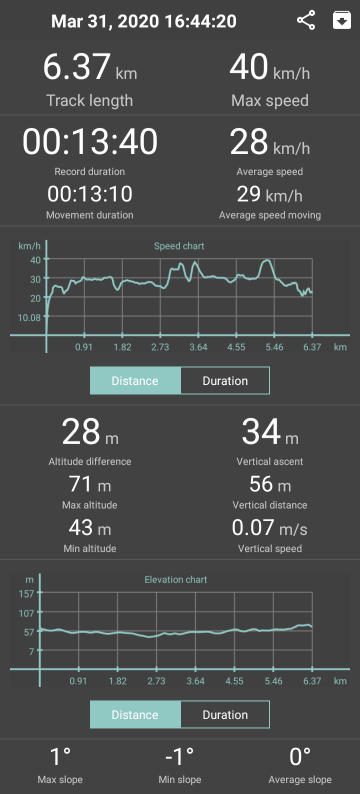
So the stats for the trip are like this:


and its pretty simple to see where the steep up hills are (and I can notice the reduced time I was going slower and the increased speed on those). The downhills are pretty clear. The trip is mostly a gentle uphill as you can see in the elevation.

Maximum speed for such short durations really isn't significant and if anything I think what matters is that but the average speed (and average speed moving) are pretty good. I only had to stop twice, for roundabouts and intersections.

This is the same run but just keeping the normal restrictions and using Power mode:


The Dual does make this trip a bit shorter as its typically 18 minutes, so I shaved 5 off. Which in the greater scheme of things isn't such a big deal, but it is a bit nicer just to be swishing along that little bit faster. Were there more places with intersections (with lights) I'd probably see even less difference in point to point times.

I have serious doubts about wanting to take my MX60 here because the bloody thing weighs too much to hump in and out of the wagon and in reality would probably only shave another 3 or so minutes off the trip.

So there you go. Again the Widewheel dual motor is shaping up as a nice sweet spot for commuting under 10km each way.

Sunday, 29 March 2020

do charger sparks harm the scooter?

Some time back I did an article about sparks between the charger plug and the battery (usually heard as a distinct "TICK" on plugging in the scooter) when plugging the battery in (see this blog post) which makes me wonder if this is actually related to an issue that manifests for a number of Wide Wheel owners.

The issue is that often settings are lost (almost randomly) (in my case) it seems when the scooter is powered down. I may have had the mode set to Power but when powering it back up its soon clear (from the lack of acceleration) that its in Eco mode. Also sometimes the Cruise Control randomly goes to off as well. Now my dual has never done this but my single has done it from pretty early on.

Today in a testing run I powered my Widewheel dual up and it was in Eco mode. Interestingly after a run yesterday I goofed with the power supply and didn't turn it on first, there was a loud snap and I cursed lightly.

My theory is this. The massive surge (which is big enough to cause an electrical arc) may be enough to damage something on the control board.


nothing is visible on mine, but the damage may be something inside a component.

I don't know if this is something on the new Widewheel Pro ... which has a different circuit board.

Let me know if you'rs goes from "no problems" to "randomly losing settings" after an accidental charger spark.

Off the mark drag race

I've been of the view that off the line the MX60 is no faster (indeed feels a little less snappy) than the Widewheel. I've put this down to the larger diameter wheels (just over 11" vs just under 8") it has the same diameter armature and magnet rotor, which will essentially gear it higher (because leverage right). This will assist its top speed which is unquestioned (because bigger battery Voltage and higher diameter wheels).

I did some quick runs first and found that the speed limiter kicked in on the Wide Wheel earlier than the end of the run (which was about 100 meters) confusing the issues, so I turned off speed restrictions on the Widewheel for this test.

So first some data from my GPS app:


The dip in the middle is a turn around point, which my App didn't log neatly, so lets just work with take off. To me it looks like the initial hit of the Widewheel is a little steeper. Overlaying them we can see it is perhaps a little, but its close.


But this app isn't ideal for such comparisons, so I thought (in case) I'd video it and compare side by side. This is that:


This seems to show that the Wide wheel does get that initial  kick going and leads by a nose for a short time, until the MX60 starts hauling it in. Which translates to "it feels stronger" off the mark. This is not unexpected when you consider the way electric motors deliver power and the effect of the effective lower gearing of the Widewheel (discussed above).


As you can see from this figure above the motive force of the motor is strongest when its stopped and gets to a point where it starts falling off in torque soon after take off. Of course since torque is the strength to do work and power is how quickly that work can be done, the more the RPM increases the more that power increases even though torque falls away.

Eventually however the electric motor spins fast enough that back EMF overpowers the foward voltage provided by the battery and you end up with nothing.

Conclusion

So as I've been saying in my ride dialog / blabbering, the MX60 is really a great "cross town" blaster, especially if you've got a number of nice long "bicycle paths" to reduce the stop starting. In theory you should not be riding at over 25kmh anyway, and so the Widewheel will keep up with all but the most serious Lycra Cyclists.

For those not restricted by (or not interested in obeying) such laws then the MX60 will outpace everything else around you except cars.

As I found on my recent video comparison between my Widewheel and MX60 the MX60 uses more juice than the Widewheel on the same trip as a percentage of the battery. Given how much more power that is in Watts it translates to much longer charging times and or much more powerful chargers.

I've got a 4Amp charger for the Widewheel, which nicely charges it (s 13Ah) battery up from 50% in less than 2 hours. To do the same on the 20Ah battery on the MX60 you'd need more than 6A and to be comfortable with such a flow you'd really need to be confident that the charging wires are up to task.

I personally thermally checked my Widewheel for signs of problems when I first bought that 4A charger. I'd need to do the same with the MX60.

As always more power comes with more costs (both time and money).

HTH

Saturday, 21 March 2020

Wide wheel swing arm cover fix


The bases of the plastic side covers on the Widewheel just seem to break all the time, no matter how I've tried they just destroy the base of the plastic. Until now I've used a variously some Silicon and lately the Gaffa tape solution (which is pretty good but falls off after a while).

The covers are more than just decoration they  protect the motor interior from water ingress along the wires when its wet. So I've made what I believe to be a good fix with M3 nylon screws.  I think it looks neat and I hope its durable.


I've used duct tape (which is different to gaffer tape) to cover the heads of the screws (which are clear but have white washers) and hopefully stop any vibration loosening.


In that video I used two lengths of screw:

  • 12mm and 
  • 25mm.
  • washers: M3 
  • and M4 (as spacers if needed, used 2)

In the video I show fitting the first but I fitted all without too much hassle. I just needed to clear the thread on one of the swing-arm fitment points from old permatex and I needed to trim a few mm off one of the bolts on another. I also needed to retighten  (and or course re-permatex) one of the swingarm bolts (as per here)

HTH

Sunday, 15 March 2020

MX60 up and down the mountain

The ride up an down the mountain is something I do with my scoots  not just because its a lovely ride but because its a repeatable and testing route, a combination of urban, roads, hills and mountain roads.


I basically had two reasons to go up there:

  1. I wanted to see how well this new scoot (with great suspension and chassis) performed
  2. I wanted to get an understanding of its power uses
So since that road is good for both purposes (see this blog post) I went there.

Summary for the TLDR crowd

  • scoot handles fantastic at speed
  • the design of the cockpit (platform and stem) is annoying on flats, an obstacle on climbs but good on down hills
  • uses more power per 100km
  • with greater power comes greater demands on energy, greater costs (battery as well as motors) and increased charging times
  • physics is a harsh mistress

Doin it

Basically I'm a pragmatic guy but one who likes to have fun, but be around to have fun tomorrow (unlike some of my dead or badly injured mates of yore). So lets get into some of the pragmatic first. This is the results of my run on the MX60:


Which is very interesting to contrast with the previous run I did back on boxing day on the Widewheel:


So lets just look at the figures:

  • Time to complete the run:43min vs just over an hour;
  • Speed: max speed on the downhill 64kmh vs 44 on the widewheel;
  • Average speed moving: 32kmh vs 24 on the widewheel
Looking closely the MX60 kept a slightly higher speed on the way to, and the crawl up the mountain while the Widewheel dropped down on each successively steeper hill in much clearer ways. The MX60 also maintained a much better downhill speed, and I can say felt more sure footed on the way down. However me myself I have no intention of making this sort of thing a habit, becuse (to be totally frank) my motocycle is far more fun, feels far more shore footed even at the same speeds and I can go faster legally too.

If I was in a rush to get somewhere then the MX60 would be the race winner. If I'm after an afternoon of some enjoyable riding then what difference does it make that one gets me back home faster?

So in some ways I sort of shake my head at wanting to buy a scooter for high speed blasts. Still I guess its like most modern cars, they'll do 160kmh but its illegal and most people aren't ever going to do that anyway.

Power needs

To get and safely use more power one needs bigger motors, bigger batteries, stronger chassis, better suspension and better brakes. All  this comes at costs; not just monetary ones either.

Bigger batteries require longer charging OR higher Volt and Amp outputs, the standard MX60 charger takes 13 hours to fully charge the battery, while standard one for the Widewheel takes 6 hours.
Of course you can upgrade the chargers (if you know what you're doing, if you don't then think explosive fire potentials) and for about US$40 I upgraded the charger on my Widewheel and got a really significant and practical charge time without pushing the limits (see here). Typically I can come home and charge for an hour and its nearly 100% again (say from down to 60%). The battery on the Widewheel is 13.2Ah, so 4A is pretty  decent and only double the Amp rating of the original.

For the MX60 however that's 20Ah and so to approach that (which is 0.3C) I'd need a 6A charger. This now starts to step into serious realms because the MX60 is a 60V system while the Widewheel is a 48V system. A MX60 60V 6A charger means its supplying 360Watt/hours to the battery (which is no small amount of energy as there are common bathroom bar heaters which are 500W) while the charging of the Widewheel (4x48) is only 192Wh and that's just two old light bulbs.

So we need more than double to go from a 1000W dual motor scooter to go to a 1600W scooter ... which is only a bit faster in practice. Recall that average speed moving (which is a reflection of trip time) went from 32kmh to 24kmh ... not double is it.

Meaning I have pay double to get 33% more overall speed.

If you're commuting, it just may be that I catch you (on the MX60) at the next intersection (on my Widewheel).

A last point (which probably doesnt' matter to most) is how much power I needed for my trip. The MX60 needed 708Wh put into it when I got home, while the Widewheel 410Wh. Meaning that my kwh/100km is worse at

  • 3.2kwh/100km for the MX60
  • 1.9kwh/100km
A Nissan leaf (with a few people and groceries) will use about 10kwh/100kmh cruising at about 90kmh. Meaning the MX60  is not as sustainable there too. I mean if one of your arguments is sustainable transport I mean.

Comparing decks

One thing which really immediately becomes obvious when you hit the power on the MX60 is that you've got nowhere to step back to and brace for that power (but hey,  just yank on the bars like a bob weight right? The stem is infinitely strong isn't it?)

Firstly lets look at the length differences:


So the Widewheel (which has a bit less power at take off) has much more board length (700mm), and its got a kickup at the right where its useful. Meanwhile the MX60, because of the stem angle you just really can't get to use that little bit more deck at the front of the MX60, except on down hills. But you'd better hope your feet aren't in any way damp ... because that rubber is friction-less with rubber soled shoes, but the grip is fantastic on the grip-tape covered surface Widewheel. If your front foot slipped off on the MX on a down hill you'd be smashing your nuts into the post then going down like a sack of broken bones. I'll be thinking about adding something to prevent that.


Its like whoever thought of the Widewheel was a agressive rider and whoever thought of the MX60 was a couch potato in need of a transport scooter over rough roads.

Speaking or rough roads, keep an eye on those bolts on the swingarm sides on the MX60, they undo. I put permatex on mine and I'll be adding this to my "keep an eye on it" list.

Lastly I'll finish off with a quick video of some of the other parts of my ride where I reflected on a number of points (not just the down hill-madness-run


If you are one to need a safe space, don't watch that, it contains "toxic masculinity" type language and you may feel afraid.

I did a ride this morning around my usual "gorge run" and got this:


which apart from a few quick "see what it'll do" squirts was not significantly different to the Widewheel either:


Which brings me to my last point, which is:

Safety

There is no doubt in my mind that the MX60 is very stable around corners and can be ridden with little skill around the same corner at the same speed more safely than the Widewheel.

The brakes are very nice (some might whinge about them not being hydraulic) but them being dual moving piston (not single sided) makes them feel fantastic. That you're forced back, by that stem, you don't have to shift your weight back with footwork, just lean back into braking and you're 90% in the right position for braking (well because you're pretty much stuck there anyway). Basically for anyone (I feel thats most people actually) who has poor riding technique that the engineering of the MX60 makes up for so much.

I feel that I won't be parting with my Widewheel any time soon, however I'm not so confident about the MX60 being with me for long.

So that about rounds it up, hope this helps someone.