Showing posts with label water. Show all posts

Friday, 21 November 2014

Hare Brained

I was reading in New Scientist today about Snowshoe Hares and how they are becoming increasingly out of step with the environment in which they live.

Snowshoe Hare (image by http://goeddelphotography.com/©)
Climate change is meaning that snow melts sooner and the hares white coats cease to be camouflage and become instead "target identification" for some predators.

So while the white stands the Hare in good stead in the snow time, by it being white during the early melt changes this attribute from a survival attribute to an early death attribute.

I thought it interesting that the researchers identified that the Hares seemed to not be aware of this coat coloring and did not alter their behavior in response to the changed environmental conditions.
Snowshoe hares appear to be oblivious to whether or not they are camouflaged. "They do not act in any way to reduce colour mismatch, or to reduce the negative consequences of mismatch," says Zimova. When mismatched with their environment, they don't hide more, flee more or hang out in areas that match their coat. In short, these hare-brained creatures don't seem very smart.

Interesting ... I immediately thought that applied to humans  as well. I don't think we are much smarter, in fact as we are aware of the issues we do not change, so we are dumber for it. For instance Urban Development goes on willy nilly , despite great evidence to demonstrate that what we are doing is neither the best nor good for us (even in the medium term) nor good for the environment.

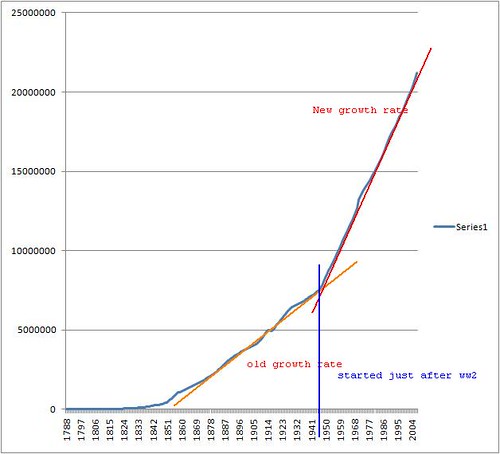
This graph shows the general trends of population growth rates in Australia:

population

So its fairly clear that our population is increasing at a high rate, yet what is our response to this? Well so far it seems to be "clear more land, increase urban sprawl, and make things worse for every other living creature" (and perhaps even for ourselves).

Back in 2011 I wrote (over here) that the infrastructure supporting our lifestyle was under stress and that (for instance) the roads are unable to sustain our needs (let alone support growth, which in my view is actually the problem).

I happen to live in Southport and commute to a small town for work (the city of Logan). It is 51Km from my door to my work door, which isn't a long commute by modern standards but forces me up and down the highway every day.

The other day an event occurred which  is perhaps a bit more drastic than usual, but as anyone who travels that road knows was only a matter of time.


Yep, you read that right closed for 6 hours.

The population density of this region is not really high by European standards, yet (I would argue) that due to urban sprawl and geography there is really no alternative but to accept that this madness is the only alternative if we want to live in the way we do here.

With a population growth rate that's actually the highest in Australia ...


I don't see that the congestion is going to ease until the population growth does.

I live in an area of the world which was once a beautiful natural haven and has for the last 40 years been fast paced into becoming the most overcrowded and over developed part of Australia (well except for perhaps Sydney). This Google Maps screen shot shows the area, hard to find anywhere now that's natural which will support construction. Indeed the only areas as National Park are swamps, wetlands and tidal sand islands.


In fact not yet appearing on that map is a bunch of new clearing (the last patches of bush) in that bit of green up near Coomera. So more population to be going up and down that highway ... more congestion longer delays and an erosion of lifestyle. It doesn't look good for the environment either.  In fact since I put that graph together the data has emerged that the population here has gone to over 700,000. Which from less than 50,000 is a massive change. Of course water will be the next problem....

Who benefits from this? Its not the people who really have no choice but to live in this "pseudo-planned sprawl" and its sure not the ecology or the wildlife (which we seem to say we love so much). Is it just the greedy few? Or is it that as a society we are just stupid and greedy?

As I wrote back in 2008, its bye bye Koala and hello urban sprawl, roads and cars.
So you tell me ... are we much smarter than the hare?

Monday, 3 February 2014

different forms of water

I was out skiing around the lake today and at one of the islands I found this beautiful example of the snow and ice.

There was a rocky island out in the lake covered in a bank of snow. Yet between the gaps in the rocks there was still something of the unfrozen (thus warmer) waters beneath the rocks. As the water gasses out from between the rocks, these ice crystals were growing.


getting in a little closer you can see the wonderful crystalline structure.


Of course the lake is frozen into a big sheet of ice (supporting my weight) and covered in snow (making skiing easier). But despite the well below freezing conditions there is still water as a gaseous molecule in the air coming out from the rocks making these wonderful crystals.

All these different forms of water and so much beauty in all of them

Friday, 5 November 2010

water woes

How long have we been debating the Murray Darling area and its water troubles? The area and its issues are not simply symbolic of the problems of the entire country they truly reflect well most of the issues.

I would guess that only overseas readers are unaware of the issues here and that they have gone on for decades. The calls from environmental interests in this issue have gone from prediction of problems, identification of problems, identification of impending crisis to finally crisis.

Its only the once in 30 or so years massive La NiƱa swing which has saved the day (but only for this or next year).

Today I see that people are starting to identify that the Government being involvement is going to hinder solution to this problem.

Folks even printed out on the lightest weight paper, there is a ton of material on this issue and almost all of it is in agreement:
  • water is being over used
  • the environment is being massively degraded
  • there are threats from sulfate soils being exposed to air
  • a few high water crop growers are consuming the majority of the water
  • the highest use water users are unwilling to pay more for their water
Center to this issue is the fundamental issue that the various State Government Water and Irrigation acts are to blame as well as the Tokenistic historically Colonial governments.

I fully appreciate the local people being up in arms about the "solution" to the issues, but as they say:
  • there has been little or no consultation with the community
  • the responce is simply that of an unfeeling bureaucratic machine.
Like the article mentions:

The result will be a monolith incapable of timely and opportunistic response to changing localised weather conditions.

It will be staffed by federal bureaucrats trying to co-ordinate with state officials with the operational responsibilities, all reporting to politicians eager to secure short-term political mileage that does not necessarily correspond to long-term environmental improvement.

The environmental bang for the taxpayer buck is likely to be significantly muffled by the bureaucratic padding provided by the CEWH.

In reality this problem can only be solved by us ... we need to start to understand the problem at a public level and then tell our politicians what to do.

If we don't do this, then they will simply rule us. But unlike a benevolent Dictator or Monarch this is not a person, but a machine.

Currently that machine is mainly being used by the inept and incompetent to make money for themselves. Don't think so? Well just look at the level of "debate" happening in any area of politics (especially Federal) right now.

Monday, 11 October 2010

how big is the current big wet?

Certainly this October we've had a lot of rain, but apart from relying on the courier mail to just tell us, just what is it like in the perspective of history?

While it is true that this has been a big rainfall for October its not yet a record rainfall. According to statistics obtained from the BoM the graph below shows the monthly records for Octobers in Southport since 1881 ...


To the time of writing, we've had 321mm of rain. The biggest rainfall that I know of in this area was in 1972 when the had 515mm in October. So with October already giving us 321mm here in Southport we are well above average and only 1/3 the way into the month well on the way to it being a record breaker month.

Did you notice the very big spike, thats 1972, but let me get back to that. So we've had a lot or rain and its been causing lots of flooding. Flooding doesn't come from yearly average or monthly rainfall (although monthly is a better indicator) it comes from serious rainfall events.

As it happens I don't have any historical daily data, but monthly indicators are telling stuff. Looking into that graph above we see most Octobers aren't above 100mm and we've already had more than 300mm 11 days into this month, so its no surprise that there has been some flooding.

This leads me to ask do we have that sort of rainfall in other months?

Well below is a chart representing summary data for the last hundred and twenty or so years (since 1881) :


Looking at the highest on record data row we see that January, February, March, April, May and June have all had levels higher than this the highest October.

In fact the "wettest October on record" does not really mean much in comparison to "wettest month on record". This means that its likely that in months other than October we may have bigger wets than this one.


The wettest October on record was in 1972 that wasn't the wettest year on record, that honor still belongs to 1974.

Perhaps no one living here now was here during the floods of 74. Hardly surprising when you look at the growth trends of the region. So with most of the region having no idea as to the climate they've moved into (probably form Sydney or Melbourne) lets have a quick look at what nature has in store for you :-)

Local Weather Trends


Firstly Rainfall is strongly seasonal here, we have a distinct wet season. But as people tend to think in years not seasons we often miss this data when we break it up into chunks starting in January and ending in December. That system may make sense to the Romans but they don't dictate our weather. So I re-arranged the data we record to construct the "wet season view" of things. Here is the view of rainfall from the wet seasons perspective from 1931 till about 2005 (I compiled this during my masters thesis)

It's a messy looking thing, but what it shows is the monthly rainfalls (as height) by season, but starting at August (when its typically dry) and going through to July (when its also typically dry). You can see that the mass of rainfall mainly clusters around December - May, with some individual peaks in strange spots. These are the statistical "outliers" almost like a very wet October is.

Anyway, I've marked two of the curves in that lot for discussion, they are 1972 and 1974. As you can see, in 1972 we indeed had a very wet October (the record one I mentioned above), but it was dry again until Feb when we had actually an ordinary monthly fall and a little less rainfall for the wet season overall.

Actually if you look at all the seasons where the month of October is high we can see far less confusing curve with less data (because October is not normally wet).


It would seem that if it peaks early then its almost as if given all its got too soon and looses out in sheer volume to the seasons which peak later. So while this may indicate good news for those who are getting flooded now (mind you I'm not a forecaster, I look at the past here) it does raise a more significant question:
what happens if we get the sort of rain we're having now in the strengths we've had in our peak wet seasons?

Well folks I think that the answer to that is "stock up on sand bags if you live in a low lying area" and "don't drive your car across flooded roads".

You see, to bring a little local knowledge to bear on all this data, back in 1974 we had a doozie of a flood. My father was rescuing people off their roof tops all over Sorrento and Isle of Capri in our boat.

Since that time we've had greater and greater development with populations growing by more than 6 times in the region (around 74 thousand in 1971 to around 492 thousand now) contributing greater amounts of rain runoff from a much larger impermeable surface (roofs and roads) contributing to greater peak flood events.

So despite the media beat-up on the wild weather, we may be in the clear this month. But, if the past isn't anything to go by and if we get rain for the rest of the month (and continue into other months) then there will be plenty of unhappy people living in what were previously flood prone areas (but have been rezoned as OK during the drought).

Wednesday, 28 July 2010

perception isn't reality

I've been back in Australia for a little while now and it seems its been just the rainiest winter ever. Just like in 1988 (when I bought a particular bike) it seems the dry winter days are replaced by drizzle and rain.

Last night it started raining before we went to bed, and then around midnight it seemed to bucket down. So I thought I'd check out the weather data this morning and found this:


so we had 27mm last night which looking at the month so far:


makes up most of the months rain in one night.

Being a kind of part time climate researcher, I thought I'd pull the data on the entire historical records for this town and have a look:


well, at a median of 56mm for this month (since records were started in 1881) this hardly makes this July a wetter than anything July. We have only received half of the median and less than half the mean.

Somehow seeing the facts and thinking about them (not just the perceptions of reality) I come up with many memories of my childhood of waiting around schools in the wet and rain, wet winter coastal camping trips and nights under the (tiny) caravan annex with the wind blowing and water running across from under the van and past my (raised) bunkbed.

It struck me that if I wasn't a thinker that I could easily go along with the office 'natter' about how much rain we're having this year and how climate change just isn't real.

food for thought?

Well I'm gonna have brekky that's for sure


post scriptum

after getting out onto the highway on my way north (to where I work) it became apparent that the rain was strictly coastal and cleared up. Looking at the weather radar shows how isolated this shower is.


My experience of this region (and looking at regional rainfall data) suggests that this sort of isolated shower is quite common here due to the geography with some areas being dry while others are getting soaked on many occasions.

All too often policy governing stuff is formed by people sitting in offices who don't get out and about enough and view the world only through their window. My water tanks are filled (in the dry times), yet just up the road a little people would have nearly no rainwater.

Which is why policy on managing water resources really needs to be region specific, not just one policy size fits noone.

Wednesday, 7 October 2009

kapulakieli

Here in Finland kapulakieli is an interesting term .. a kapula is a stick or a card which (for example) kids put into their bicycle frames to rattle along when they ride their bikes.

Kieli means language.

so when combined into a word it means something like language, that is seemingly Finnish, but written in such a way that one has to read it over and over again to try and see what it's trying to say. Bureaucratical forms, instructions etc are a common source for this fine art of language.

So in other words ... "flapping your gums"

It seems that Australian politicians are also versed in this linguistic as I read this gem:

Ms Bligh said the latest forecasts indicated the chance of exceeding median summer rainfall over much of the state was only slightly higher than normal.

Anna ... come on ... don't you have anything meaningful to say?

Then there's this:
Some areas such as Jondaryan, Cambooya and Clifton have been drought declared since October 2000.

for the curious that area is here


View Larger Map

gosh ... west of the ranges, west of Toowoomba ... out in classic dry country. Lets look at the last hundred or so years shall we ...


hmm ... median rainfall is not real good at the best of times with barely enough to wash down your roof ... the standard deviation is between 80% and 100% of the median meaning you'll stand as much chance of getting nothing as getting nearly double the values. To pick a high rainfall month it will mean you'll stand as good a chance of getting 160mm in December as you do of getting 30mm in December.

Either way its not much.

I'm surprised noone's planing to build a dam out there ...

You know, we keep wanting to apply the same strategy to solve our problem. There is little evidence that its worked so far.

It takes guts to admit you've made a mistake ... when was the last time you saw that in politics?

Well anyway ... I promise my next post will be about cameras not politics!

Tuesday, 6 October 2009

pushing people around for water

people who read my blog may have noticed I'm quite strongly interested in water, how its sourced and how its used. There has been a dam proposal for some time around the north of Brisbane in South East Queensland. Politicians have been keen to push the dam adgenda for some time, with a number of reliable study showing it to be uneconomical, environmentally unsustainable and requiring the displacement of many people.

Today our Premier has announced:

"I don't expect that people who live in the Mary Valley are going to be pleased with this decision but it is important to understand that over the next two decades, south-east Queensland is likely to grow to more than four million people," she said.

"We simply have to provide them with water and this is the best possible and most cost-effective source of that water."


So with the major dam of South East Queensland (Wivenhoe dam, which was really meant to be a flood mitigation project) not supplying enough water in anything except the wettest of seasons ...


its clear that we need to change something.

The Government is getting twitchy about how voters are reacting in the dry times, how then are we to manage the extra population and avoid nasty water restrictions as we had in 2003 through to 2007? Gosh .. the answer must be we'll need more ...

First, some silly questions:
  1. why are we not planning to be more efficient with our water?
  2. why are we going to have 4 million people here?
  3. do you as a Queenslander want to be living in LA or NY style crowding? (just wait for the increases in road rage)
  4. did you know that by using a rainwater tank for household water uses such as laundry and flushing your dunny we would cut our dependence on treated tap water by over half?
  5. did you know we spend nearly 4 times more on waste water disposal than water provision?

Well anyway, most people on the capital city of Brisbane just want it to keep coming from the tap (they are paying for it after all ...). Since the dam is "away over there", not in any area where there are too many voters, perhaps it doesn't enter into the minds of many ... but how would you feel if you were forced out of your home for others to have more water to waste?

To quote from the leader of the opposition:
"Are we for the socialist state, with its subordination of the individual to universal officialdom of government?" intoned Turnbull, speaking through Robert Menzies' oracular words. "Or are we for the ancient British faith that governments are the servants of the people?"

Malcomb Turnbull

But I wonder what they would really do if they were in power?


Back to the costs for a moment, have you ever noticed that we have water rates (charges), water restrictions (on what we can use it on) but no one gets any rewards for being efficient?

Hmm ... sounds real close to socialism or communism ... you go to work and everything else is provided for you by the state.

I mean think about it in money terms ... would you (say) give you kids a visa card and just pick up the bill on how much they spend? Put "use restrictions" on them like you can only water the garden on odd or even days if they go over $1000 a month? Surely this is not the way to learn how to be economic?

How come no one in government seems to notice that we can do more with less?

To me it seems that water has become some sort of national welfare thing ... you get taxed, you then expect there to be unlimited water, but you're not allowed to manage it yourself.

Remember it was only in the last major drought that public opinion forced local governments to allow water tanks again ...

Some further reading on this can be found on another blog of mine here, or if you are really interested in the topic you could take a glance at my masters thesis here.


PostScriptum

There seems to be gathering momentum on this decision being a bad one, as this ABC report suggests.

Wednesday, 9 July 2008

it comes from the tap...

Water

we all just think it comes from the tap, especially if you come from a town or a city.

A few years ago I'd say that you've probably either never given it a second thought, but in Australia at least it has become a hot topic (especially with the introduction of water restrictions). What, with media attentions, news paper articles, talkback discussions it seems that almost noone can have dinner with friends these days without the discussion turning to water issues (such as a rainwater tank).

If I may quote the first paragraph of that wikipedia page just up there, it says:
Water restrictions are currently in place in many regions and cities of Australia in response to chronic shortages resulting from drought. Depending upon the location, these can include restrictions on watering lawns, using sprinkler systems, washing vehicles, hosing in paved areas and refilling swimming pools, among others. Increasing population and evidence of drying climates, coupled with corresponding reductions in the supply of drinking water, have led various state governments to consider alternative water sources to supplement existing sources, and to implement "water inspectors" who can issue penalties to those who waste water.
well, that's what it said when I accessed it on Tuesday, 8 July 2008.

I've marked in red the points which pique my attention.

Drought: while everyone "knows" that we're in the grip of the worst drought known to mankind, the fashionable topic of Climate Change seems to be the first donkey to get the tail pinned to. Certainly there has been some depression in rains, but is it fair to lump it all at the feet of Climate Change? For example, here is the rainfall data for the Queensland coastal town of Southport from 1882 to 2006 (this is now part of the Gold Coast City). If you can see any remarkable trends towards less rain in there I'll be interested to hear where you think they are and why.


Btw, the period called the worst drought is from 2002 to 2006, this is when the water restrictions came into force.

Interestingly the term "drought" can be defined as things like "a protracted period of deficient precipitation" (makes sence to me) or "acute water shortage". This last definition is interesting, because if (say) population increases (but climate doesn't change) then with more people drinking the water there'll be less water.

So is this drought acute water shortage, rather than anything caused by climate? Lets see if the population has got anything to do with this ...


This graph is the change in population from 1961 till 2001 (and its grown a further 15% between 2001 and 2007).

Looking at the growth of population from 50 to 500 thousand between the 60's and now. Clearly all other things being equal (like how much water each person uses) we must be drawing at least 10 times more water now than then.

If then we say that drought is "acute water shortage" well, its no wonder to me that with 10 times more people wanting water that there is some kind of water shortage.

Rather than looking at this as being any significant change in the amount of water that the environment provides, lets look at it from the perspective of dividing a bucket of water among increasingly larger population.

If we think that the bucket was big enough for 200 thousand (there were less than 100 thousand when the system was designed), lets see how it goes as we successively divide this across more people. The chart below does just that:

Looking at the amount of water available to us (through our dam which puts that water into our taps) it would seem that (based on the calculated and measured ability of the dam to provide water to us and not become empty) the population in the area at around 2001 finally grew to exactly the limit of water availability.

No environmental drought here, just water shortage from too many people consuming water. So it seems that it is over consumption of the resources, not the commonly stated reasons of "not enough rain" being the most significant aspect here. As can be seen that we're not getting a statistically lower amount of rain than shown as normal in the above historical chart, but we are increasing the population significantly.

So it seems like its population increase rather than anything caused by climate change. That's a pity ... that means we can't blame the environment for our woes and we have to take responsibility for it ourselves. Wouldn't that be a change!

So, are we at some sort of limit?

Maybe ... The idea that there may be some limits to growth has been around since the black stump was a tree. It was perhaps popularized by Thomas Malthus who generally believed in growth of populations as over using the resources available and being the cause for famine. This limits to growth idea has not gone away, despite the many criticisms of it.

Some put forward that technology can come to the rescue (hasn't it always) and provide us with more water by such methods as membrane filtration to recycle water and provide desalination methods. While this is certainly a source of additional water it comes with an energy cost (and energy costs money too).

I thought I'd look into the additional energy costs if we follow this path, which I've called a Business As Usual use of water. The solid red line shows the increase of energy need created by sourcing our additional water with desalination methods. To provide some sort of contrast or comparison, I thought I'd add another where magically we just had more rain fall into our dams (marked with the red dotted line).

Now since the population of the Gold Coast is slated to rise by about 3 times in the next 50 years I plotted this energy requirement change over time with the expanding populations.

As you can see quite quiclky the energy needs are higher by using the technology to "make more water" available. By the end of 50 years the end points of the red lines are quite far apart, as population increases this becomes rather an enormous power demand. But what is that blue line in there?? Well, I'll come back to that in a moment...

Is this suggesting that Malthus was right? There are limits?? Well it depends, people used to prove that it was impossible for humans to fly, impossible for us to travel at faster than 35 miles per hour and impossible to escape earths orbit.

A problem is created by the way you look at something.

If we were to use canons to fire us into space then the maths proving that man could not escape earths gravity are indeed correct. Luckily for the astronauts they didn't follow that school of thought, and used rockets instead of canons.

So if we change the way we think things then perhaps what seems to be a limit is in fact not one at all. Ecological Modernisation is a school of thought which suggests that we can solve our equation through a combination of moving further into technology use and balancing supply and demand along ecological lines.

Now, lets go back to my chart and that blue line again. If we were to change our water use methods to reduce how much we drain from the tap, say by reusing water (eg using shower water to flush out toilets, or say the rinse part of our clothes washing), we can in fact reduce the amount of water we need to use without needing to change anything much.

Using a view point called Urban Metabolism to consider the city's water needs (like considering your own metabolic needs) its possible to consider the city as like a plant. This has roots in the ground drawing water (the pipes transporting water from the dam to our homes) and leaves where water is used and ultimately lost back into the environment. Some plants are more efficient with their water than others (like Cactus) and can do very well when there is plenty of water and cope when there is less. The blue line represents the energy needs of the metabolically efficient city. By consuming less from the environment and using it more efficiently not only is the city within the environmental limits, but the cost is also reduced!

So, if we were to plan our directions towards reducing consumption from the supply (without changing our need for water) then we can effectively cope with the lager population. If we do things like this, then Malthusian limits to growth are non existent.

But are we doing that?

Well, it doesn't look like it. Instead the South East Queensland government is mandating the construction of expensive desalination and water recycling plants. This in turn will mandate the construction of more and more power generation plants (to cope with the added power needs) as well as in all probability result in more generation of green house gases, making worse any climate change effects which are perhaps attributed to our use of energy.