Showing posts with label electric vehicles. Show all posts

Thursday, 16 April 2026

The Flying Flea (and what Journalists get wrong)

Long term readers of my blog will know I've had a lengthy interest in two wheeled machines and even 2 wheeled EV type machines. So it should come as no surprise that I'm quite interested in the Flying Flea by Royal Enfield.


I don't want to get into the comparison with the original (read a bit about that here).


but you'll also know (dear reader) that I have an interest in motorcycles, including classice old style ones like my SR500


... which is of course an internal combustion engine type not an EV.

Also I've written more than a few articles where I dive into the energy consumption per distance travelled and found interestnig things with ranges in various conditions from

so you can see that a stand up scooter with little wheels the idea of getting 2kWh/100 is not absurd, so when these articles seem skeptical about the Fleas claims; for instance NewAtlas writes


Which given the 3.9kWh battery  suggests that over the100km range is entirely possible >> if you consider the reality of city driving in India << and drive according to the commuting reality there ...


where you won't be doing 60kmh that much.

Personally I'm keen to see one, but the reality of my location and the pernicious Queensland registration costs are that I'm unlikely to buy one because I can't really use it much here. If I lived in a more sizable town (like Warwick, or back where I came from on The Gold Coast) it would be perfect, but here in my town I prefer my electric scooter or my bicycle.

A pity really; but who knows I might try to justify it.


Wednesday, 21 July 2021

EV breaks the ICE (maybe)

We all know that EV's will save the world by reducing CO2 emissions to zero.

right?

Well ... the other day I was in the supermarket and I saw this vehicle promotion set up


No prices mentioned ... but I'll get to that

I sauntered over and looked at the stickers on the windscreens; first the Niro


I couldn't help but notice that it was Zero ... yippie ... but what's that hard to read small print in low contrast there?


oh ... what do you mean "unless 100% renewable energy is used?"

Well if you charge that in this area at home at night then its basically going to be electricity coming from the Coal Powered grid, and so the "combined test" 16kwh / 100km ... or (as identified in a previous post) means releasing 13.6kg of CO2 / 100km ... oh dear.

So lets have a look at the Cerato


Which gives 6.8L of fuel per 100km, which will translate into (based on their claims) 15.8kg of CO2 / 100km which isn't much different to the reality of 13.6kg really.

But wait, what's this Combined and Extra Urban??

well this is because Internal Combustion Engines (ICE) use less fuel on highway use than around town use. Interestingly with EV's this is reversed. This is backed up by not only this site:

Unlike gas- or diesel-powered vehicles, which regularly beat their EPA ratings in our highway testing, every one of the 12 EVs that we've run range tests on to date has fallen short of both its EPA highway and combined figures.


but in the personal experience I have with friends who own EV's and also my scooters. Literally the faster you go the worse it gets (which is also true of ICE powered cars, but nobody tests them doing 80km/h along the track).

So this means that out here in the countryside that Niro will be more likely to be used at 100kmh NOT "combined" which will mean that the CO2 produced will simply go up above that claim, and maybe produce even a little MORE CO2 than the ICE version.

Oh Dear. 

No wonder they didn't list them separately ... cunning.

Prices?

So the Cerato is the 1.6L Turbo with Dual Clutch Transmission which is listed at AU$34,190 while the Niro is listed at AU$70,990

FARRK that's over AU$36,000 more.

So lets just do some quick stuff here. At current prices of about AU$1.50 per liter even just spending $30,000 will give you 20,000L of fuel which even at 8.9 (the urban figure) will give you about 222,222km (or something like 10 years of driving).

As always the devil is in the details when dealing with King Wang Marketing...


Thursday, 3 June 2021

My position on Electric Cars

I did my masters research in Environmental Science, my focus was on sustainable development and I believe strongly in the viewpoints of Ecological Modernisation.

So that being said I have nothing against Electric Cars (EC) per se.

Modernisation should be undertaken in a stepwise manner which is consistent with Sustainable Development. I do not see evidence that the EC industry is sustainable, but it is quite happy to ride a wave of public sentiment which is essentially based on the idea that it is a panacea for climate change. It is not. Instead we see Government "picking a winner" (that'd be EC's) and pushing that agenda. This is a bad idea.

What I am against is what I see as the following list problems.

Why do it?

Well first there is the idea you're saving the planet with reduced CO2 emissions, lets work an example.


In a recent test on the Mini SE (electric) it used about 32kWh to cover 190km. This is about 17kWh/100km which is pretty typical. However if you charged that in Queensland apparently that results in about 26kg of CO2 (according to this site  https://www.powershop.com.au/carbon-calculator/).  

Now if you drove the regular Mini (based on its claims) it will use 11 liters of fuel which is about 2.4kg of CO2 per liter or 26.4kg of CO2

"I just shit my pants" (laughing), because you just spent $10,000 dollars more to virtue signal on something that does not achieve the objectives you imagined it would. Does that make you a fool or a zealot?

Motivation of Governments should always be viewed with scepticism (see this older post), as should the motivations of industry. When I see things such as the following I find it hard to not be sceptical about the actual motivations.


Such things in the points as diesel cars, curiously touted by governments and backed by fuel price advantages previously, are now bad news; this in a matter of a few years. I understood that the incentives to get into a diesel car are now dwindling ... will that happen to ECs? Well yes, we already are seeing that in places that began adopting them.

While arguments are made for the reduction in "tail pipe" emissions from cars in cities the drive to replace hydrobarbon based conversion of energy into motion in the car to only storage of electricity in the car is not backed up by similar clear spending on generation sources and transmission sources of  electricity.

Its well understood that most generation is not without pollution (even CO2) and the best studies have shown that its at best about 30% reduction of CO2 depending where you live and how your electricity is generated. Yet we do not see a proliferation of ECs in the lower power demands, we instead see them in the higher power demand areas. Tesla leading the charge and BMW and others coming on board.


The prices are certainly not something the average person is going to afford, with them being priced in the order of over AU$100,000.


Top Down Driven:

Meaning that in the "top price tier" there isn't so much of a difference between the xDrive and the older X5 BMW, but for "people's cars" the bill is very high. This is not news to me, as my recent comparison of "like for like" EV vs regular (now called) ICE cars shows you pay more than double (nearly 3 times) down at the lower end for the same thing. 

There is no mention anywhere of how many kW hours per 100km these BMW's consume. Which is even something that the average person (the one expected to make decisions) barely understands. Even when it comes to liters per 100km in their car ICE car. 

For reference my eScooter consumes less than 2kWh per 100km and the most generous figures you can expect from an Electric Car is more than 10 times that, but that comes with the issues of recharging (soon).

Fairly clearly these Electric Cars are not aimed at the masses (even the Hyundai EV, for who on the low end can afford 3 times the price for a basic car), nor it seems aimed at doing anything more about reducing CO2 than virtue signalling. Remember, electricity often depends on stuff which generates CO2.

However it goes deeper in my view, because the central (yet to be solved) issue is the cars battery pack. Currently this is Lithium, which while itself abundant currently relies on elements which are certainly not, NOR is there a certain supply of it (places such as the Democratic Republic of Congo and China being the world top two suppliers).  Lets side step the supply and ethical issues involved right there, but expect wars over this. Just like wars are over petroleum right now.

Its commonly touted that battery prices are falling (but ignored that the battery packs in cars are requiring more and more battery), with even reputable institutions putting out "public fluff" in blog posts selling the idea that  lithium batteries are getting cheaper.


I personally love the projection into the future ... suggesting it will continue falling, but their point of "look out, auto industry" is perhaps the storm that will drive prices UP not down.  Its quite certain that there is not enough battery being made (probably in any short time being able to be made) to supply the volume of batteries the ECs (which apparently we all need) will require. 

Fun Fact:

Did you know that while your laptop has maybe 3 lithium cells in it, my scooter 78 that a Tesla has over 7000? So if we consider the battery an essentially non recyclable component, and indeed a representing a scarce resource its important to make good use of it. We can make 100 eScooters per Tesla just on batteries alone ... so which would make more impact for reducing emissions? Tesla on the road or 100 more people in (say) London using an eScooter for last mile?

Yep. We are going to need a LOT of batteries. I read recently that a major Italian conglomerate is stepping into the ring:


which may sound encouraging but will this actually reduce prices or will a massive demand increase drive the price higher? 2Giga-Watt hour ... it seems a big number, but how many EC's is that? Assuming that an "average" EC needs a 50kWh battery that's about 40 Thousand cars. Currently the EU buys about 1 Million  cars a year ... so thats enough to give 4% of new car sales. Piffle innit.

Perhaps they are only in there because of government distortion of the market?

What do I mean? Well apparently Europe has now decided that even Hybrids are not sufficient to satisfy their regulatory requirements


which pretty much leaves EC's which means more battery sales and probably because of demand higher prices for the makers (who are already in a tight margins game).

What is Power

So, if we have an Electric Car we have to charge it right?

The power needed needed by EC's is best understood in Watt hours ... like if you run a bulb for an hour, or a car for an hour you need Watt hours. Most people (or so it seems) do not understand their power bill, so lets have a little look at mine:

So last month I used 168 kWh, if I'd had an EC and was charging it at home, and lets say it was one of the better EC's that uses 17kWh/100km and I did 20km per day (getting to and from work)  that's 100km or 17kWh per week (just to and from work) that's about 70kWh per month. That's a lot less than the average distance driven per week, which is much closer to 260km per week or about 176kWh per month, meaning double my draw from the grid.

Notice I didn't talk about the money ... just the draw from the grid.

So the grid will need to account for at least something like that in order to cope with the load.

Sure, we'll do it in stages, but you know ... somebody has to pay money for all the increased power generation, all the increased grid capacity and probably this will come in the form of increased power costs (so you'll pay more for your power). Also you'll probably have to pay something in the short term because power (measured in Watts) is underlied by two factors (sorry, again the general public is going to have difficulty with this because many failed science); Amps and Volts. Indeed its simple its exactly a multiplication. 

If you are going to pull 1000Watts (that's 1kW) from the grid then (assuming you have 240Volt power as Australia, Europe and the UK do; but America doesn't) you'll have to pull about 4 amps. For every 1Kw you want you'll need to add another 4 amps.

If your battery (like the BMW is 77kWh; go back up and check) and you want to charge it in 10 hours you'll need to pull 7.7kW from the grid for those 10 hours. This equates to about 30amps ... 

So?

Well the average house is wired to cope with pulling about 80 amps from the grid, so I hope you aren't using your AC or Electric Heater, Boiler or other electrical appliances because if you are you'll trip a fuse that's INTO your house and you'll be "off grid"

Clearly unless of course we get some magic solution we will be setting ourselves up for problems.

So back to Sustainable Development to me

  1. none of this seems sustainable ecologically
  2. it does not work economically for the masses
  3. it is a lot of effort for a smaller return, perhaps even a negative return when all the adaptations are counted in.

Alternatives?

To me the Sustainable Development is to do the following

  1. work at actually reducing your driving, get a bicycle or maybe an eBike, a  small motor-scooter (perhaps electric?) or an eScooter for those smaller trips (like getting to work). Myself I've cut my petrol consumption in half using the above.
  2. use public transport as much as possible, perhaps get a folding bike or an eScooter for the "last mile" (*as eScooters are not legal yet in some places (yes, I'm looking at you UK) then perhaps agitate for that?)
  3. try to think deeper and really grapple with the problems and the knock on effects
Friends of mine will know this is not my first post on Electric Vehicles, indeed I've had a few (see here, which will include this). Interestingly this whole thing really hasn't changed in the last ten years, as my first post on Electric Scooters was just over 10 years ago (think Vespa, not the stand up type you can take on the subway). In that post I clarified that it makes no economic sense and returns little benefit to the consumer. Nothing has changed, and all that has happend is we've clarified that without cheaper electricity that is not polluting there is little benefit to the environment then or now for EC's.

Indeed if batteries are wasted (like the 10 year old Nissan Leaf rotting up my street) then the advantages of an EC are quickly negative. I fear that in the hands of "the general public" (because right now its only enthusiasts) we'll see lots more "lost resources" with people stuffing up their EC's by misoperation and general neglect.

Its a path we need to consider carefully before rushing into. Ecological Modernisation isn't just about what technology Society uses, its about how Society thinks and operates ... this isn't just about consuming, about buying more (but Tesla and BMW would love you to think it does), it means you need to engage, you need to understand and you need to act!


because in reality we are fighting for our childrens lives (so make sure you understand the basics).

Sunday, 11 April 2021

Widewheel battery durability testing (revisited)

 I enjoy riding up and down the local mountain road. Its not only a very pleasant escape but its an excellent opportunity to test the battery and how its shaping up.

Now its worth while remembering that I bought this scoot in July 2019, which means its nearly 2 years old. In that time I have followed the following principles of battery handling

  1. always fully charge it (some minor exceptions exist)
  2. use the scoot soon (within a day) after charging
  3. do not recharge if I know there is sufficient charge to make the trips I'm intending (frequently I do three or four 3km trips in a day)
  4. it has been charged at 4Amps since I bought the fast charger in Jan 2020
So over the last (nearly) 2 years this equates to about 312 full charge cycles in its use.

The Test

Load testing of batteries is the best way to determine their health and their current capacity. Usually load testing is done on a bench with tools to map out the battery performance (represented by voltage) under a stated load. Since people are often confused by data that's about each cell (the 18650 cell) that comprises our packs I've annotated this graph with the voltage that a pack of 13 cells in series would show if tested this way

So yes, its normal for voltage to drop over the discharge of it. Importantly this is for a single cell, and discharged at 2Amps; as my pack has 6 cells in parallel for each cell to get 2A sucked from it the motors would need to be sucking 12A out of the pack (cos 2 x 6 = 12 right?). At 48V that would amount to something like 500W on the flats to do 25kmh. which is a pretty reasonable estimate of the power . Then given an 8% grade which my parameters indicate that to keep average 23kmh up an average 8% grade will need 743W. Suggesting that on the climbs I drew more like 2.7Amps per cell.

So its ball park and a good actual real world test

To refresh you with the course the distance and elevations are:


Basically I did that route again. 

Rather than record the whole trip again I decided to record just the most important parts: the slug up the hill from the bottom of the steep climb up to the top.


This clarifies the grade of the climb, the length and that the scooter just hauled up with almost no change in speed. Impressive on a 2 year old battery. 

The return voltage was 46.4V which is almost exactly what I'd got in the past and charge required 406Wh to refill which is almost exactly what I've got in the past.  This means that over 26km I consumed 406Wh which is 1.6kWh/100km (15.61Wh/Km) or almost exactly what it normally uses (no surprise there either).

Points to consider on this I went up to Johns (adding a couple of km of uphill) and on the way up to Queen Mary I had a tail wind (which would have assisted somewhat). On the way down (of course) I had a head wind, but for the steepest parts the speeds were still sufficiently high that back EMF would almost fully negate any additional power demands for that.


Previous results

This test was pretty much a repeat of many tests and probably the best reference is this one from May last year, back then I determined there was no appreciable loss. Another test run worth a look at was this one (where I dug into more figures)

Conclusions

So given that this scooter is two years old, and has been (as mentioned above) fully charged when cycled (but usually no less than 40% before recharge) and is still performing within all practical intents as new. This is not unexpected and something which I explain in this blog post here. I've got further discussion here and here.

So the next time your on Reddit and some pack of fully ignorant-kiddie-wankers go on about killing your battery by charging it fully (NB using it as designed) ... just ignore it ... there is no evidence other than the clear evidence that they're idiots.

Saturday, 27 February 2021

more on electric cars

 Over the years I've written occasionally about EV's. Indeed I own 3 (one's on loan, one I'm selling) Personal Electric Vehicle (PEV) which has allowed me to make 100% of my around town commuting and shopping electric (either here in my country town or when I work down in the State Capital City).

Over the 10 years since I wrote my first blog post on EV's (I was pretty critical of them) I still feel that there is no clear case for them from an economic perspective. Worse I am now clear that with any existing technology there is utterly no way these can be rolled out to the masses like the Shills (I encourage you to look that word up in the link) who try to convince the market to get into one.

  • Materials for batteries being the most compelling problem for mass roll out and
  • electric generation and grid issues being the next.
There is basically no sound economic argument or even environmental one for this whole circus.

Someone will ignore the first paragraph and say "why don't you like EV's" ... well here's a link for you explaining the issue.

let me be clear

I believe that ultimately we will develop a closed Carbon Cycle system, we bloody well need to but its not here yet. Until then I go with small scale but big benefit. PEV.

My use of my PEV has reduced my petrol usage by an enormous amount, not to mention done my part to reduce the many issues which are caused by cars (EV or ICE).

I have a petrol motorcycle (which I use for local intercity work) and a petrol wagon (which I use when I have to carry loads, if its pissing down rain, or longer intercity transport such as when I drive down to the Capital for work with my weeks clothes and stuff).

Working from home (thanks COVID) I now put petrol in my motorbike perhaps every 2 weeks (12L) and petrol in my wagon about every 6 weeks (50L). Based on my logs (yes I keep a log) this has about halved my petrol use.

Contenders

I am not the sort of guy to buy a hot performance car but rather have a more "middle tier" practical car. I've personally never spent the money on a new car (because depreciation) and have always bought a good condition car (myself never spending more than $6000 on any car so far).

Its hard to get an eggs to eggs comparison (one can't easily compare a Toyota to a Tesla) however Hyundai makes a great car that happens to be the same car with the same interior and just Petrol VS Electric.

Here  it is:

So the first thing that jumps out at me for what is otherwise the same level of equipment and specification (both 2WD, not AWD) is the price (for the A MerryKan readers AU$ = Australian Dollars)

ICE = AU$24,000 (data)
EV = AU$64,000 (data)

this is because there are no "freebie" hand outs to customers of EV's unlike some countries.

so what do you get for that additional $40,000 ... (myself I'd be able get 3 more new cars or some dozen or so good used cars)? Well in the main your get virtue signalling (and if like many in the population you live in an apartment building probably difficulty in charging) but also get a fair level of occasional inconvenience.

At current prices petrol is about AU$1.4 per liter ... that's 28,571 litres of fuel, which at a conservative 7km per 100L is enough to drive you 400,000 km or on average (25,000 per year) good for 16 years of driving.

What's the chances you'll keep the car for 16 years? Heck, what's the chances that a modern car packed with electronics will last 16 years?

Most commonly these things break down and become uneconomic to repair (often a cheap electronic component buried dozens of hours of labour deep in the car) well before then. 

Did you notice I didn't even factor in electricity costs? Yes, its so far ahead to get an ICE car that even if you get free power you'll never break even, probably even the second and third owner won't.

So what do Hyundai say themselves about the running costs?

Lets run two scenarios, one at $1.40/L for fuel and current household power costs (oh, you know what you pay for power of course don't you, regularly check your bill, understand it ...) and the other with a possible future with EV's being charged higher rates for evening charging at home and perhaps on a differently TAXED electricity tariff (oh, you think the government is going to forge tax such as in fuel excise for ever?).

so with a fuel saving of $587 / year it should only take you 68 years to break even on the additional $40,000 you paid up front (or 126 years if the price of your EV's fuel (electricity) goes up. It only gets worse if the price of fuel drops because demand is dropping ... which it already is.


dam ... that's going to hurt.

Sadly it gets worse, because the savings are based (according to Hyundai) on this:


This tool is for illustrative purposes only. A consumption rate of combined 7.4L/100km has been assumed. Actual consumption rate and fuel savings for your vehicle may differ. 

Ok then, since its a run-around town car, what if you bought a smaller 4cylinder car that used less fuel, say something in the order of 5L/100km ... like say the Kia Picanto (a perfect little round town run-about) then you'd pay AU$14,190 new (so thats now $AU50,000 less up front) and it is suggested to use 4.2L in urban usage ... factoring in that reduction the Hyundai calculator suggests the savings cost on the electric is $96 per year

... oops

Whats next

Then there is (not so small) matter of weight. One of the important issues with anything that stops and starts is weight, the heavier something is the more it takes energy to change its speed (physics is a harsh mistress).

Lets look at that
  • nasty foul mouthed ICE engine Hyyndai = 1353kg
  • pretty dainty EV Hyundai = 1743kg
oh dear ... dainty little EV is quite the heavy bitch isn't she? That's 500kg and the equivalent of having 4 people in the car right there.

I hear you ask "Why the fuck is that?" - Well I'll give you a guess its a word beginning with B

envelope please .... and the winner is ... Battery!

You see to have any sort of useful range (claimed a bit over 400km without head winds and no hills and certainly not carrying 5 people as its supposed to be able carry) this baby needs more batterys ... which weigh ... 

This is on contrast to my PEV which weighs 30kg (yep) and that I can easily load into my wagon and when in use in real world mixed conditions (including climbing mountain roads) gets me the very excellent 1.9kWh per 100km ... the Hyundai however inconveniently doesn't mention this on their web site (anyway, its all numbers, confusing meaningless stuff to the innumerate. And if you could do numbers you'd already be laughing) however if we look around on the internet we can find:

 15.3kWh per 100km

So in a commuting role my PEV consumes 0.19kWh on a 10km commute while the EV 1.5kWh ... and interestingly gets me there in not much less time (particularly in morning commuting traffic).

outcomes

All this looks a lot worse if you're the type to sell the vehicle after 3 or 5 years. You'll take a bigger hit on depreciation (because you have a bigger capital investment) and that will still not make up the costs of fuel. Redbook suggests in the first 2 years you'll loose nearly the entire price of a new ICE car in depreciation of the EV version alone.

Basically it comes down to this:


and why all the Shills out there get you to make emotional decisions

but what about saving the planet?

If our fundamental goal for an EV is reducing C02 then its pretty well established that driving mile for mile that a EV produces less C02, however exactly how much depends on how the electricity is generated (oh, you thought it just came from the wall didn't you). According to this study (on a pro EV site) we see its about 22% less.

This means that to equal the "eco friendly" aspect of an EV you just need to drive your ICE car 22% less.

and I haven't even started on the bottlenecks emerging on the production of batteries, or the ethical issues in the production of core elements of batteries. But that would only be more of those troublesome numbers.

I'm sorry but sadly we are not able to "consume our way into sustainable development" so (as the Norwegian study on electric cars found) if you want to make a difference:
  • use a PEV (which uses a tiny fraction of the power that an electric car does)
  • a PEV typically contains 1% of the batterys of a basic EV, meaning that 100 PEV's can be made for the amount of battery that 1 EV contains. 
  • use an actual bicycle (eBikes count as PEV)
  • use public transport
  • walk more
  • combine 2 or more of the above
If you still want to get an EV then I strongly suggest something small with just sufficient battery (say, 20kWh) to make around town shopping and commuting well within its capacity. You are hogging less batteries (meaning there can be MORE EV's) and you'll spend less. Either buy or rent an ICE vehicle when you need to travel over 100km.

If you're thinking of a Tesla, then you really are a Religious Electric MORE ON or just after the power and performance, thus not concerned with environmental anything in any other way than seeking prestige in social signalling (also known as wanking).

So if you really want to save the planet then get a PEV and drive less ... if its something else then please, stop with the virtue signalling wankery ... right?

Wednesday, 15 July 2020

selling shit to the unwary

eBay is a great place for bargains, but equally you can get shit there too. Happily the buyer protection system works. Case in point, these 10,000 mAh 18650 cells:


there were originally 4, but one has been sacrificed on the altar of science.

I was instantly suspicious about these cells as soon as I opened the pack, they were too light. I popped them on the kitchen scales and they weighed 24g each. A typical 18650 should weigh 45 ~ 50g

A typical 18650 should be expected to deliver somewhere around 2000mAh (even a cheap one) or more. However I'd sort of expected these to be "below par" and perhaps be ok to 1500 or so ... sadly for the seller I have a cell discharge tester and a few tests found that these cells were about 350mAh.

That's right

  • good = 3000 (or so)
  • average = 2000 (or so)
  • these = 320 or about a tenth of good and four times less than I'd expected
That's of course simply shit.

So, why is it so (and indeed how is it so)?

Naturally I decided (after getting a refund) to cut the head off the cell and have a look. I found this:


and almost immediately noted the abundance of empty space in there with very little winding of "electrolyte",  becoming obvious when pulling it out of that cell


I count 9 turns ... which is low (commonly its over 20)

Here's a quick video


so, measuring the area of that electrolyte (as shown in the video) I get about 137cm2 which is also very below par with this publication suggesting 846cm2 for the area.

As 137 is about 0.16 of the area then that pretty much perfectly reflects in the reduction of capacity because 0.16 x 2000mAh = 323mAh ... or what I measured. Good thing I didn't use these cells for attempting to build a scooter battery.

So this is of course a working practical example of why you went to school and why they taught maths.

Monday, 27 January 2020

Scooters as practical and ecologically sustainable transport

I love my scooter as a practical and fun transport method for short trips. Not only that but its just bloody practical to store at home too (right at my back door).


Making it super handy for a quick trip to the shops, or up the hill to visit my elderly mate. Pictured is my 500W single motor

One of the aims of most transport planners is to encourage less trips (especially short trips) by car, to minimise the impacts of cars on both infrastructure and the environment.

Cars (generally speaking) last significantly longer and generate less pollution if used for long continuous times, not shorter trips with lots of stopping and starting. Around town their fuel use goes up (per km) and the emissions get worse both in quantity per km and break up of what is emitted. Engines do better warm than cold.

Wikipedia has an interesting article here that goes into it, and puts walking as the standard (which is pretty efficient) and bicycles make that twice as efficient:
A standard lightweight, moderate-speed bicycle is one of the most energy-efficient forms of transport. Compared with walking, a 64 kg (140 lb) cyclist riding at 16 km/h (10 mph) requires about half the food energy per unit distance
Interestingly they find that a scooter gets nearly 25km per MJ of energy, while walking gets only 4.5. This puts the scooter at the number one spot for efficiency by a big margin (discounting the Velomobile simply because they're really quite impractical and have some real visibility problems in traffic).

 So leaving the exercise benefits aside (which perhaps you shouldn't), considering also time taken to get somewhere as part of efficiency, of all the mechanised transports a scooter is about the most efficient in particular for short journeys (which becomes clear when you compare the data in their table)

Now its interesting that the data from the Wikipedia article above has for scooters comes from simply the claims of Xiaomi 365 based on their claimed maximum range.  Now, I know that you know that claimed ranges are not always reliable, so I have been making some measurements of energy usage on my own scooters (as you may have seen in other posts) and thought I'd do some additional tests. On this test all I did was one specific run, then recharge it. This is the run I do (discussed before here):


and so yesterday I did it twice in the following manner:

  1. fully charge the scooter
  2. do the run
  3. rest the scooter for 20 min and then recharge
I got an average of 147Wh needed, which means 15.3Wh/km or 1.53kWh/100km to use the same language used in that above table. This is not significantly different to the most optimistic claims of the much lower powered Xiaomi (which is 1.15Wh/km).

That's simply amazing stuff, and for contrast Tesla Model S is cited as being 17.25kWh/100km (best case), so 10 times less energy.

Yet (considering time) I'm sure I can walk out my back door, step on the scooter and be at the local shop (just under 2km away) in less time than I could do it in either of the above EV's

Impressive stuff.


Further, readers of my blog will note that I've done quite an amount of experimenting with small scale solar and I know that even multiple recharges per day of my Mercane from a solar system with 200W worth of panel (and controller, inverter, battery).

So in the event of any infrastructure failure I'm also covered there too.

Conclusion

Now all this is just back of the envelope stuff, but I'm sure that well treated and well maintained one should be able to get similar usage life out of a scooter when you factor in how much smaller it is, how much less you had to invest to get it, and how much less you'll pay in operational taxes. A starter for that calculation is this:

  • my Mercane dualie weighs 24kg, a Model S weighs 2,225kg 
  • my Mercane dualie has 78 lithium 18650 cells a model S has 7,104 
  • my Mercane cost AU$ 1400, a model S cost AU$140,000 

so about 1% of the Tesla in all cases. Interesting.

This leads me to be more confident that Electric Scooters are not just good for the environment and highly practical but they're bloody good fun on a low budget too.

Win Win

Thursday, 16 January 2020

4A Charger for the Mercane 1000W scoot

Given that my scoot has 13.2Ah battery capacity, charging it at 2A seemed ludicrous, especially given that Lithium batteries are well within safe limits at 0.5C charging (and 2A is about 0.15C) and 4Amps will still only be 0.3C.  As well my 2A charger gets rather hot on a hot day (so I wanted to get something with a fan). I got this one from Aliexpress for about $40:


it came "plugless" at the scooter side and so I added a compatible plug (no big deal) for my scooter.

Plugged it in and whop: perfect:


the astute will observe that this photo was taken before the one above because I had not got around to putting insulation on the plug ... heh

Some observations have been made about the noise of the fan, and I can say "its obvious" ... not "Commercial Hair Dryer" but not "Silent Night" either.


Naturally my battery wasn't "dead flat" so I can't provide full charging data, but I can say that normally Lithium follows 2 stages of charging:

  1. Constant Current (where the voltage gradually inflates like a baloon)
  2. Constant Voltage (where the voltage barely moves, but the final parts of the battery pack "expand" in capacity like blowing up a balloon).
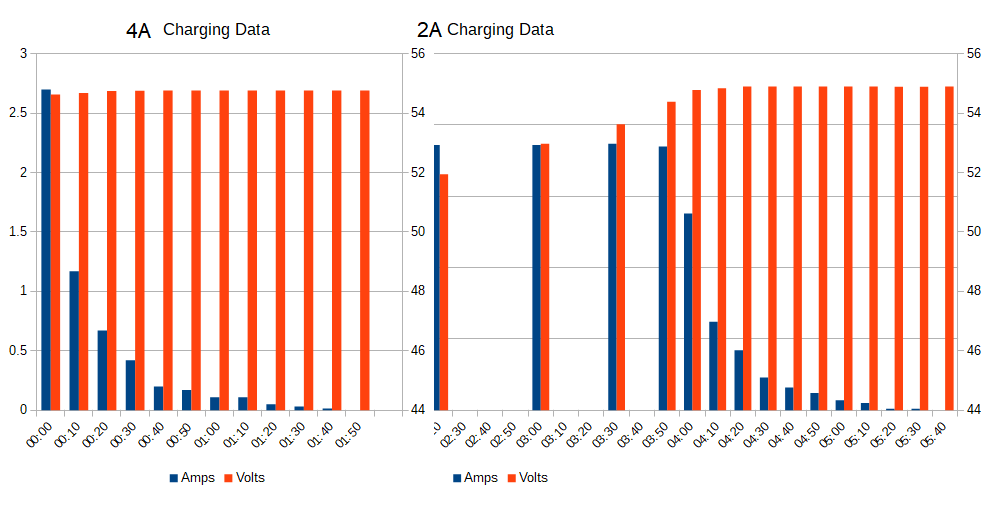
So I thought I'd record the latter part of the charging and compare it to the existing data I recorded using the 2Amp charger the other day.

so basically both the 4A and 2A charger took the same time for the "balance charge" component, 1 hour 50min . The 4A charger makes it plain when its in that phase by not just making a light go green, the fan shuts off too, so it goes very quiet.

So while the 4A charger will bring up the bulk of my pack in half the time, meaning that it will charge to the start of balance charge time in 2 hours instead of 4 hours, the remaining balance stage will still take nearly two hours (for either charger).

This is actually very close to what Battery University report for charging Lithium Ion.


which is charging at 1C (while I'm charging at lesser amounts, like 0.15C on the 2A charger and 0.3C on the 4A charger. Both my results and their results show that the last part of charge takes nearly two hours.

Assuming you are doing a full balance charge (and I would at least every second or third charge) the 4A charger will bring it down a lot but no matter what higher speed charging has its diminishing return points because even with charging at 13Amps it would take 3 hours in total.

Summary:
  • 2A charger -> full charge (including balance) time = 6 hours
  • 2A-> full charge (no balance, just to green light) time = 4 hours
  • 4A charger -> full charge (including balance) time = 4 hours
  • 4A charger -> full charge (no balance, just to green light ) time = 2 hours
And of course if you just wanted a quick top up then half an hour will get you twice as much as the 2A charger.

Pretty comfortable that this is money well spent (cos sometimes I just need a quick boost and go out again)

Thursday, 20 June 2019

Electric Vehicles Battery Facts (helping make the most out of yours)


Having had a few discharge cycles on my Mercane scooter I've been getting some experiential evidence which (strangely ;-) supports the facts about Li-Ion batterys that I have known for some time at a theoretical level. None of this will be any surprise to a seasoned electric bicycle, skateboard or scooter rider but none the less may provide some value to help you get the most out of that battery pack before it becomes landfill.

TLDR;

Modern folks are impatient, so:

  1. batteries are not cells, by grouping them we have greater voltage and therefore greater power, so therefore what is done to charge is different (more complex)
  2. let your battery fully charge (at least every third charge) to allow cell balance to occur (I fully charge >90% of the time
  3. discharge more shallow if you can: meaning don't let it get as flat as a lizard drinking water all the time, so charge it early rather than late.


In this post I'm going to reference two really good articles:

I get that much of that is way more technical than most riders want to get into, but if you want to get the most out of the money you spend on your gear then hopefully understanding these points in my blog post will help.

So lets start with

power and power loss

Electric motors are not engines, they only convert electrical power into rotation. This power is stored in the battery, the less electrical power you have the less "power" your bike or scooter or skateboard has to get up hills (or to accelerate). In electricity power is the simple multiplication of Volts and Amps, so as your battery drops in Volts the power available at your back (or front) wheel drops too. This is the typical power curve of a Lithium battery (note: a single cell):


So you can see that this drops from 4V down to 3.5V in a fairly gradual and linear manner, but falls off a cliff as you go below that. This is important because of two reasons:

  1. you will degrade the amount of life your battery has if you let it go below 3V (and some battery controllers will let it go to 2.8) - so don't deeply discharge as a habit.
  2. power available takes a big dive fast after that 3.5V level which is when you only have 20% of the charge left - meaning you may end up walking suddenly in that zone.

Batteries VS Cells

A "battery" is a bunch of cells together (here), and so to understand your battery you need to understand cells. Below is a "discharge" diagram of two cells, showing how quickly it falls from a fully charged voltage to a fully discharged level.


Note that they both really stop at between 3 and 2.8V This is because the test is truncated there, going lower than that will damage the cell. Also note that ffrom about 3V things get a bit hairy and they fall really fast.

Most eBikes and eScooters have electronics in them to prevent damage to the battery from trying to drain too far or charge too high; this is a Battery Management System (BMS).

Juggling requirements

Cells both weigh and cost; so all eBike and eScooter and especially eSkateboard makers will want to balance weight VS cost VS performance very tightly. They may also opt for clamping you in a tighter range of the battery using electronics that s only down the the 40% state of charge. This is what a "good" battery manager will do, and this will mean you get years out of your battery instead of months. The best of my knowledge this is only done in higher end EV's like cars.

Why: well this is because depth of discharge has a great impact on cell life.

Now also that above graph does not give voltage above 4V, which seems a bit surprising when a fully charged 18650 cell will show 4.2V on the volt meter when its fresh off the charger. There are some possible reasons for that but lets just say that (as you can see) its unimportant because the voltage drops pretty fast off the charger.

Below is the curve you'd expect from actual battery (a bunch of cells) tests (see this site for its excellent discharge database):


To get larger voltages you put a string of cells together in a Series, and to increase how many Ah you get you put them in a Parallel arrangement (all the +ve connected and all the -ve connected) Now  I have a 13S4P in my scooter; this means it has 4 cells in parallel and 13 of those bundles arranged in a Series.

My Mercane Widewheel 500W model is 13S4P, so that means that to get 1A per cell (in the above diagram) you've got to be sucking 4A from the pack and to get 3A per cell 12A from the pack.

The voltages are what you can read when its under load, not sitting around, also is why some battery packs are reported as 48V and others 52V. Because depending on what you want to call standard battery voltage the lithium cell in your battery pack may be called 3.6, 3.7 or as much as 4.2. My Mercane shows 52.4V* when its fresh off the charger which is close to 4V per cell (*note: I've come to suspect this is some sort of fault ... either of the BMS or what I don't know, because its not common NOR does my dual motor version do that I have since replaced the BMS and repaired an issue in the pack).

But (if you have a voltage gauge like the Mercane does) we all experience that pretty quickly the Voltage drops to the high 40's (or in that 4 to 3.5 range of linear decline).

So when my Mercane is fresh off the charger (or my mates skateboard) it will climb hills nicely, but when its about "half way" discharged (based on how far I normally travel before recharging) its already noticeably sluggish going up that hill. This comes back to that power equation of Volts x Amps that I mentioned earlier.

  • At 52V (and lets assume 10 amps) I have 520Watts available on my rear wheel (and the Mercane has a 500W motor so that's unsurprising),
  • But as my voltage falls to 46V I have only 460W available. (and this is where I choose to recharge my battery, because like; why run it down if I don't have to).
  • 44V = 440W ...
you get the picture. So those of us who like the fresh power hit will recharge about then, which is usually less distance than the maker says the bike will do. So as I mentioned, I typically put it on the charger at 46V and this turns out to be a good thing for the battery and for my wallet (recharging early).

Looking at the second article we find some interesting points, firstly this chart showing how the batterys stood up with full discharge cycles:


From that article they write about that:
The 1,500mAh pouch cells for mobile phones were first charged at a current of 1,500mA (1C) to 4.20V/cell and then allowed to saturate to 0.05C (75mA) as part of the full charge saturation. The batteries were then discharged at 1,500mA to 3.0V/cell, and the cycle was repeated. ... All packs started at a capacity of 88–94% and decreased to 73–84% after 250 full discharge cycles. The 1500mAh pouch packs are used in mobile phones.
So they relentlessly hammered them down and then recharged and then repeated for 250 times.

Just take a moment to think about that, to equate this to real world riding you'd have to fully saturation charge (the so called 100%) and up the steepest slopes it can take (because at higher speeds you don't draw as many amps) until it was flat, then charge and continue going up hill again without any break except to fully charge.  Ask yourself "is that likely"? (I'm guessing no)

Further they were charged at C which is Capacity, which for a 8Ah battery pack would be being charged at 8 amps ... can you even do that? I'm willing to bet NO because a standard charger is 2A

So basically this piece of evidence used by people (who don't get what they're reading) to justify don't fully charge is irrelevant to real world eScooter and eBike riding.

Even then they found that by going the extra distance and taking the battery to "Battery Management System" shut down (meaning your walking) that after 200 cycles some of those batteries had dropped 20% of their capacity from new. Whoopdie do. At the risk of stating the obvious there's 52 weeks in a year, so I'll leave it to you to work out if that's years or a years worth of use.

Next they found (presented below) that only discharging as deeply as 60% Depth of Discharge that the battery could be cycled 1,500 times before falling into that failure above compared to a less than half the charges by taking it to the limit each time


... which is about where I take my battery to with what I wrote above of taking it to 46V (or about 3.5V per cell).

The solution it seems simple; charger earlier and only use that full discharge as an unexpected need

This leads me to my last point, which I mentioned earlier and that is the 4V level (per cell) in the first graph. Given that LiION batterys can be charged to 4.2, why not charge them to that? Why 4?

Well again its longevity but to be honest its not as simple as the raw data would suggest. It seems that by charging the cell to 4V we get a return in a increase in the number of cycles possible before loss.


While this seems attractive it ignores an important point ... we are not charging just one battery.

In the real scooter world we use battery packs (not just a single cell) which are comprised of (around and for example 4 bundles of cells in parallel and 13 of those bundles in series (daisy chain)) to make the humble 18650 cell (which is 4.2V fully charged delivering typically 2.6Ah) into a beast that can deliver 52V and 13Ah ... such a pack is called 13S4P.

The parallel bundles keep themselves balanced (by the physics of being in parallel) the string of series bundles will tend to get themselves into trouble over discharge / recharge cycles (because only in a computer simulation is everything ever perfectly identical). Thus we have BMS systems which actually take care of this, the rub is however the more simple ones (meaning costing less) we usually see in our battery packs do their balance at the end of the charge cycle (moving voltage from the full ones beside the ones slower to charge). This is why its significant to recharge full.

But, don't wait till its super low to recharge as that's just pushing the battery cycles deeper and that will also contribute to lower cycle life ... This is very positive (yep, you picked it, that's a pun).

Whats in my pack?

This is where its important to know how many cells in your pack not just its voltage, because knowing both tells you about how long your likely to get (assuming the cells themselves aren't crap). Why? As mentioned above,  battery packs are combinations of Series and Parallel, this of course dictates the voltages found.

For instance a 12 cell pack charged to 4.2V per cell would be showing 50.4V and so when coupled to a 48V motor would seem right, right? But equally a 13 cell pack charged to 4V will be 52V and as we've just seen will mean that pack will last more cycles (or years instead of months) and not to mention not die as fast. (*note: in practice this isn't what's done in the vast majority of systems, but I'll get to that).

Die as fast in both ways:

1) run out of grunt (because when the cells drop off to nominal not full it will be 3.7V per cell or 44.4V and your motor won't have the 500W anymore it'll only have access to 444W)
2) life cycle till the battery won't hold much charge (due to excessive electrical wear on the battery).

But this isn't the whole picture

Batteries as mentioned above are really a string of cells (which just like a bunch of chickens) is called a battery.


As it happens most eBikes and scooters have something over 10 and maybe as many as 16 cells in a string to make that battery. Like this:
So if each cell is as mentioned above nominally 3.6V or fully charged at 4.2V then

  • 4 cells would be 16.8V
  • 13 cells would be 54.6V
  • and the 16 cells here would be 67V 

As you can imagine, it would only be in ones dreams that each of those 16 cells (or even 13 of them) would accept charge identically and discharge identically, which will lead to what's called "imbalance" and the pack would soon become unusable.

Enter the Battery Management System (BMS), whos job it is to keep that pack from over charging some cells and leaving others under charged.

Discussing the BMS is actually a complex subject but for our purposes here lets simply it by saying that the BMS starts forcing the "stragglers" to take some of the power that the full batteries have and thus keeping the pack level when its finished.

But (and here's the important bit), it only does this balancing (well lets exclude the high end ones not found in eBikes or Scooters) right at the end. This is important if you're inclined to not fully charge the pack before removing it from the charger because it can lead to an unbalanced pack, which will definitely result in your experience of less charge.

So by not understanding the details and by listening to people without a clue you're probably more likely to be damaging your battery than protecting it.

So if you are inclined to give your battery a little top up now and then (rather than fully charging it) that's not a bad thing, but you really do need to let it fully charge most of the time to ensure your batteries are brought back up to "being full" most of the time.


Lastly while I don't normally feature other peoples work I recommend you watch this youtube presentation on the subject (which I found recently in answering some twit on Reddit)


Its really worth sticking it to the end of that because (like my article above) he starts with the theory first (the ideal situation) and then moves into the practical and then lastly "what he does".

Outcome

So hopefully you'll be able to make what you have last more now and be better equipped with knowledge on the next time you are researching eBikes, scooters or skateboards. Be careful when reading specification (because most of us can't go to a shop and see these things nowdays) and ask some important questions of the maker (like how many cells, what voltage does it charge to ...).

Best Wishes

Thursday, 13 June 2019

Mercane Wide Wheel eScooter (the "Cadillac" of electric scooters)

I decided that while going under 2Km on relatively level grounds that my Evo kick scooter was fine, but that when going further afield all that kicking was getting old (like me). What I needed was a bit more assist (read some power) because I'm not getting younger (and nor are my knees) and lets give hills a mention too.

I've of course seen many of the eScooters around (hello Lime) but having some amount of experience with scooters (starting 10 years ago) I know that bigger wheels means better wheels.

Now while the little Evo I bought (mentioned in my previous post here) is doing the job (with those crap bearings replaced) its still a little restricted and probably a little unsafe (brakes aren't that effective, and from experience worthless if any water (from rain, a puddle or snow) is on the wheel. The Mercane solves a lot of this.

Closer look

When looking at the options the Mercane came up in my searching and it looked quite the good item, well made and effective.

Its not till you actually see one in the flesh that you go WoW

Now there's plenty of images on the net to look at (and I'll add something from the Mercane site at the end) but I thought for my first post on this scooter I'd just show you some images which I hope will put in perspective how this thing is a entry into Electric Vehicle not a borderline toy.

So for those who are considering this as a commuter (and may have some experience with the sorts scooters on the market),this is it beside my Evo. Both have about the same diameter wheels, however the Evo is under 4kg (and an easy carry) while the Wide Wheel is about 17kg and a bit of a heft.


This heft (and the wheels, the suspension and steering geometry) translates the Mercan from "a twitchy thing" into "a confident stable ride".

Storage

Back in the office (or in your flat) the little Evo tucks nicely under a desk (or in a closet) but the Wide Wheel may attract more looks in any more crowded open plan office (and won't fit under the bed either).


But its far easier to store than an eBike ...

I've long been a fan of bigger wheels on scooters (bigger means 120mm not the less than 100mm often seen on kids scooters) not only for bump handling but for not being "stopped suddenly" by a small bit of rock, other crap on the road or even an out of level pavement block.

The wheels of the Evo are a bit bigger, but when you consider the Wide Wheel; the width and cushioning of what are very similar to pneumatic tyres (but aren't thank god), with softer pliant tyres and suspension it is just orders of magnitude smoother over stuff on the footpath or cycle way.


Its clear that while the Evo has slightly bigger diameter, it will still get snagged in any cracks between concrete pavements on the foot path or longitudinal cracks on the road, not the Wide Wheel though.

I say almost pneumatic tyres, because they are not quite, they're like this *(from the Mercane site):


which is essentially half way between a solid and a pneumatic because it has a rubber skin like the penumatic and a softer foam for a bit of bump compliance underneath. The foam provides some "give" and the rubber is ... well ... just like a tyre. The feel of the tyre give (when pressed with my thumb) is about equivalent to a mountain bike tyre inflated to 40psi (270kpa), which myself I find is good compromise for ride VS rolling resistance.

That diagram shows the brakes, so lets have a look at that on mine. The disc on the rear is more than up to the task and unlike the friction of pushing down the rear metal mudguard onto the plastic tyre of the Evo is predictable and dependable even with a little moisture on it.


So absolutely nothing to complain about here. Indeed if you lean back (transferring your weight on that rear kick up support there) you'll stop even faster because you can transfer your weight almost totally over that back wide wheel.

Now as the deck is alloy (and beautifully formed) that "kick up" at the back is also alloy and very study. Its actually an excellent place to put your foot on (always ride with one foot foward the other back on a scooter, not feet side by side ... you'll balance better that way). This provides an excellent feeling of balance and support when the motor starts.

But unlike the little Evo this isn't the brake (but if you're used to scooters it'll feel right at home having your foot on it.

The next thing I'd like to mention is found in the exploded diagram on the Mercan site:


The above diagram is actually exactly my bike (with one small exception), as I have the single motor 8.8Ah battery variant. Aside from the fantastic build quality and suspension system this diagram shows something that every Xiaomi 365 owner will eventually attest to: changing a tyre is a fucking nightmare. Now while I have not yet done it (come on, I've only had it 2 days) notice that the rims are split down the center into a left and right? I imagine that will make changing the tyres so much easier when they wear out (and being solid won't get punctures).

Handling

I have once or twice seen mention of the fact that as you corner harder you'll experience a strange "resistance" to the bike turning. This is indeed because of the width of the wheel and the profile of the tyre. In practice you may not notice it, but as soon as you want to do a U-Turn you will. The bike fights you as contact patch of the wheel moves further away from center (take a look at the above shot again showing the wheels).

Now the answer to this is to lean your body further into the corner (keeping the bike more upright). Actually on a scooter this is a good idea also because if it "slips" (like I've had happen on the little Evo) you're prepared with your foot out ready to kick and restore grip. I'm not sure that such is going to happen at 20km/h but none the less ...

I've read (presumably from people who can't ride a motorcycle) that turning it is done like turning a motorcycle, where you lean. While not even slightly correct (you don't turn a bike by leaning it but turning results in it leaning) its good enough for a non rider to "get the hang of it".

Decisions

now everyone needs to balance how much they are willing to spend against what they want it for. For me, this was more about an effective transport than a "fun" machine. So while I do want something that can get up hills (who doesn't) I also didn't want to spend nearly 50% more on the scooter just to get the more powerful (and then require the bigger battery too) if this would do my job (and be legally compliant).

When I went the sellers place (BZooma on the Goldie here in Australia, whom after sales has been an utter disgrace so I DO NOT recommend them) they had a substantial hill just across the road from them. I was able to climb that and still go faster than I'd walk it. Better yet, I stopped on the middle of the steepest part of the hill and was able to kick and go and continue climbing.

That sold me on the scooters ability and only time will tell if that was a good test. But when I get back home to where I live I'll be testing it on more substantial hills and I'll report then.

Conclusion

So right now I'm really stoked about this scooter, its doing everything I expected of it and that I only paid about AU$1000 (instead of about $1600) is fantastic.

I'll be reviewing more in time, so look for this tag label (Mercane Wide Wheel) in the left hand side.

Enjoy

(PS, I mentioned the seller I bought it from because they were so good to deal with. I believe strongly in the "Invisible Hand" of the free market and so my mention of them is totally my choice and totally un-rewarded. I have nothing to do with them except buying this one product).