Tuesday, 17 June 2008

India - why all the mess?

I've just come back from India from my second trip, and (again) I feel troubled by what I see there. Pollution is getting worse and poverty seems not to be getting much better.


Walking around is so different to seeing photographs. I just can't convey the stench of the piss soaked walls or the things which wash past you when you walk up a street in the rain.


It seems to be a land of contradiction and contrast. Filled with iconic architectural marvels (like the Taj Mahal), yet immersed in such chaos, environmental disaster, filth and exploitation. I've not personally seen the like of it anywhere in Asia. On this occasion I spent a little time with a woman from Cameroon and she said to me that things were indeed not the same in her country.

People's first response to why its like it is is because of the overpopulation. So, starting with some simplistic comparisons lets compare some European countries with India.

Based on information from the "world fact book" it would seem that "Population Density" of India is not as high as the Netherlands and only a little higher than Germany


NationDensity (persons / Km^2)
India386
The Netherlands490
Germany235

Parts of Sydney, certainly Tokyo and even Helsinki are equally dense in habitation to New Delhi, so just on the surface of it its not looking like that is the main culprit (see here here and here).

I suspect part of the answer lies in India itself. While the elite within India like to entertain notions of National Grandeur (I was stunned to see recent examinations of "will India become a superpower" in the newspapers on this visit), not much seems to have brought to the attention of the upper and middle classes (or should I say castes?) the magnitude of the problems created by the lower classes and poverty.

Part of this thought process started while visiting the Red Fort in Agra, where I found this plaque on the wall.

I read it, and started to wonder if despite all the exploitation of India by the British colonial forces it if was not perhaps the British who had also taken some care and interest in the preservation of India?

I wonder how many of the NGO's who devote time to trying to help the poor and needy in India were started by the British or other foreign powers?

Its an interesting question, and I believe cuts to the root of the problem. No one in India seems to care much about anyone other than themselves (and perhaps their family).

One of my personal yardsticks of civilized behavior is the ability of people to form an orderly queue and wait in turn for some service. Just go to the airport, visit McDonalds or even just go to a shop and there everyone is always pushing their way in or jumping straight to the head of the queue. Not just some people, its most people. Perhaps its because all the "special people" in India are so used to being the only special person that when they are surrounded by them they could not possibly think that there is anyone else less than themselves present? Waiting for a burger at McDonlands in New Delhi the poor clerk had to tell everyone who came up and just shoved money over the top of the counter that he was serving someone, there was a queue and please wait your turn for service. Seemed to ruffle up the feathers of some high class people every time.

Drive around for a while and its the same on the roads, no one seems to give the least regard for things like lanes, roundabout directions (or even road driving direction for that matter) or overloading unsafely. Its like no one else matters.

This "I'm the VIP here" attitude got one fellow at the airport on our way out of New Delhi into an argument with the armed Indian Army Sergeant on duty at the security check. The guy tried to push his way though another person just getting onto the metal scanner and then started talking down to the guard when he was told to go back. Its hard to fathom.

Meanwhile whether it be the poverty, the lack of education, the lack of resources or just the lack of interest sees Indian rivers (and streets) choked with pollution, human excrement, rotting food and plastic bags.

Its almost like its assumed to be filthy outside (where the common people and animals live) and no one seems to even notice it, much less care.


I only hope that in their race to be a proud world super power that it is not these Indians who suffer the most.


I've been suggested this reading by Milton Friedman to help explain the economic basis to the problems. For example this poignant quote:

...though the number of tourists entering India in recent years has been growing, the amoun recorded in official statistics as spent by tourists has been declining.

Reminds me of the "receipt" we got for our meals at one of the hotel. I just felt for sure that it was going straight into some ones pocket.

or:

The current danger is that India will stretch into centuries what took other countries only decades.

The authors final summary was not highly optimistic (although written in the 1960's).

It will, I fear, take a major political or economic crisis to produce a substantial change in the course on which India is now set in economic policy, and I am not at all optimistic that such a crisis if it occurs, will produce a shift toward

I hope not ... although I think the document makes quite a compelling argument. I wonder how much it explains the other social interaction issues. While I was there this time there was an ongoing dispute between people in Rajastan (called Gujjars) and the central government in New Delhi. This seems to have escalated into road blocks and train derailments ... next thing they'll label them terrorists and crack down heavily on them.

Time for my last quote from Friedman:

"The British left parliamentary democracy and respect for civil rights as a very real heritage to India.Though I very much fear that this heritage is being undermined and weakened..."

Amazingly an article in The Times of India ("Green cover up, says CM on Environment Day "friday, June 6 p9) speaks of Delhi being one of the Greenest Capitals in the world. What a laugh! Its been said that there are Lies, Bloody Lies, Statistics and Maps ... this is surely a Statistics application of the truth!

The future will make it clearer I suppose.

Monday, 16 June 2008

Oracle 10g bootcamps

I just got back from doing my 10g boot-camp (Oracle's "hands on" component for the 10g certification pathway) with Koenig in their Dehradun center. The purpose of this blog entry is to give advice and information to anyone else who is thinking of doing this sort of course, yet reluctant to accept at face value what may be written on their website in student feedback section. I too felt that these might be just the result of censored or 'approved' writings.

In summary, I found it the best value for money of any option available to me for completing the Oracle hands on training component and having a crack at passing the tests.

For me there are 2 significant issues in taking training:
#1 quality of training, then
#2 an appropriate study and learning environment.

My impression of Koenig was that they did quite well on #1 and fantastically on #2. I have a more detailed version of this article on my personal web server here. Its a word document, and about 2Meg in size. Anyway ...

#1 Quality of Training: a high pass

If you're going to invest some thousands of Euros into your career, you really want to make sure you get value for money (well I do at least). To get Oracle OCP certification, you need to not only pass an examination, but you also need to attend "hands on training". Keeping in mind the vast details in the Oracle Database product there is only so much that you can learn (and retain) in two weeks of lectures. Oracle prints a series of publications for this course, and the trainers could take two strategys for this:
  1. simply read this with you in the class,
  2. they can move through the materials while highlighting important components, fleshing out significant points and explaining confusing details.
This last strategy is the method we had with our trainer on the course. He was knowledgeable (and I've been working as an Oracle PL/SQL developer since 1994) and comprehensive. We covered the material in as much depth as one can in the time available in such a course delivery schedule.

Accordingly if you intend to sit and pass the exams then preparation for the exam using tools such as MeasureUp and Pass4Sure are essential to getting a favorable result. Don't get me wrong, I'm not advocating not learning the materials and understanding the product here. Its just that the 10g exams test some of the most arcane and trivial details. Furthermore many of the answers on the exams are quite arguably ambiguous. There may be some implicit assumptions which make the right answer 'righter' than the others (or maybe not). Questions can come from seldom visited sections of the user interface too, so don't just rely on your experience and your absorption of the coursework. This is not like doing your Masters thesis.

This is the one area in which I felt the school dropped the ball. They assured us (in our course) that we were using latest exam dumps for our final preparation, but they were not. In our group the only person who passed the Administration 1 exam did so by 2% (hey, a pass is a pass right?) but aside from him everyone else only got as high as 66% (me). 68% is needed for a pass. Subsequently to taking the exam I purchased the current versions of the preparation materials and they are much more representative of what is on the test.

Also, while we did look at some of the labs provided in the coursework, it was cursory rather than in-depth. I think we were fairly tired too, and so we didn't really have the time to do these labs and cram for passing the exams. So its swings and round-abouts.

#2 Good environment: fantastic

Firstly the organization of the entire event was first rate. From my collection at the airport, to the travel back to the airport to go home everything was superb. Arrival in a third world airport can be a confronting experience. Taxi drivers all just about mob you with demands to use them to take you to anywhere they want. So to be met at the airport by someone expecting you is a great relief, trust me I've done it both ways. I received (unexpectedly) an envelope from the driver which contained a letter of welcome, my train ticket to my destination and some cash to get by with for incidentals. This was 1000 rupee, which is quite enough to get by for at least few days. I immediately felt I was in well organized professional hands.

It only got better ... at school Satender (the manager) is very keen and willing to help with any issues, at the accommodation Sanjay and the boys (who don't speak English very well) kept the breakfasts and dinners happening and the rooms cleaned.

But that's not the whole story, keep in mind that travel to India means travel to a third world country and brings with it many issues you should consider carefully. Romantic images of the Taj Mahal aside for a moment, India can be one of the filthiest locations in the world. Poor or non-existing infrastructure for waste disposal, crowded public areas, you might contract malaria, food poisoning, diarrhea or just simply be miserable because of the huge differences in climate and or food. With a little care the risks can be minimized to nearly zero, but just keep in mind its not Disneyland here ... ok!

This is where Dehradun comes into its own. Looking at their locations page, it would seem that Dehradun has nothing much to sell it over Delhi, perhaps only negatives with some extra hours of travel and minor cost disadvantages. Certainly you'd never be able to make the choice based on interior pictures of the centers. However I'm going to go out on a limb and say if its at all possible, then go to Dehradun.

Why?

Ok ... keep in mind that New Delhi is perhaps one of the most crowded, dirty cities on the planet, this is not just my opinion do a little research perhaps start here. Despite the fact that there are perhaps some potential savings in cost of living in Delhi you'll have more hassle, everyone (outside of school staff) tries to rip you off, and food poisoning is a very real issue there. Remeber, if your sick for 4 days in 20 of your study that counts!

Living in Dehradun we could easily move from the school (located in a newly developing technology park) to our residence, either by the shuttle provided by the school or by other means. You can go out for a quiet walk up to Rajpur or over the ridge past Saibaba. If you desire even greater mobility, some of the fellows even rented a small motorcycle for around 200 rupee a day to give the freedom to explore and go out and about.

Traffic in Dehradun is crazy (... its India) but not semi-suicidal manic like Delhi. I'm 43, I come from Australia and have ridden motorcycles all my life (here's a few of them). I've traveled a lot and lived in many parts of the world (not just visited for a holiday):
  • Tokyo, Japan(where I rode my own motorcycle almost every day)
  • South Korea (just out of Seoul)
  • Finland
  • Bangalore (India)
I would not feel comfortable riding a motorcycle in Delhi, but I would (and did) in Bangalore or Dehradun.

Just a quick tuk tuk ride down the road (back into town) are some nice hotels (the Madhuban hotel has a nice bar) and the Opal Lounge, this place has great Chicken Tikka, cold beer and is generally where the local foreigners hang out. Its safe and refreshing.


The School itself is still under construction, although the ground floor is open for business (again not common in the west, but like I said - its India).


As I said, the location of the Dehradun school is in a newly developing technology park. Keep in mind this is India we're talking about and not Berlin, LA or Tokyo. So it looks a little different for a westerner.


Downstairs is the cafeteria (where you get your lunch) and the ground floor is where the training rooms are. These are comfortable rooms and are suitable for 4 people and a trainer, which indicates the intended class sizes. No over crowded teaching classes here, you can ask questions and is as good as 1 on 1 teaching.

Computers were modern, operated well and were suitable to our tasks. There were some occasional power outages, but the entire IT system is on a UPS so its no major issue to have the lights dim for a little while. As you can see the room is lit well enough with ambient light.

I brought my own laptop, but ended up using their systems for installation of Oracle server cos I really didn't have enough RAM for that. So, unlike my previous experiences with IT training in Bangalore in 2001 I'd give this a big thumbs up.

In contrast, the training center in New Delhi was compact and cramped, but then hey, that's what you get in a crowded place like New Delhi.

The accommodation is called "the farmhouse" by the organization, but unlike the name suggests was anything but that, it was really a small group of 7 flats nestled on the edge of a hillside and (as I mentioned) excellent. After walking into the property, you find that it falls away quite steeply. Here you can just see the rooftops of the 2 storey flats. The roof top (btw) makes quite a nice place for a drink and a chat after class, or a morning stretch or just admire the view.


The the gardens of the house (we didn't live there, but in the flats) were beautiful, and indications of the stature and wealth of the owner (remember what outside looks like again).


nice places to chill after class ... ohh, and up the road in Rajpur they sell beer and sprits (80 rupee for a 700ml beer 400 rupee for a vodka or Gin).


Walking down the path a little more you find the two sets of units. One is a group of 6 the other is detached. This shot is taken from the rooftop of the detached one.


A view a looking along the path ...


and a view of the single detached unit from the roof of the 6 pack of flats.

I happened to be lucky, so this was my apartment. It was (in my opinion) the best of them all, as not only was it the quietest (not being effected by noisy neighbours) but had a nice view, good breezes and I happened to like the interior layout the most.
Below is an ugly "pano" I stitched together to give you an idea of the interior and its size.

The bed was not quite double sized, had a very firm (quite to my preference btw) mattress, a reasonably sized bathroom with shower and toilet.

The furnishings were neat and the linen kept clean by the house keepers (who were also our cooks and often rescued our laundry from the rain showers while we were at school ... thank you again Sanjay).

Without trying to paint too "rozy" a picture, it was one of the nicest places I stayed in in India on this trip, and I wish that my partner and I had stayed here for a few more days before doing our trip to Agra and Rajastan. I had very cute squirrels running about and beautiful birds in the trees outside my window. Yes, it really is that good.


The view up the valley from my rooftop 'terrace':


I've spent so much time on the accommodation because if you want to study and learn, having a comfortable, secure and quiet place to live is my #2, right after quality teachers at #1. So I don't think you can under play the importance of having absolutely no stress where you live and study.

But this is where it now gets critical for Koenig, having got a nearly 100% occupancy in their residences yet only having less than 10% utilization of their new facilitys capacity. They will need to manage growth in student numbers with their accomodation. I think they can do it, but it will remain a challenge for them to keep their existing high standards at Dehradun. From the voices I heard an the brekky and lunch tables, the hotels are noisy and inappropriate for good / effective study.

If you're after more information, like I said up the top, download the word document from my web server here, and feel free to contact me if you would like more information send me mail: pellicle at hotmail dot com.

Lastly, I was thinking that if anyone else has a blog on their experiences, please post a comment with that link (or it to me ) and perhaps some sort of coherent picture of experiences can be found by others.

So, if you go there have a great time, and Good Luck!

If you have any questions, feel free to .

:-)

Thursday, 8 May 2008

holga at 6x12

Hi

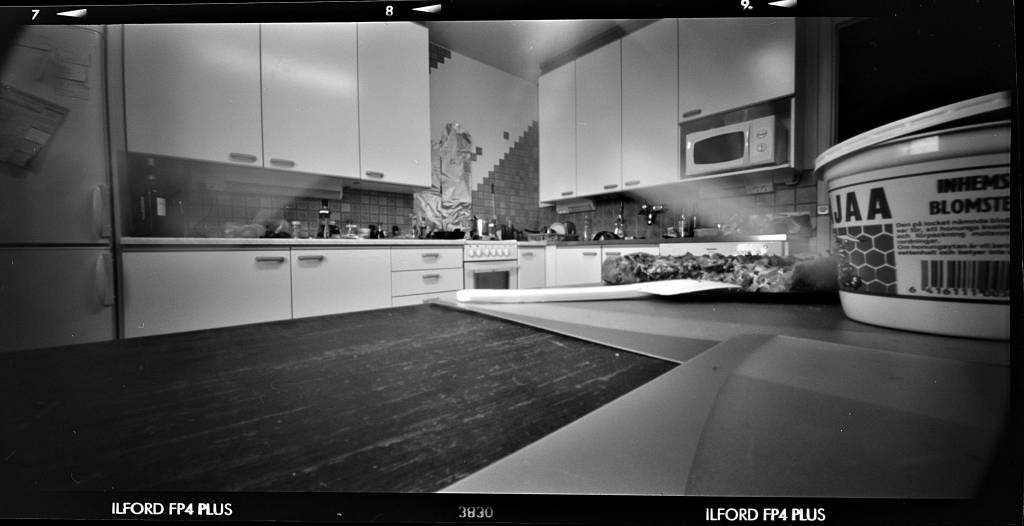
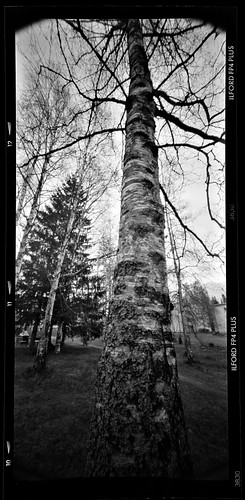
I've now done some tests of my new Holga using the 6x12 mask. This little thing is impressively wide.

kitchen6x12

I was wandering around the kitchen during the 4 minute exposure, so I'm the 'fog' in there

tree6x12

I'm really impressed! More than just impressed with the width, I'm really impressed with the tonal range I get from the film, this really kicks but and shows how close to multi exposure HDR digital techniques that Negative is (all in one click too). I've got a page on that here, but especially the kitchen image and the image I took in 6x9 are truly amazing. This is it here

loungeRoom

not bad at all (especially for $50)!

Tuesday, 6 May 2008

Holga pinhole camera

Having recently started using 120 film, I wondered about making or buying a 120 pinhole camera. I did a little searching online and found that a basic wooden box camera was some hundreds of dollars. While its fashionable to be able to spend hundreds on toys I'm not so fashionable.

Just as I was resigned to making my own (perhaps from a junked folder) I came across the Holga pinhole on ebay. It arrived yesterday, and I've tested it and posted my first findings on the camera here. I'll probably post more as I find it.

The camera is a little bigger than I'd imagined, but considering that it does 6x9 and 6x12 I guess that I shouldn't have been surprised.

In terms of features, its surprisingly well appointed, with not only a lens cap (an able shutter in itself) and a shutter (seen to the left of the camera).

The camera back has the typical red window for determining the exposures (NB by reading the paper backing of 120 film) meaning that 220 is out of the question.

Also, the manual is not only unclear on this issue but entirely wrong. To use the 6x9 mask you need to put the switch up (with the arrow pointing to 16) and the number beside 12 visible. Then, you need to read the numbers as if you were taking 16 exposres (which you aren't) and use every second number. I tried evens first, and found that I had too much wasted leader and a ½ a frame when the film ran out. I'll use 1,3,5 ... next time.

As you can see from the paper tape here the locations for the window do not correspond with the correct location for 6x9, rather they're (as the numbers suggest) for 645 and 6x6. So to get (for example) 6x9 one will need to start at 1 and wind to 3 for the next frame. There will of course be double the border gap between frames :-)


The film access is by removing the entire back (no sophisticated hinged door here ;-)

These little latches double as the neck strap holder, and slide down (quite easilly) to allow the back door to fall off. The neck strap (when attached) prevents this (note to users).

You can also see the 'film advance' knob here. It has the feel of a cheap ratchet mechanism associated with a kids toy. I don't know how long it'll last, but hey, it only cost $50!


Another lovely touch on the camera is a bubble spirit level. This is a very handy feature, considering that you need to be using this on a tripod and as it also does 6x12 getting things level is really important for some landscape shots.

I'd reckon that when using the larger format that it might just be handy. The camera also comes with a shutter release cable as well as the masks for 6x9 or 6x12 (as you can see below).


Lastly, how well does it work? Well quite impressively in my opinion. Here's a few images from my first roll of film. I set exposure using my digital camera(at f5.6) , and calculated the required shift exposure by multiplying the time by 1000 (based on 210 which is near enough). I used ADOX CHM 120 film. This kitchen image in particular is actually the best tonal range (to match my scanner) I have ever had from the film.


the lounge room. Note again the exceptional range here. this is based on 15th @ f5.6 for the shadows, and even the full sunlight on the floor only just hit the edge of the film capacity! HDR pinhole!


Lastly I'd like to leave you with an 'eggs with oranges' comparison. This is an image which I've taken with at a different time also with my 10D. Comparison is fascinating. The lighting is (of course) different, but its from the same balcony of the same apartment.

First the overview


Then a 100% segment


Then the image that my 10D gets with a similar angle of view lens (a Tokina ATX at 15mm). This is taken on a tripod with mirror lock up. You'll notice that the composition is not exactly the same, this looks more to the right.


Then the 100% segment.


Conclusions:

For sure, the Holga image is grubby, but (of course) its largely diffraction limited. If I could use f64 on the 10D it wouldn't look so crash hot (let alone f135). So the Holga is damn fine value for money, and a welcome addition to my image kit!