Showing posts sorted by relevance for query panasonic G1. Sort by date Show all posts

Thursday, 21 October 2010

G1 vs *ist: noise and focus issues

Good images can mean many things, sometimes noise makes an image better and sometimes some blur makes images better. However depending on the situation one may detract more than another. In this blog post I thought I'd compare a Pentax *ist with a Panasonic G1.

Regular readers of my blog may know that I use a Panasonic G1 digital camera.

So why would I do this comparison?


We happen to have a Pentax *ist camera in the office, which I've used a few times and generally thought it was a "vanilla" sort of DSLR. I had always thought it was more or less the equal of my older Canon 10D. However after recently taking a picture of the plover chick with it ...


I stunned how badly it took photographs.

The only day that I didn't have my G1 at work (all the other plover shots are taken with it) and I get to see the chick just after it has hatched and I had this miserable image. My initial view of the image left me shocked how bad it was (I took a few and they all sucked), after all this camera should be more or less similar spec to my 10D (which was quite acceptable).

I looked around the image and realized that it had back focused.

I was reminded of the problems I regularly faced with my Canon 10D and 20D and having used the G1 for so long had more or less forgotten about this issue. The AF on the G1 (particularly with the kit zoom but any other AF lens) is fantastic and has been spot on each and every time.

Then after a recent conversation with a workmate about him not wanting a G1 but "proper SLR" camera (and he mentioned the Pentax) I thought that it might be interesting to see what was what with these two cameras.

I'm not mad about megapixels, and other image qualites (such as noise) can make a better image, so I thought that it might be valuable to see if the Pentax could do a better job of a shot than the G1.

With that in mind I thought I'd do a few quick test shots in the office with the aim in mind of just examining the images for noise. I intended to test at:
  • 200 ISO
  • 400 ISO
  • 800 ISO
  • 1600 ISO
  • 3200 ISO

The office Pentax has a Sigma 18-55mm zoom on it while my Panasonic had the 14-45 standard kit zoom on it. I took my shots and when I got home and loaded them on the computer I was quite stunned.

I thought (using generalizations like x1.6 and x2) that the lenses would be quite close to each other at the long end (88mm vs 90mm), but that was the first surprise

The overviews:

Pentax ist
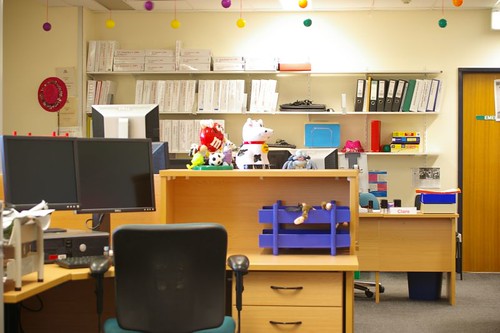
pentax-scene-overview

Panasonic G1

G1-scene-overview


As you can see above the horizontal capture is really quite wider on the Pentax (with its APS-C 23.5 x 15.7mm sized sensor) than the G1 (slightly smaller 18 x 13.5mm sensor), making this format a much better choice for Landscape style shooting ... this is a slightly unexpected outcome from my perspective. While I had the 10D right up until I bought the G1 I didn't make exactly this sort of comparison.

The next thing which stood out to me was the fact that the Pentax images seemed quite soft and blurry t me. Closer examination shows some interesting things ...

My focal point was the toys on the desk, and they were so much sharper on the G1 image than on the Pentax image. To make this comparison easier, I resized the image from the G1 back to being 2000 pixels high: the same as the Pentax.
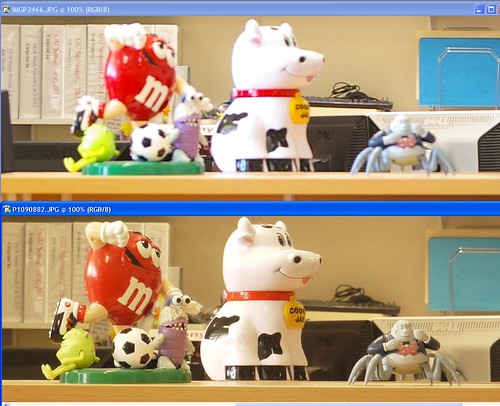
Pentax-back-focus-issue

The G1 focus is perfect on the toys (look at the face of the crab man on the right). The answer is I believe that the Pentax was back focusing. Looking at the Dell monitor in the mid background and the mouse and keyboard shows that indeed the focus of the Pentax is back focused.

Just to iterate this point, here is one that the G1 image not scaled down:
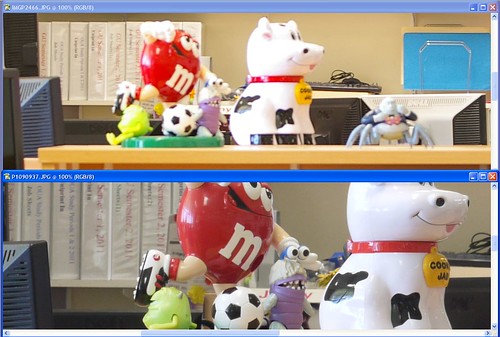
istvsG1focus

I repeated these shots a number of times, not only for each of the above ISO steps but I also tried again deliberately after seeing these results and every time I got exactly this result.

In fact I went outside the next day (after finding these results) and took these shots of this flower to see if the focus was still back focused.

Pentax:
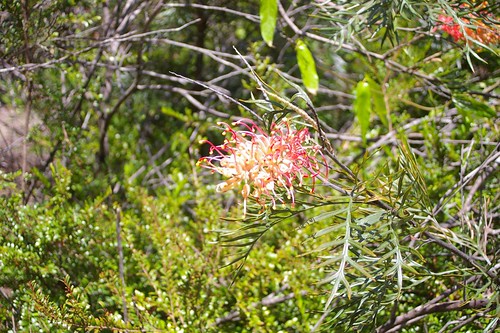
pentax-flower

G1:
G1-flower

Look carefully at the Pentax image, the focus seems to be at the back of the flower at the stem. The G1 focused just where the focus point was.

I left both cameras on Av at f5.6 and found not only that the G1 focused better on this clear easy central target, but that the G1 picked exposure better too!

wow ...

This is quite significant, forgetting all other factors (lens, sensor noise, number of pixels ...) if the camera can't focus for you properly then no matter what : it will be a poor image.

Ok ... lets get back to the noise:

I picked the chair back and the red channel (as it and blue are the noisiest ones) to examine.

200:
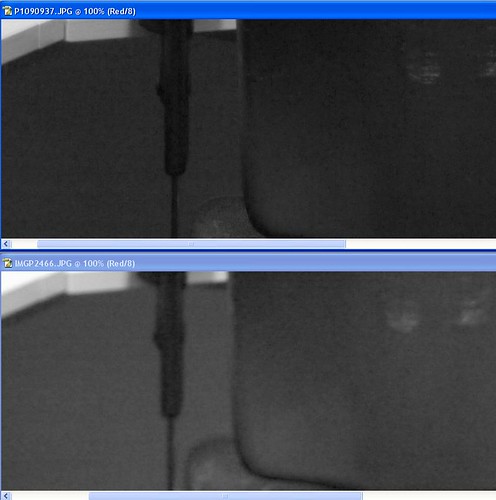
200-red-noise

However when I started to examine the other higher ISO images I found that it starts to get a bit less clear. I'll show you what I mean.

400noise-details

The Pentax image (the top one) seems to be blurrier than the G1 image, with the details in the back focused crab man clearly favoring the G1, but notice how the writing of DELL in the black monitor really drops in detail compared to the Pentax?

I don't know exactly where critical focus was on the Pentax (if it was anywhere) but even at 400ISO it seems that the Pentax is holding together better than the G1 is.

Any difference in noise is hardly visible but to me the side effect of noise control - the destruction of detail is becoming evident. This for instance is the comparison between the Pentax JPG and the G1 RAW file (converted in PhotoShop)
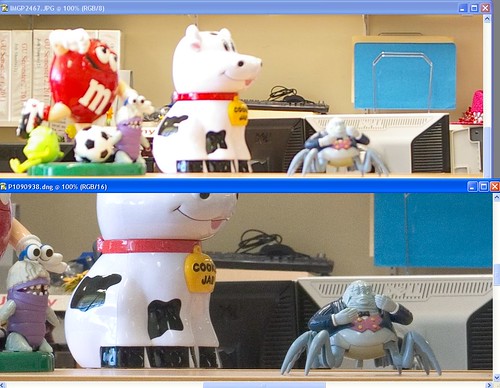
400-raw-noise-details

The Dell in the black is little less washy but the noise is ramping up, yet we are only at 400 ISO. Lets step this up by moving to 1600ISO.
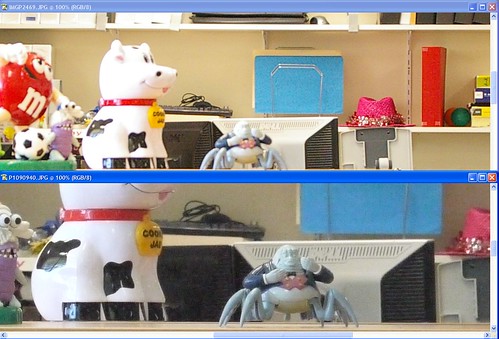
1600-noise-details

Here I see that the loss of detail in the G1 image is marked, the Pentax is showing some chrominance noise in the black areas but holding details better. Something I started to notice however was the saturation of channels in the Pentax is higher than in the G1. This would be an interesting thing to test for: does the Pentax control signal to noise with sacrificing of dynamic range? When we look at the G1 Raw vs Pentax we can see though that the Panasonic is doing some amazing processing to dress down noise:
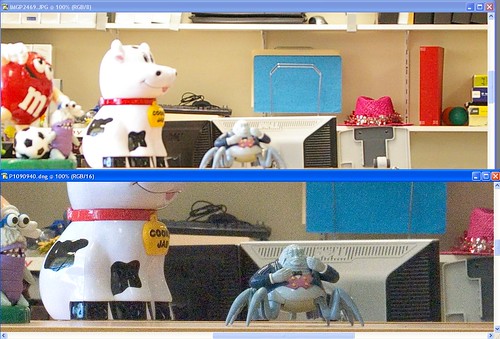
1600-raw-noise-details

This makes me wish I'd taken shots with the Pentax in RAW to make comparisons between them too. Perhaps another time.

So moving along to 3200 we see this:
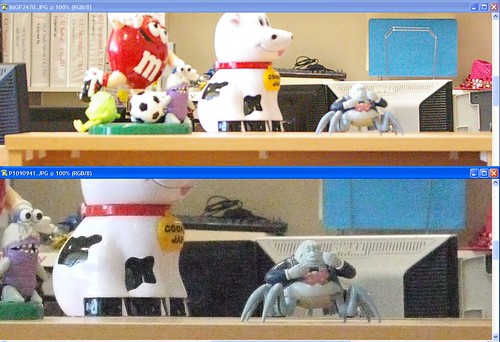
3200-noise-details

Noise is quite horrid on the G1 however other image aspects (like exposure and dynamics) seem to hold up better. If I scale the G1 image down to be 2000 pixels high, what effect will that have on this noise?
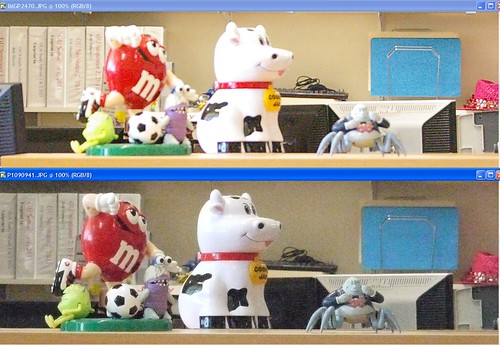
3200-scaled-noise-details

Well it starts to look less "in your face" than it did before (which is good) ; which suggests to me that if you were doing 8x10 prints from each that the G1 image would look better than the Pentax image in areas like:
  • Focus
  • Exoposure
  • Noise
while it may loose out a little in subtle contrasts (as you can't see anything in the black of that monitor back).

conclusions?

While I'm not as clear as I hoped I would be about the older larger sensor having any noise advantage (by having "bigger pixels") I have confirmed a few things about the G1 which do help me make sure I get better images.

In particular focus, and the ability to be sure of what I focus on. In the hit and miss world of "grab it" shots maybe either would be equal, but when I have a moment to take a photograph (say some scenery, or a family gathering portrait) I know that the G1 will give me a better image.

I have not discussed it yet, but when I started taking the pictures with the Pentax I used manual focus on my first set of pictures (not used here), these were clear in the view finder (piddly little thing that it is) yet the images were as we see here ... poor.

I then re-shot the images and used AF paying attention to the focus points and double and triple half pressing to allow the camera to settle AF and be as certain as possible of AF. There was no discernible difference between the AF and the Manually focused images, yet in all cases the image looked "clear" in the viewfinder.

Perhaps the explanation of this focus issue is poor alignment of the focusing screen (which leads to errors in focus). What ever the cause is the fact that the G1 shows you the image that focuses on the sensor and not something reflected by mirrors onto a focusing screen gives you the advantage of what you see is what you get.

So I'm still happy with my G1

Wednesday, 4 November 2009

G1 vs 5DMkII (bambi vs godzilla)

firstly I thought I would address the question of why the hell would I compare Bambi and Godzilla

well, just because I can ... Read on if this doesn't disturb you too much

I'm sure you know both of the players so perhaps they need little introduction. But I thought that I'd put them on the stage together so that you can get some idea of the differences

This of course ignores the heft in the hand and weight around the neck.

With the lens you're lookin at nearly 2.6Kg for the 5D Mk II and 660g for the Panasonic in the left corner. The Canon 5D is nearly 1Kg alone and when you add to the 24-105mm IS USM (670g) lens it becomes 1.6Kg, while the G1 with its lens is 0.639Kg

This is clearly a heavy weight vs a bantam if you look at it that way.

Now lets look at what they may have in common:
  • both have good rear screens
  • both have good sized viewfinders (although the 5D MkII is optical and the G1 is EVF)
  • both have interchangable lenses
  • both have Image Stabilised Lenses

Speaking of the lenses:

now, the zoom coverage of these two is quite close although again not the same, the Panasonic on the left is the equivalent of 28~90 while the Canon is 24~105.

As of writing the Panasonic kit will leave your wallet €600 lighter (costing €938/kg)  while the Canon kit will leave you €3100.(costing €1937/Kg). Interesting.

allow me to digress a moment

Clearly the 5D MkII (by dint of a physically larger sensor and more pixels) will produce a more detailed image than that of the G1, that is fairly obvious (or should be). The little G1 will however hold its own well against the Canon 5D MkII which is of course similar to the 5D in terms of the physical dimensions and weight. So in that respect the little Bambi can stand up to the father of Godzilla... Sure both will be quite good, but no doubts in my mind that Godzilla is more powerful. I'll leave that argument to the pixel peepers, as for me the G1 represents "good enough" and what I'd rather carry with me on a holiday.
However ultimate image quality between cameras is not really the main purpose of this post. Here I'm more interested to see how sensor progress can be determined in the future from these cameras.

The Canon as we all should know has a 36x24mm 21Megapixel sensor while the Panasonic has a 18x13mm 12Megapixel Sensor. This gives the Panasonic a higher density image capture but a capture area that is smaller. Some years ago I examined my Canon 20D vs my Nikon Coolpix 5000 and made a projection that we could see 26Megapixels out of APS cameras.

Naturally I didn't come here to bore you with only words, but to tell a story. Since it is said a picture tells a thousand words I'll use some of them.

I took on this occasion a 'brick wall' photo with both cameras (having limited time to access the 5DMk II as its not mine and I used JPG and let the cameras do the thinking), so, lets look at the overviews of each:

Panasonic at 28mm (effective, actual is 14mm)


Canon at 28mm(yes, I dialed in some exposure compensation, but forgot to redo the G1 image...)
I think that the Canon looks nicer without any touching than the G1 image ... but hey, you can fiddle with either till your hearts content if you use RAW and so desire (I normally do)

Now I don't wish to see which camera has a better detailed image, as it doesn't take much brainpower to work out that Godzilla wins that race hands down (like DUH its 5616 x 3744 Pixels spread over a bigger capture area than the G1 ...)

What I am instead interested to look at is just what happens when we forget about any "focal length multipliers" and look at what we capture with the same lens.

Why? Well I wonder if Full Frame will ever have the same pixel density as the G1 does.

I thought I'd go for the 45 end (which is not the better end of the Panasonic Kit lens btw) to see what each captures. Now recall that as I said above the has a 36x24mm 21Megapixel sensor while the Panasonic has a 18x13mm 12Megapixel sensor. So I expect that the Canon will be wider and hihger by a significant margain, but I'm very interested to see if the higher density Panasonic sensor produces more information from the same focal length lens.

Ok ... the overviews:

Panasonic with a 45mm focal length


Canon 5D MkII with a 45mm focal length

and exactly as expected there is the extra capture afforded by the double width in the sensor ... so now ... do we see more detail?


and the answer is a most clearly yes we do. The image is not only bigger, but it does render more detail. This means that if you want to travel light, and take a stitched pano with the G1 (take in portrait to stitch together a landscape) you'll have fantastic images of greater quality than the 5D for those occasions when you feel you really need it. (yes I know you can get even better from the 5D if you do that but you still have to carry it in your pack, which is what I'm trying to avoid)


Another way of looking at this experiment is to recall that back in the scanning 35mm film daze people were saying we need more, there's more in the film than I'm scanning.

Essentially a 5DMkII is a perfect 4000dpi scan of film, while a G1 is a 5500dpi scan of film.

So, there still is more to get from the excellent optics an precision afforded by modern cameras.

Conclusions?

Well this means to me that the megapixel race is not yet over.

Sure the 5DMkII is just awsome in terms of high ISO, but if you are a landscape photographer that's not really so important to you .. heck I find myself using ND filters even at 100ISO to give me longer shutter speeds .. some of us like images like this:

sprinbrook stream

So it is possible we could get the same pixel density found in the Panasonic sensor packed into a full frame 5D (MkIII?) giving images which would rival those from 4x5.

High ISO is of most benefit to sports photographers and probably indoor event photography. Landscape photographers are often after details.

Back in 2003 or so I was examining the output of my Coolpix 5000 5Megapixel camera and looking RAW vs JPG. As well as finding that JPG contributed to significantly to perceptions of noise in camera produced JPG artifacts in that article, I also found that:

"... for a sensor the same size as the 20D could get (22.5 x 290) x (15 x 290 ) = 6525 X 4350 pixel area if packed to the density of the CP5000.That's about 28 Megapixels"

I might have been conservative as seems that looking at these results that that if a camera had the same sensor density as the G1 but over the same area as the 5DMkII that something nearing 40Megapixels is possible. Now that's enough to make me leave my 4x5 at home!

I wanted to test the 5DMkII against the G1 with some high quality prime optics, but stupid me left the FD 50 f1.4 at home ... so that'll have to wait :-)

Of course another conclusion to this is that a G1 provides an image which (I've tested and have given evidence to support) is as good as a 4000dpi scan of 35mm film in a package which is light, portable, flexible and cheap ... so while we're waiting for these mammoth cameras to push the limits of what we can get with existing technology go out n grab a G1 and take the weight off your shoulders cos its great value for money:-)

Friday, 9 October 2009

two films and a digital

Recently I took my Panasonic G1 my film EOS and 2 films with me to the park for some quick test shots. I was after a few things:
  • some exposed negative and some exposed slide to compare with eachother
  • to then send these films to a fellow to compare his Pacific scanner with my Nikon LS-4000
  • and to compare my G1 with what film can give
I thought when I started putting this together that I'd use 200 ISO as my reference as the G1 is reportedly a native 200 ISO sensor. I picked Sensia (a very commonly available Fuji 200 ISO film) as my negative and Sensia as my slide. I was only able to get this in 100 ISO in my dinky-fart-town here in Finland.

In particularly interested to compare 35mm full frame film with a 21mm wide angle lens prime to the Panasonic with a 9-18mm zoom at 11mm. I had previously seen that my 10D was very close to film but the G1 is a latest model camera and at 12 megapixels in a 4/3 format quite at the cutting edge.

Ok ... here's the slide scanned (and nothing done to it).
[for those who are interested, I have my scanner software set to put the image into Bruce RGB and I then assign that profile when it gets into photoshop. I then convert to sRGB for uploads or use screen grabs, my monitor is Spyder calibrated but I don't know if yours is]


[don't forget to click on any of these images to download the full size]
now, lets zoom in to the patch of red leaves in the middle (to 50% of full resolution).


and compare this to the previous examination of the Neg and the G1


Now firstly I think its important to say that my LS-40 scans a full frame of 35mm to about 5570 pixels wide (4000 Dots Per Inch scan of 1.4 inches is 5600 ... right)

This means that the digital capture of the film will be more greatly magnified than the sensor captured information. So in the previous examination I scaled them to be the same - 4000 pixels wide. I guess that I should do the same here to make direct comparisons with the digital more simple, but the reality is that life is not simple, scans of 35mm film will not neatly fit the mould of digital and so we have to make sence of this somehow.

Probably one of the first things you may notice is how similar the digital is to the negative, but how much darker and inky the slide is. This goes back to the fact that slides are designed with projection onto a screen in mind, while negative is designed to make a print on paper. This is not an insignificant difference.

Ok ... so lets get into pixel peeping and look at 100% views of what we got (100% means one pixel in the file maps to one pixel on your screen.


Slide


which is a segment from an original which is 5573 pixels wide, so it looks bigger. It also looks softer as it hasn't been sharpened.

G1


which is a segment from an image which is 4000 pixels wide and has been sharpened carefully.

It seems to me that the slide image is somehow softer than the image from the digital file (and the image from the negative). Certainly the colour rendition of the digital is more pleasing to my eye than that of the Slide.

One could argue that the digital image seems sharper as it is of a lower magnification, but scaling the slide scan down doesn't seem to make much difference. Possible answers to this could be:
  • scanner focus was off
  • the focus of the lens was off

To answer this I can say that I specifically chose the red bushes as my focus point for scanning, and used Nikons focus system to to that.

On the subject of focusing, I can report I focused carefully on the screen as I could, and I focused manually. As well, Depth of Field calculations for a 21mm lens at f 5.6 suggest that assuming I focused on something which was about 6 meters away (the trees were a bit further away) that the front of the focal zone would be about 3 meters before me through to infinity. This sort of rules out focusing error here.

Interestingly I have observed exactly this effect in every compairson I have done of Negative VS Slide film.

Ok, lastly ... I think that its fair to say that comparing non sharpened scans to post processed digital is a little difficult to do. So below I have done the following:
  • scaled the TIFF from the G1 up to be the same size as the image that comes from the LS-4000 scanner.
  • I have colour balanced the scanned slide to be as close in hue to the TIFF as I could
  • I applied some curves to darken down the shadow details in the TIFF (as the shadow detail was better than the slide was)
  • I applied some strong sharpening and local area contrast enhancement on the Slide scan
[note: the G1 file was a single raw image processed using a flow of dcraw to convert to linear TIFF -> Photomatix to apply careful tone mapping -> photoshop to apply curves and colour balance, there was bugger all sharpening done]


I still think that the G1 comes ahead of the slide, both in colour and detail. As well the Slide actually runs out of dynamic range before the G1 does ... although not before negative did ;-)

note the clarity of the grasses and the leaves. There was no wind on the day.

Certainly the scanned 35mm file will be larger (more pixels) than the G1's file, but the G1 file is so clean and copes with a smidge of upscaling no problems. So when it comes to printing and detail capture it would seem that the G1 and the lenses available to it can at least equal that of the 35mm system. Without a doubt (assuming well exposed images to start with) its easier to get a good printable image from the G1 than it is the 35mm film.

... for my money I'll be using the G1 from now on and using the 35mm for black and white only.

Hope that was useful to someone.

Stay tuned for a scanner comparison in a few weeks!

Sunday, 13 September 2009

Wide options on a G1

Once upon a time there was film, and we tended to think in Formats, 35mm was a format (mainly because almost noone has heard of half frame), 120 roll provided a number of formats like 654, 6x7 and 6x9 and of course there is a number of so called "large formats".

Most people's DSLR cameras are 4/3, APS or Full frame; all of which refer to things smaller than and up to the size of 35mm. Most are however APS.

The diagram to the left shows the comparison in size between APS and 4/3rds (green and yellow) over the Full frame. There really isn't much difference between them in comparison to Full Frame.

One of the things which is an issue for using a smaller format camera like the G1 is how well it works with wide angle photography.
You see, to get a wide angle view you need short focal length lens, but as the format gets smaller you need to have that focal length shorter and shorter.

People seem to get all lost on photography (perhaps because they get caught up in thinking in terms of brands features and functions rather than just grasping the elementary basics, but hey where is the fun in learning the facts when you can be dazzled more easily by magic right?).

It goes like this: you're after wide angle, meaning you want to capture more of left to right than you think of as 'normal' ... To pick an example wide angle I'll choose 24mm focal length on a Full frame camera. This works out to capture 73 degrees of view.

Pretend that the lens is a single pinhole in a flat pate (heard of pinhole cameras?), so depending on the sensor format you are using you need to put the sensor at a specific distance from the 'lens'.

Looking at the diagram to the left you can see the blue line represents the width of the full frame sensor, and is at 24mm from the center (lets keep this simple here). A 4/3rds camera has a smaller sensor right? So for a 4/3rds camera (with its smaller sensor) it needs to be closer to have the same image projected on the sensor. This works out to needing a 12mm focal length lens.

So essentially a wide lens such as a 24mm on a Full Frame system works out to be a 12mm on a 4/3rds.

For ages a "standard wide" length in Full Frame was 28mm, but many people (rightly) feel that this is not really wide enough. It may not seem like a lot but in fact going from 28mm to 24mm makes a difference.

So with the "kit" lens being 14-45mm (similar to 28-90) wide angle fans are left scratching their heads. There really isn't much in the 12mm or less focal length range.

Two potential lenses are Panasonic's 7-14mm lens which is really wide but at over €1000 leaves people wondering if there are other options. Olympus makes a 9-18mm lens which is perhaps the next logical choice and at less than €600 is often considered. I paid about €100 for the adaptor, so this brings them closer together in price.

There are several tests of the Oly which you can find on the net, not much yet about the Panasonic and very little to say what people think about each. A common question though is what they look like and how do they compare to each other.

To answer that question I have written this page.

On the left is a picture (kindly provided by a member of a good forum on 4/3rds cameras) of the Kit 14.45 beside the Panasonic, owners of a G1 will likely be familar with the kit lens so it makes a good reference. You can see that the Panasonic really is very very similar in size to the kit lens.

Its important to note that the Panasonic 7-14 has a very bulging front element, thus it has a permanently mounted hood (as much for protection of the element as anything in my opinion). This however detracts from the lens in that you can not use any filter with the lens (yes, no polarizer, no Cokin gradutated filters ... nothing).

I have taken an image to compliment the one above and place my 14-45 so that we could compare them side by side. As this image shows, the Olympus is a little larger and a little fatter. Notice that I have got the lens mounted on the required 4/3rds to micro 4/3rds which is needed to use this lens on the G1.

Sorry if the perspective is not perfect, and I left the filter on my kit lens, but apart from the shock transfer between the 14-45's middle you can easily compare the Panasonic to the Olympus at the exact same scale.

To me the Panasonic looks quite similar in size to the kit lens, and the Olympus looks larger but not really by much. I remember when I first opened the box and pulled the Olympus out that it looked small ... much smaller than my previous Tokina 12-24 which I used with my 10D

But the surprise came when I put it on the camera ... you need to see how they look on the camera to get the point, so here this is below:
(please be patient with this image loading, blogger doesn't host animated gif (converts them to something else) so its coming from a slower server).

?

Its really interesting to see it mounted on the camera, as while the Olympus looks a little larger than the Panasonic you really need to keep in mind just how compact the G1 Camera is.

In use it makes the camera more like a viewing screen for the lens. The camera becomes insignificant and the whole thing kind of reminds me of the Sony F717 I used.

I didn't mind it, and in fact it made a nifty handle for shooting at different angles.

If you only have the 14mm wide kit lens and are wondering how different the two are I've put a couple of images below to show you how much wider you get when going from

14mm

to 9mm


This can be tricky to handle but works well in tight indoor situations. Clearly there are good outdoor wide angle opportunities too. Getting rid of foreground can be tricky and depending it might be as good for single shot panaroma like below.

lake with mist

Perhaps stitching and panorama is better use of the camera, but of course can't always be used in every situation. So when you need wide the 9mm is wide enough to get it all in one shot. The image quality of the lens will cope with it too and I am totally satisfied with what it gives, I was at a conference during the week and used the lens to make some interesting images there.


P1030436

the ability to hold the camera in different ways (with its tilting swiveling screen) is excellent for working creatively with this lens. Although you do need to be careful with people shots as the strength of how wide it can be may give effects some may not like such as below ...

P1030433

What I can say, he isn't really an Egg head.

However after using the lens for about 2 months is that it focuses really slowly, and it hunts quite a bit if you are in lowish light. Now I'm used to a diversity of cameras, from EOS 35mm SLR cameras (and yes, with wide angle lenses like the EF24 f2.8 which is not USM) through to to a little Nikon "prosumer" camera from 2001 (an era not noted for making fast focusing digital cameras).

So when I say (in the above company) the Oly can focus slowly (with a little machine like whirring) and hunts about a bit I really mean it.

Further you don't get Continuous AF only AF-S.

On the upside, the Panasonic G1's manual focus system (with its engagement of zoom focus in the focus point) really comes in handy, so you can intervene or simply leave the camera on manual focus and keep the aperture to f8 or something.

Neither lenses provide image stabilisation, and both weigh about the same. Technically the Panasonic is slightly heavier, but with the Olympus you need to add in the adaptor.

summary / conclusion

The Olympus is a nice lens gives great images and isn't too bulky. I like that I can mount filters like my Cokin system on it and that it is wide enough for my preferences.

Its well priced although with the adaptor required isn't so far away from the Panasonic lens in price.

So in the end I think its not an easy decision. I feel that the price for entry into Wide Angle lens is high on the G1, enough so that you can really consider getting an EOS 5D with a 24mm lens for not much more. So if you are considering this you need to ask youself a number of questions, not just about cost and filters but about handling ease of use and system compatiblility.

Tuesday, 24 March 2009

digital camera evolution

Some things seem to be coming together at the moment in digital cameras to perhaps give us something many of us have been looking for in a digital camera; compact and high quality.

Readers of my blog will know that I value a compact camera for hiking and that I also like images of high enough quality that I don't feel tempted to be dragging along my 4x5 camera.

I've been very keen to see results of the new Panasonic G1 as a great light weight camera for hiking that doesn't have the bulk of the traditional DSLR.

Reading the latest tests on DPReview for this camera make it clear that it makes images which at may rival full frame DSLR's such as the 5D. I can wel understand why some people may be skeptical, so I thought I'd put together a few views on "how can it be so".

There are some points which need to be considered in understanding how digital cameras are presently and how they may be (without technology changes) for example:
  • resolution of DSLR cameras is often sensor limited (meaning higher density will reveal more of what the existing lenses can produce
  • manufacturing sensor density is already at its peak (particularly in the case of compact cameras)

many of the APS sensor DSLR cameras (and some of the full frame ones) were until quite recently limited in how good their images can be due to the limits of the sensor. Even full frame cameras like the 5D which can record about 50 lp/mm still don't record what the best lenses will produce. So your camera may not be able to record the image quality that the lenses can deliver. A quick peek at DPReview will show that with the same lenses images from (for example) the Canon APS series (10D, 20D, 40D, 50D) have been showing more and more details as sensor density increases.

This means we need higher packing density than the DSLR's are giving.

So, how high density can we have on our sensors?

Well right now have the ability to pack very high, with (especially compact) digital cameras being so high that we are hitting limits. The problem is that the photo-sensors are now getting so small (due to packing density) that this is effectively a limiting factor because they are not getting enough light hitting them (compare a bucket in the rain vs a thimble, while the thimble won't get filled the bucket will perhaps get a deeper amount of water in it than the height of the thimble).

So after sensor densities get higher than a certain size the amount of noise gets higher than you would want. So there comes a trade off point where you can't pack them any more and to get images of higher quality you need to get a bigger sensor.

Where might that be?

Now, when it comes to low noise images my old 3 Megapixel Coolpix 990 was pretty good, and my Coolpix 5000 at 5 Megapixles was good too. But my Canon A520 which is newer produces noisy images which are dreadful. Its interesting to note that the A520 has a much smaller sensor and thus a higher pixel density than the Coolpix.

So this gives us a kind of empirical measure of the limits. The A520 is about 16 MP/cm² in packing density while the Coolpix 5000 is more like 5 MP/cm².

Some time ago I wrote a page about image noise in digital cameras, in this article I explored the issue of image size vs sensor size as well as that of image noise comes from JPG processing over RAW post processed on a PC images. In that page I suggested that as :

.. the camera image sensor sizes are:

CP5000 sensor size = (8.80 x 6.60 mm) with an image size of 2560 x 1920 pixels
20D sensor size = (22.5 x 15.0 mm) with an image size of 3504 x 2336 pixels

This gives the CP something like 290 pixels per mm of sensor and the 20D about 156 pixels per mm of sensor.

Following this 'calculation' I guesstimate that for a sensor the same size as the 20D could get (22.5 x 290) x (15 x 290 ) = 6525 X 4350 pixel area if packed to the density of the CP5000.That's about 28 Megapixels.

So if you take this that I felt that at 5 MP/cm2 5000 was a reasonable upper limit of packing density VS noise tolerance. This means you could make an APS sized sensor DSLR's that would make images equal in per pixel quality to the Coolpix 5000 as big as as 28 megapixels.

Given that the Canon 50D is already 15 megapixels I don't think this metric is out in space cadet world.

So where should we go from here?

This is where my present highly desired camera (the Panasonic G1) comes in. Sitting nicely in the middle of the balance of compact size / smaller sensor / reasonable packing density. It has enough size to allow big photo sites and high enough packing density to make use of high resolution lenses.

With a 10Megapixel output, and a packing density of around 5 MP/cm2 its not that far from the latest Canon 50D (which works out to be 4.5 MP/cm2), yet its all in a nice compact device which weighs less than 1/2 the 50D.

To the left I put this into a table to show the increases over successive models.

Looking at this table the G1 produces nearly the same number of pixels as the 5D and with 4 times the packing density should be able to reveal more of the details captured by the lenses.

Now, of course there are still has many advantages in the bigger and denser sensor, for example there are now some some pretty hot processing applied to push its high ISO performance to 6400 ISO (and wow, isn't that hot! think for a minute regular film is 100, 200 or 400. 800 used to be as grainy as all shit. 1600 was barely usable and I've never even heard of anyone using 3200 or 6400 in film). But how many of us want to process 21Megapixel images or spend $8000 to get it? Maybe sometimes, but seriously it really consumes memory and resources and I can get a 6x12 120 for much less.

Getting back to the comparison of the G1 with the 5D, it still has a lower density than my older compacts (so noise should be acceptable) and we can also expect that will make images which should be clearer the 5D because it can make better use of higher resolution lenses than the 5D can.

To give a comparative feel here the G1 sensor is a wee bit smaller than APS (the rectancle in green) and about 1/2 the size of 35mm (width or height) making it heaps cheaper to make than the 35mm.

So this (in my opinion) adds up to what we see: a cameras being significantly smaller than APS cameras (like my 10D), having ability to resolve more from the lenses and with a low price point.

I think that the Panasonic G1 is at about that sweet spot between the highest density for resolution and noise. The only way to get better will be to put in a bigger sensor.


I'll go out on a limb here and say: without a major paradigm shift in technology I think we're pretty close to the limits of technology and won't see much in change from this point ... for the next few years at least.

Tuesday, 31 March 2009

the Panasonic G1 (brief review and impressions)

Well my G1 has arrived and I'm happy to say that it has totally met, my built up and maybe unrealistic expectations.

One of the major ones I had of the camera was for its physical size (NB compact). I've scoured the websites which have comparisons (such as dpreview) of this and other cameras. From that I'd been able to get a rough comparison of sizes by looking at the images from them (such as the one I've used before to the left here) resizing them based on their dimensions and overlaying them.

Not having a G1 in any shops around me its hard to get one in my hands and get a feel for it. Just holding one makes understanding things much easier. Its very compact!

So now that I've finally got one I've been able to use it hold it and take some pictures of and with it. Here they are together on my desk.


Here you can see the fully exposed sensor as well as the focusing screen in the moving mirror of the 10D. The G1 looks a little more compact, but 2 dimensional images are deceptive.


comparedSo I took this pair of pictures on my kitchen scales (for a constant reference) and merged them into a morphing animation. I think it shows well not only the size difference but the weight difference. I put my EF 50 lens on the 10D as this is about the same weight as the "kit" EF-S18-55mm f/3.5-5.6 IS lens which often comes with cameras like Canon and has the same "effective focal lengths" as the kit lens on the G1. (note: both are image stabilized which is very nice thank you!)

This comparison shows up that the Canon 10D (which is more or less exactly the same as the 20D, 30D 40D and 50D) is really quite a chunk beside the little G1.

Yep, and as you can read on the scales the 10D weighs just over 1Kg while the G1 around 0.64Kg, this is with both having a battery in and a media card ready to roll.

Worse for me is that the 10D can not use the EF-S18-55mm f/3.5-5.6 lens (although later models like 20D can) and I use instead the Tokina 12-24 lens as my normal lens. This is a really nice wide angle lens, but its rather bulky weighing in at 560g and bringing my camera to 1.4Kg.


Here is a picture of my nikon Coolpix (which is almost exactly the same size as the G1) beside the 10D with the Tokin on it. I loved the images I got in India with my 10D and this lens, but I really didn't like carrying the brick around my neck.

Not only is the G1 much lighter (nearly half) but its considerably smaller and thiner in all directions. Using the G1 makes me feel like I've got my Pentax MX back in my hands again (if you don't know the MX, it stamped compact as being possible on professional 35mm SLR when it was released in the late 70's).

In fact, my film EOS 630 (which I still have after 17 years of use) is more compact in my hands and feels better than any of the digitals I've used before this G1. The 630 was quite a camera when it was released, with the fastest AF in the business and 5 frames per second motor drive. Strangely I've always thought that the digitals were 'bulky' for what they were (even more so when you add something like the BG-ED3 grip to theses cameras. Perhaps it might be a nice fantasy to have a "big chunk" to look like a professional, but I'm willing to bet many professionals would be happier if their 1Ds was more compact.

If a camera has to be bulky, then fine, but I don't love bulk for bulks sake. The Imaging Resource also have some excellent images comparing the G1 to the even smaller Canon Rebels here.

I recommend reading that review in fact, they have a different style to DPReview and present different and interesting information. For example they have this diagram demonstrating just how much depth the camera saves by not having a moving mirror and an optical light path.

At the prices these cameras seem to be selling for I can only say that its well worth getting one.

While I have really liked my 10D (and there is still nothing wrong with it), after using the G1 for a few days I am very much sold on the lightness and image quality. It is so good that it competes with the Canon 40D and 50D quite evenly. I encourage you to download the DPReview test images for the 50D here and for the Lumix G1 here.

View Finders

quite a lot seems to be discussed about electronic view finders on cameras, but it seems to me that many have really no basis to compare anything with anything. Before I started using 35mm SLR cameras (yes, film ones) I used 35mm range finder cameras. I liked SLR cameras because they offered a way to be sure that what you were seeing in the viefinder was actually what you were taking (no parallax issues). However they were rather difficult to tell if you were exactly focused on subjects (especailly when its a little dim) compared to range finder cameras (like the Leica or Nikon range finders). This is especially an issue when using zoom lenses which aren't very bright (like f4.5 or 5.6) compared to nice prime lenses like the EF50 f1.8

With the advent of effective auto-focus (AF) systems I can honestly say that most of the time I simply rely on it as most optical viewfinders are simpy too small for critical focus.

My first digital camera with a swivel body was the Nikon Coolpix 950. After being able to view through the lens from any angle I wanted I was sold, I could never go back to only peeping through a small hole in the back of the camera.

Better yet, the display screen of a digital camera provides us with immediate exposure and compositional information on the image we've just taken. Digital camera screens are nice but suffer from difficulty of actually seeing what's being displayed when you're outdoors in full sunlight, and this is where the electronic view finder "EVF" of the G1 simply rocks. Compared with any other EVF I've ever used this one is the largest and most detailed. So, if you're a digital camera chimping kind of user you'll love the G1 because when using the EVF in bright light you don't need to chimp its there instantly.

None of these advanced features is available with a plain optical view finder as on cameras like the EOS series.

Worse, on the cheaper models the optical viewfinder is so small dark and pokey its frankly an insult to anyone who's used a proper SLR before. Do yourself a favor, go visit a second hand shop and pick up any decent Japanese film SLR from the 70's you find, look through the view finder and compare it to the dim small thing (search on penta-mirror) that are found on "starter" DSLRs like the 350D, 450D or even Nikons D60.

Once upon a time big bright viewfinders where what people sought ... now its just "DSLR" without any idea as to why.

Whats not to like?

well, first cab off the rank is battery. Why do makers continue to shaft us with one-off orphan batteries and charge ridiculous prices for them. At the moment a battery is 89 Euro or over US$100. I feel so strongly about this that f I had been thinking about it in the beginning I would have avoided buying the camera. Seriously I feel that strongly about it. For years I avoided any digital camera that didn't have AA batteries simply because the proprietary Li-ION battery's are annoying:
  • don't last as long as AA NiMH batteries
  • are often way more expensive
  • require you to have a specific charger for each camera (I now have 3, one for a Canon, another for a Nikon and one more for this Panasonic). A friend has 2 canon IXUS camera's and each has its own charger and battery.
  • do not allow you to go "whoops I forgot to charge the camera while on the way to a camping trip / wedding / party and thus you have no options for buying disposable

Next, well lens selection really, though this is a two way street (if you don't mind used manual focus lenses via an adaptor) and not an absolute as some people are buying these cameras because they can use other lenses.

The camera comes with a 14-45mm lens, this is about 28-90mm in good old 35mm world and is 90% of what I'd like to have (and almost exactly what comes with my Coolpix 5000 as well as most compact digital cameras). I've used cameras for quite some time now and to be honest this represents 99% of what I like. In fact with 35mm I often use only either a 24mm or 50mm fixed focal length lens.

Certainly for a working professional this may be an issue (depending on what you do with the camera), but for many folks I wonder just how significant it really is? In fact these days I prefer to use a less extreme wide lens for landscapes and stitch. This image for instance was made with a moderate wide angle lens and stitched together (using PTGui) from 4 images. This gives so many more pixels that a 50cm wide prints looks magnificent above my desk (and I'd need a vastly more expensive camera to achieve it without stitching).

rombaken

Because this system is slightly different to the regular 4/3rds system it needs an adaptor to use their lenses and will not work fully compatibly with them either. Panasonic publishes a list of compatible lenses here, and reading it seems a little disappointing with almost all of the telephoto lenses operating in manual focus mode only and many having compatiblity listed as "NG" (which seems to be technical for unworkable).

But its not all grim, as the micro 4/3rds offers the ability to interface with many older (and beautiful to use) manual focus lenses. Such is the interest in these cameras that there are already options out there for adaptors. I've just bought one and an FD 300 f4 myself. I've paid about US$75 for the adaptor and about US$300 for the lens.

bird buttholeIf you've ever taken wildlife photographs much you'll know that AF can be annoying (bird goes out of AF spot and paf .. focus goes nuts .. while trying to recover you miss any good shots) and if you've ever used (or grew up on) older manual focus lenses you'll know that the build quality and focus feel is just beautiful. You'll need to spend thousands of dollars to buy (say) Canon EF 300mm L series lenses to equal them.

Even better, the smaller sensor means that my FD 300mm lens will more or less turn out to be a 600mm lens on the little G1, for birds thats fantastic as in the past I needed to either use a tele-converter (which degrades image quality) or buy a longer lens (which degrades my bank balance).

I will be posting more on how this lens works out when I get it.

anyway ... that's all for now, check back later for more details on how its going :-)

Friday, 12 February 2010

digital and compact: why not both?

Readers of my blog will know that I'm quite fond of the G1 as not only an excellent digital camera which has interchangeable lenses, and is a lightweight and compact camera in the world of Digital SLR.

I'm feeling that DSLR's are undergoing some sort of bloat, much like MS Word or Office twoThousand and whatever and that we're getting somehow used to it ... as if its normal proper and expectable. But first, I'll introduce a few things to couch my argument in before I make my point, please bear with me a little here.

?I used to mainly work with a 35mm camera, then added a 4x5 sheet film camera. It was fantastic for some things, but compared to the 4x5 the 35mm was compact and incredibly versatile.

I could pop 3 or 4 rolls of 35mm in my pack (weighing next to nothing compared to 4x5 holders) and then wander about with a setup which (strangely enough weighed the same as the 4x5) I could use easily and conveniently.

This enabled me to take quite reasonable quality images, and to get shots which I would probably not have taken with the slower and bulkier 4x5... for instance, this image was taken with my EOS and a plain old 24mm lens while walking around.

So there are benefits to compact and portable.

After 2001 I bought my first reasonably usable digital camera and suddenly the 35mm found itself in the cupboard most of the time. I think there are quite a few people who know that particular story.

Naturally enough I found myself wanting better images than my IXUS 200 was delivering (ok for small postcard prints but still with a digital look) but had been spoiled by light weight and small size of the digital. The problem was the digital was nice to carry around but didn't give me images which were good enough to make anything to put on the wall (or try to sell).

So I kept using my EOS film camera and waited to see what would happen in the market

For some time I resisted the pull towards a DSLR because, apart from being bulkier than my EOS film camera and more expensive, I felt the smaller sensors (APS-C) did not give images with the right look for my taste. However it was just too handy and so I started using the 10D and 20D cameras in my photography.

I would often take a compact digital along too, as it really wasn't much more burden than even one the the lenses (the Tokina 12-24 sure is handy, but it isn't light ya know).

So along came the G1 which seemed to be exactly the camera I had been wanting all along. Light, compact, great image quality and inter-changeable lenses.

Great ... I could have a camera which
  • was not limited by the standard lens (often quite enough, but sometimes its really important to do more with your images)
  • was light weight
  • very compact
  • versatile and
  • made excellent images that I could actually print 40cm wide
Due to a great design feature of the micro 4/3 cameras, I began getting into all manner of alternative lenses for the little critter.

Elgeet mounted on G1 G1 with 12.5mm f1.3 Computar

110-50mm 110-kit

my G1 OM system G1 with 300mm f4

As you can see, not only that it is an interchangeable lens camera, but that it can accept lenses from almost anything.

With a growing collection of Olympus OM lenses around I impulsively bought an OM 10 just for the hell of it (and it was cheap). This lead me to a re-discovery ... just how compact the OM film cameras were.

the G1

g1-noLens

and the an OM-10 35mm film SLR:

OM-10-noLens
almost exactly the same size aren't they.

I found myself beginning a cycle of reflection and learning. By making comparison to the past with the present I was pondering how far we'd come.

I'm thinking now that while we've made some steps forward, some sideways and some backwards.

Since they say a picture paints a thousand words, I thought I'd start my case with a quick video introduction.


But wait ... this camera harks from the year 1979 ... that's more than thirty years ago.

110-50mmNow, this gets more interesting when I say that the Pentax 110 camera uses film with exactly the same size as the sensor on the G1 ...

Both are SLR cameras,
both have inter-changeable lenses,
both are fully auto exposure cameras

That's right ... the G1 is essentially the digital film version of the 110 film camera, although the G1 offers far more manual control over the exposure than the 110 does, and the 110 does not have autofocus. Say, there has been progress since 1979 after all!

In fact one of the images above (this one above) is exactly the Pentax 110 lens used in that video on the G1. It begins to look even small on the G1.

For example the lens above is a 50mm f2.8 lens, comparing the 110 lens to a 35mm lens (both on an adaptor to work with the G1) we see this:

110-theFifties

So clearly the 110 lens is much smaller, lighter and more compact that of the 35mm camera. Actually as I found in this post the 110 lenses don't perform much differently to the larger 35mm lenses.


One of the "promises" of the micro 4/3 was to bring us more compact cameras and lenses.

Certainly these 110 lenses are compact (as is the camera), yet if we look at the equivalent lens in the micro 4/3'rds range they really aren't even this small.

Now, if you look at a "standard" focal length for this format, like a 24mm, the Pentax 110 version of this is positively comically small.

On the micro 4/3 front, people rave on about how small the Panasonic 20mm is, but its nowhere near this small.

Sure, the Panasonic 20mm lens has a lens iris built in and an autofocus mechanism, but that tiny little silver one up there has an aperture built into it too ... and its not big

So what indeed have we done to ourselves?

Ok, I'm sure that the next thing people are going to say is I'm not comparing eggs with eggs ... so lets set a few things straight then.

The G1 sensor is exactly the same size as the film recording area of the Pentax 110, sure the quality of images from the G1 exceed the quality from the 110, but that's due to things like:
  • film vs digital
  • 110 film had dreadful film flatness issues
not the optics and not the size. In fact as you go up in formats (say to 35mm size) the gaps close, and high quality scans of 35mm indeed approach digital (others may say digital approaches film, but I don't want to go there right now).


Same lenses on each (don't ask why do I have two Pentax 110 50mm lenses) ... the G1 micro 4/3 camera starts to look less compact when you put them together like that doesn't it ... recall they're both capturing the same size area sensor. The G1 even has a compact mirror-less design, while the Pentax 110 retains the mirror and penta-prism and is a regular optical SLR.


If you then compare a 5D to my G1 or to an Olympus OM-10 you'll find that the OM-10 is a compact little thing, being the same size as the G1 compared the Godzilla of the 5D (wait till you put an extended battery pack on that 5D ... heh)

Oh ... yes, that's right ... its all that electronics which makes it all so huge isn't it. Well folks I'm sorry but if you believe that well ... I have this bridge which will make a great money making investment to offer you.

I mean seriously, what are the reasons that they need to be this big?

The 5D surely isn't empty space, but yet its much bigger than my film EOS 630 camera (from 1989) and that has an inbuilt 5 frames per second winder with AF which is nearly as fast (although less focus points to choose from) and a much better mode DEP (no, A-DEP doesn't cut the mustard).

Ok ... lets look at the electronics abstractly first:

Here is a 3 megapixel camera which dates from nearly ten years ago.

As you can see its a comparable size to my Pentax 110, it houses an autofocus system, optical system, storage system (heck, even Compact Flash, not even something small like SD media is).

If we can't make anything more compact than this after ten years of trying, what the hell is happening?

I remember back in the 80's when I was a recording studio and concert engineer dreaming of something smaller than compact disk. I wanted there to be something compact and with no moving parts.

Give it up ... your a dreamer ... there are physical limits you know ...

Yep I heard them all. Then one day in 2000 (ten years ago) I bought a new MP3 player, this is it.

Cute little fella, innit.

The size of a matchbox, and about as thick too. It ran all day on a single AAA battery and took two media cards which are exactly the same dimensions as the SD card my G1 takes today.

That was ten years ago.

So look at this MP3 player, the above IXUS camera and tell me again that we can't be makin them smaller than the G1 or even close to the size of that 1979 Pentax 110

This is not to say that I am unhappy with my G1 ... the opposite is true. I love it, its better than my 20D in so many ways (but not all of them) is as compact as my 35mm film camera was, takes comparable images and has better automation.

It is however hardly more "micro" than that system. So when it comes to digital and compact, taking into account the "promise" of micro 4/3; all I can think is folks we've been swindled.

so in my view we've brought digital cameras (and their advantages) to about the levels of where 35mm cameras were in 1989. Not bad in 12 years.

Perhaps in a few more years we can get back to where Pentax started to take us in 1979